Acetic Acid Diluent Australia — 0.6% for Poor Solubility
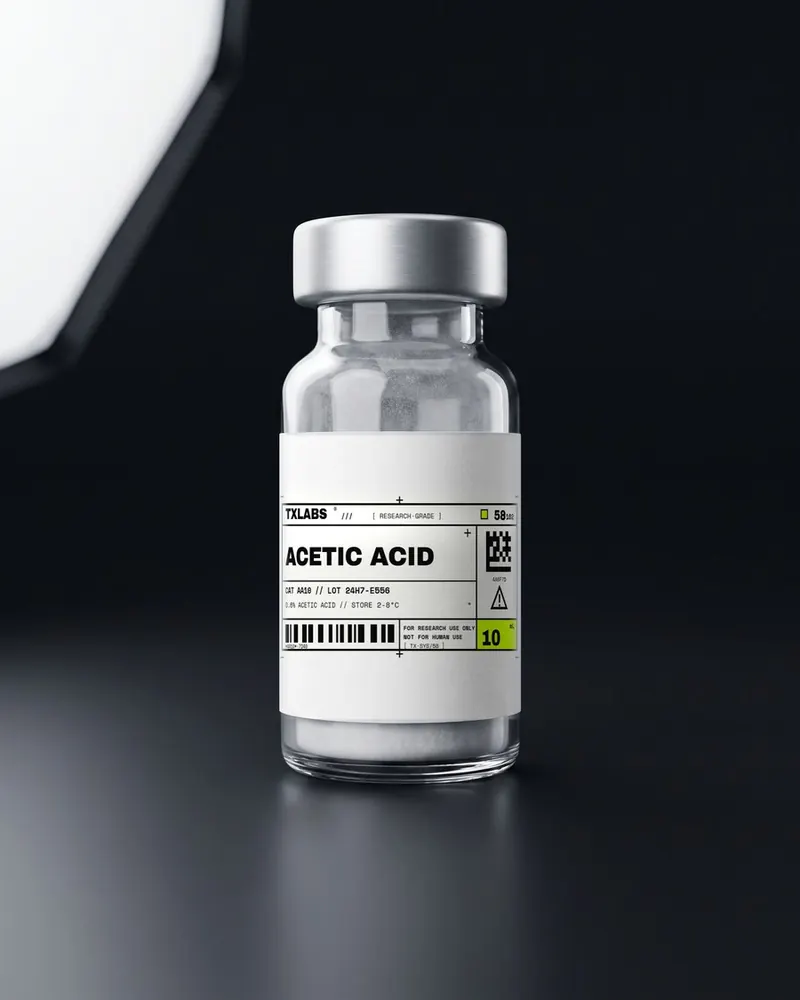
From $19 AUD · ≥98% HPLC purity · third-party COA · ships Australia-wide
What is Acetic Acid Diluent?
Acetic Acid Diluent — a research-grade peptide reference supplied lyophilized for laboratory use only.
Specifications
- From: $19 AUD
- Category: Supplies & Reconstitution
- Form: Lyophilised powder
- Purity: ≥98% HPLC
- Testing: Third-party Certificate of Analysis
- Classification: Research reference material · For Research Use Only
What the research covers
Acetic acid diluent is dilute acetic acid in water, commonly supplied at 0.6%. It is not a general-purpose diluent and using it where it is not needed adds an unnecessary variable to a preparation. It exists for one situation: peptides that will not dissolve properly in water at neutral pH.
The underlying chemistry is worth understanding rather than following as a rule. A peptide dissolves when its molecules interact more favourably with water than with each other. Two sequence characteristics work against that. The first is hydrophobic content: sequences rich in leucine, isoleucine, valine, phenylalanine and tryptophan present surfaces that prefer each other's company to the solvent's. The second, and more often the real culprit, is net charge. A peptide at its isoelectric point carries no net charge, so the electrostatic repulsion that would otherwise keep molecules apart is absent and they associate readily. A sequence whose isoelectric point happens to sit near neutral pH will therefore behave badly in plain water even if it is not especially hydrophobic.
Lowering the pH addresses the second problem directly. In dilute acid, carboxylate groups protonate and basic groups are fully protonated, shifting the molecule away from its isoelectric point and giving neighbouring molecules the same sign of charge. Like charges repel, self-association breaks up, and the peptide solvates.
The conventional order of operations follows from that. Dissolve the powder in the smallest workable volume of acid first, confirm that it has genuinely dissolved rather than merely dispersed, then make up to final volume with the intended aqueous diluent. Adding acid to a gel that has already formed works far less reliably.
TXLABS supplies acetic acid diluent as a laboratory reagent for research use only. It is not supplied for human or veterinary administration.
Reading the certificate
A certificate for an acidified solvent has one item beyond those for plain water, and it is the important one: the acetic acid concentration, confirmed by titration or by another quantitative method rather than stated from the formulation record. Because acetic acid is volatile, the concentration is a property that can drift, and a nominal 0.6% is a formulation intent rather than a measurement. pH is a useful accompanying figure and is directly relevant to the reagent's function. Beyond that the expectations match any solvent: sterility with the method named, bacterial endotoxin by LAL with the limit stated, particulate matter, and container-closure integrity, which matters more for a volatile solution. The certificate should also state the base solvent, since that determines whether benzyl alcohol is present. TXLABS publishes third-party certificates for tested lots in the CoA library; none is published for this diluent, and the lot certificate is available on request to support@txlabs.bio.
Storage and handling
Store at controlled room temperature and do not freeze; there is no benefit and freezing stresses the container and closure. Acetic acid is volatile, which has two practical consequences: an inadequately sealed or repeatedly opened vial loses acid over time and its concentration drifts, and the characteristic odour on opening is normal rather than a sign of a problem. Inspect the vial for clarity, particulates and seal integrity before use, swab the septum and allow it to dry, and use a fresh sterile needle for each entry. One point requires checking rather than assuming: acetic acid diluents in this market are supplied either in plain sterile water or in bacteriostatic water, and only the label tells you which. That determines whether benzyl alcohol is also present, which matters for analytical work and for repeated entry. In Australian conditions a hot vehicle or letterbox is worse for a volatile solution in a sealed vial than for an inert one, since elevated temperature raises internal pressure; collect promptly and store indoors.
Working out concentration
Concentration is calculated against final volume, and that is where two-stage dissolution catches people out. If a 10 mg vial is taken up in 0.2 mL of acetic acid diluent and then made up to 2 mL total with water, the concentration is 10 mg divided by 2 mL, giving 5 mg/mL, not 10 mg divided by the 1.8 mL added second. Forgetting the acid volume is the most common arithmetic error with this reagent and it overstates the result. Record both volumes separately. A 10 mg vial dissolved entirely in 1 mL of the diluent gives 10 mg/mL by the ordinary calculation. The reconstitution calculator works from mass and final volume. Concentration examples only, not a protocol.
How it relates to adjacent compounds
Bacteriostatic water and sterile water are the two default diluents and cover the great majority of preparations; acetic acid diluent is the exception reserved for sequences that resist them. Within this catalogue ovagen is a clear example of the problem it solves, being a tripeptide whose terminal leucine and low isoelectric point together make plain water an unreliable solvent. Longer hydrophobic sequences elsewhere in the range raise the same question, and the answer is always sequence-specific rather than general. These are functional relationships between reagents and the materials they are used to dissolve, and they say nothing whatever about what any compound in this catalogue should be used for.