Bacteriostatic Water Australia — 0.9% Benzyl Alcohol
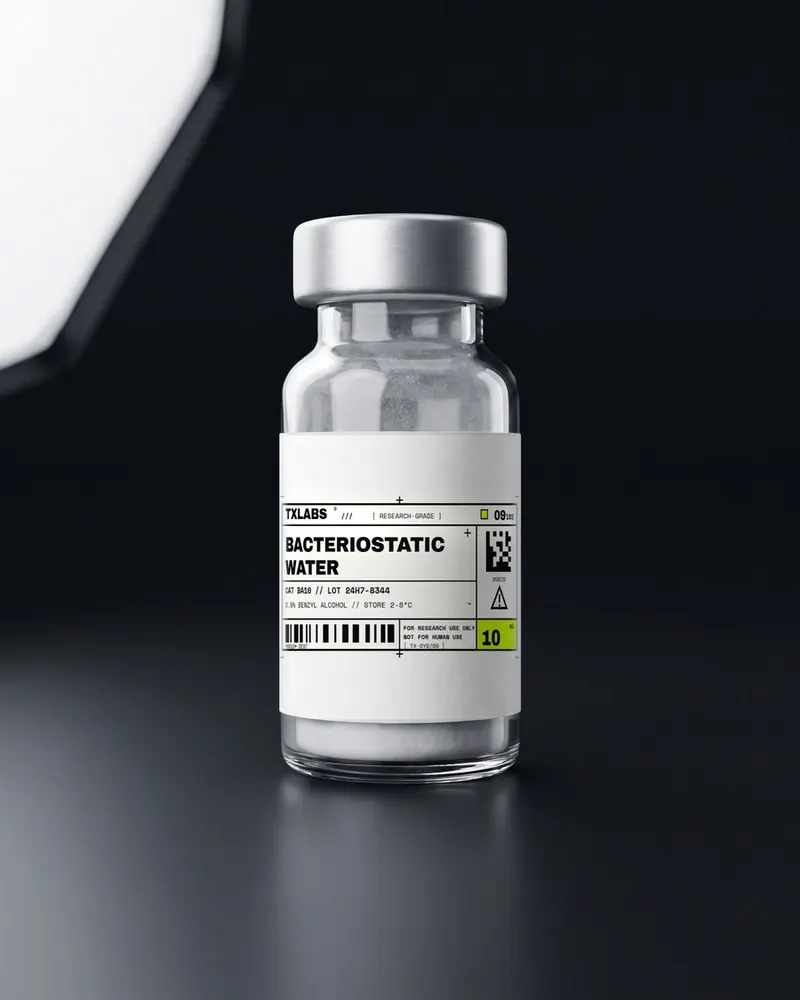
From $19 AUD · ≥98% HPLC purity · third-party COA · ships Australia-wide
What is Bacteriostatic Water?
Bacteriostatic Water — a research-grade peptide reference supplied lyophilized for laboratory use only.
Specifications
- From: $19 AUD
- Category: Supplies & Reconstitution
- Form: Lyophilised powder
- Purity: ≥98% HPLC
- Testing: Third-party Certificate of Analysis
- Classification: Research reference material · For Research Use Only
What the research covers
Bacteriostatic water is sterile water containing 0.9% benzyl alcohol as a bacteriostatic preservative. It exists to solve one specific problem: a vial that will be entered more than once. Every entry through a rubber septum carries some risk of introducing organisms, and in plain sterile water anything introduced can multiply freely. The benzyl alcohol does not prevent that introduction; it inhibits the multiplication that would otherwise follow.
The distinction between bacteriostatic and bactericidal is the most commonly misunderstood thing about this product and it is worth stating plainly. Bacteriostatic means growth-inhibiting. It does not mean sterilising. Benzyl alcohol at this concentration slows or halts the proliferation of contaminating organisms; it does not eliminate an existing contamination, it does not sterilise a solution that has been compromised, and it does not compensate for poor aseptic technique. A vial that has been contaminated is a contaminated vial regardless of what preservative it contains.
What the preservative does buy is a usable in-use period. In medical practice a multiple-dose vial is conventionally discarded twenty-eight days after first entry, and that convention is what the preservative exists to support.
Benzyl alcohol is not an inert additive and should not be treated as one. It is a small organic molecule that will appear in a chromatogram and absorb in the ultraviolet, so it is a contaminant in any analytical context. It is a recognised incompatibility for certain populations, neonates in particular. And it can interact with some peptides and with some container materials.
TXLABS supplies bacteriostatic water as a laboratory reagent for research use only. It is not supplied for human or veterinary administration.
Reading the certificate
A certificate for a solvent tests entirely different things from a certificate for a peptide, and a purity percentage by HPLC is close to meaningless for water. What belongs on it is sterility, with the test method stated, since sterility claimed without a method is an assertion rather than a result; bacterial endotoxin by the LAL method with the limit applied made explicit; pH; particulate matter; and container-closure integrity, which is what actually keeps a preserved multiple-entry product usable. For this product specifically, benzyl alcohol content and identity should be confirmed rather than assumed from the label, since the preservative concentration is the entire functional basis of the product. A document reporting a purity percentage and nothing else suggests a template rather than a test. TXLABS publishes third-party certificates for tested lots in the CoA library; none is currently published for bacteriostatic water, and the certificate for the lot supplied is available on request to support@txlabs.bio.
Storage and handling
Store bacteriostatic water at controlled room temperature. Do not refrigerate as a matter of course and do not freeze it: freezing risks compromising the container and the closure, and there is nothing in a preserved aqueous solution that benefits from cold storage. Inspect each vial before use against a light background for clarity, for particulates, and for any discolouration, and check the closure and the aluminium seal for damage. Swab the septum with an appropriate agent and allow it to dry before each entry, every time and not only the first. Use a fresh sterile needle for each withdrawal; reusing a needle both damages the septum, generating rubber cores, and reintroduces whatever the needle previously contacted. Record the date of first entry on the vial, since the in-use period runs from that date rather than from receipt. In Australian conditions a 10 mL vial left in a hot vehicle or an unshaded letterbox through a summer afternoon can reach temperatures that stress the closure seal; collect promptly and store it indoors at room temperature.
Working out concentration
The diluent is one half of every concentration calculation. A 10 mg vial of any lyophilised material reconstituted with 1 mL of bacteriostatic water gives 10 mg/mL; with 2 mL, 5 mg/mL; with 5 mL, 2 mg/mL. One subtlety is worth knowing: a lyophilised cake occupies a small volume itself, so adding 1 mL of diluent produces a final volume slightly greater than 1 mL. For dilute preparations the difference is negligible; for concentrated ones it is not, and the concentration should be calculated against final volume rather than added volume where accuracy matters. A 10 mL vial supplies several reconstitutions. The reconstitution calculator handles mass against volume. Concentration examples only, not a protocol.
How it relates to adjacent compounds
Sterile water is the same product without the benzyl alcohol, and the choice between them comes down to a single question: whether the vial will be entered once or repeatedly, and whether a preservative would interfere with what follows. Acetic acid diluent is the third option, for the minority of peptides that will not dissolve properly in water at neutral pH. Among the compounds in this catalogue, ovagen is a good example of a sequence where plain water may not be sufficient. These are functional relationships between reagents and carry no implication about what any of them should be used for.