Sterile Water Australia — Preservative-Free Diluent
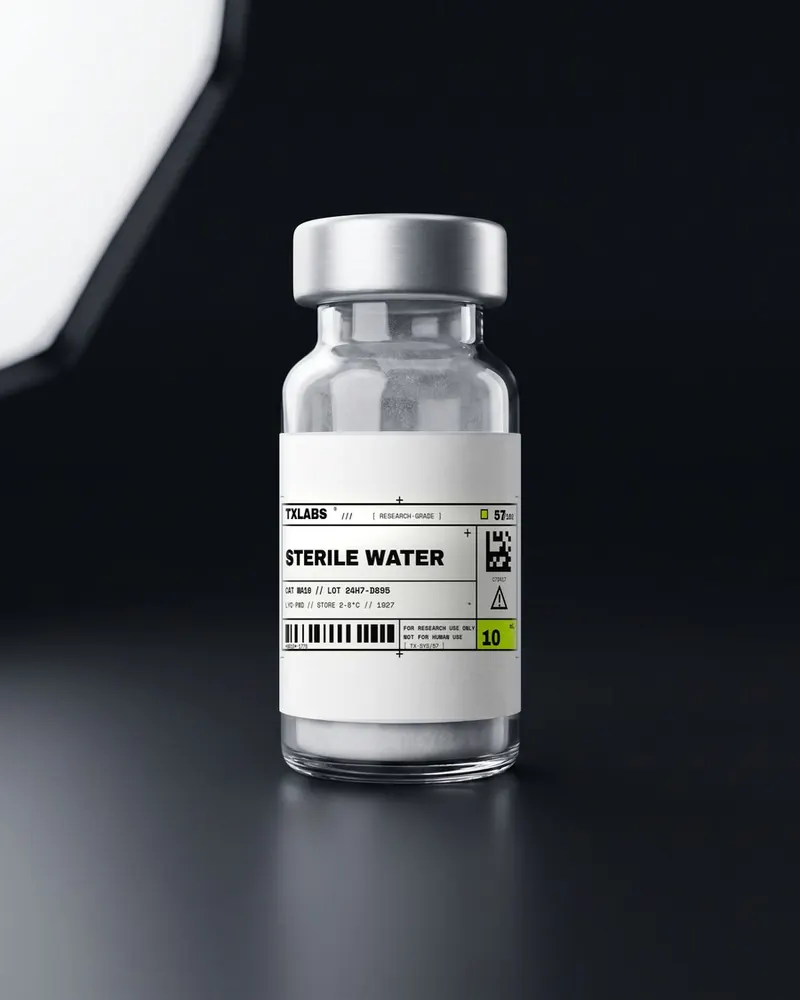
From $19 AUD · ≥98% HPLC purity · third-party COA · ships Australia-wide
What is Sterile Water?
Sterile Water — a research-grade peptide reference supplied lyophilized for laboratory use only.
Specifications
- From: $19 AUD
- Category: Supplies & Reconstitution
- Form: Lyophilised powder
- Purity: ≥98% HPLC
- Testing: Third-party Certificate of Analysis
- Classification: Research reference material · For Research Use Only
What the research covers
Sterile water for injection is exactly what the name says and deliberately nothing more: water, sterile and non-pyrogenic, containing no antimicrobial agent, no buffer, no tonicity adjuster and no added substance of any kind. Its defining property is what has been left out.
That compositional simplicity is the whole point, and it carries one direct consequence. With no preservative present, nothing inhibits the multiplication of organisms introduced during a withdrawal, so the vial is a single-use item. Once the closure has been entered, the contents are used and any remainder is discarded rather than kept for later. This is not a conservative recommendation; it follows from the composition. Storing an opened, unpreserved vial and returning to it converts a controlled product into an uncontrolled one.
There are three situations where preservative-free water is the correct choice rather than merely an available one. The first is analytical work, where benzyl alcohol is a contaminant: it is a small organic molecule that absorbs in the ultraviolet and elutes in a chromatogram, so a preserved diluent puts a peak in every run and a background in every spectrum. The second is preservative-sensitive material, since benzyl alcohol can interact with some peptides and with some container and device materials. The third is any context where the diluent must be compositionally simple so that anything detected can be attributed to the sample rather than to what it was dissolved in.
It is also the appropriate reference point for anyone asking what a diluent contributes to a measurement, because the answer here is nothing.
TXLABS supplies sterile water as a laboratory reagent for research use only. It is not supplied for human or veterinary administration.
Reading the certificate
For preservative-free water the certificate is shorter than for the bacteriostatic version and every remaining item carries more weight, because there is no preservative providing a second line of defence. Sterility is the central claim and the test method used to establish it should be named, since sterility asserted without a method is not a result. Bacterial endotoxin by the LAL method should be reported with the limit applied stated explicitly, because water is a classic endotoxin source and pyrogen-free is a measured property rather than an assumption. pH, particulate matter and container-closure integrity complete the picture. An HPLC purity percentage is not a meaningful measurement for water and its presence suggests a template rather than a test. TXLABS publishes third-party certificates for tested lots in the CoA library; none is published for sterile water, and the lot certificate is available on request to support@txlabs.bio.
Storage and handling
Aseptic technique carries more weight here than with a preserved diluent, because there is no chemical margin for error. Swab the septum with an appropriate agent and allow it to dry before entry, use a fresh sterile needle, and plan the work so that everything needed from the vial is withdrawn in one session rather than returning to it. Store at controlled room temperature, protected from light where the packaging directs it, and do not freeze: ice expansion stresses both the container and the closure, and the container-closure barrier is the only thing maintaining sterility. Inspect each vial before use against a light background for clarity, particulates and any damage to the seal or closure; with an unpreserved product a visible haze is a definitive reason to discard rather than a judgement call. In Australian conditions the practical caution is against leaving a 10 mL vial in a hot vehicle or letterbox where seal integrity may be stressed. Collect and store indoors.
Working out concentration
The arithmetic is identical to any other diluent: mass over volume. A 10 mg vial of lyophilised material reconstituted with 1 mL of sterile water gives 10 mg/mL; with 2 mL, 5 mg/mL; with 4 mL, 2.5 mg/mL. One consideration specific to an unpreserved diluent: because the vial is single-entry, a preparation should be planned around the volume actually needed rather than around a convenient round number, since a 10 mL vial partly used is a 10 mL vial finished. Note also that the lyophilised cake itself occupies volume, so final volume slightly exceeds added volume, which matters for concentrated preparations. The reconstitution calculator handles mass against volume. Concentration examples only, not a protocol.
How it relates to adjacent compounds
Bacteriostatic water is the same product with 0.9% benzyl alcohol added, and the choice between the two is a single decision about whether the vial will be entered once or repeatedly, weighed against whether the preservative would interfere with anything downstream. Acetic acid diluent covers the separate case of peptides that will not dissolve properly in water at neutral pH regardless of which water is used. Analytical work on any of the compounds in this catalogue, including copper complexes such as GHK basic where trace metal content matters, is where the compositional simplicity of sterile water counts most. These are functional relationships between reagents only.