Ovagen Australia — Glu-Asp-Leu Tripeptide, 20 mg
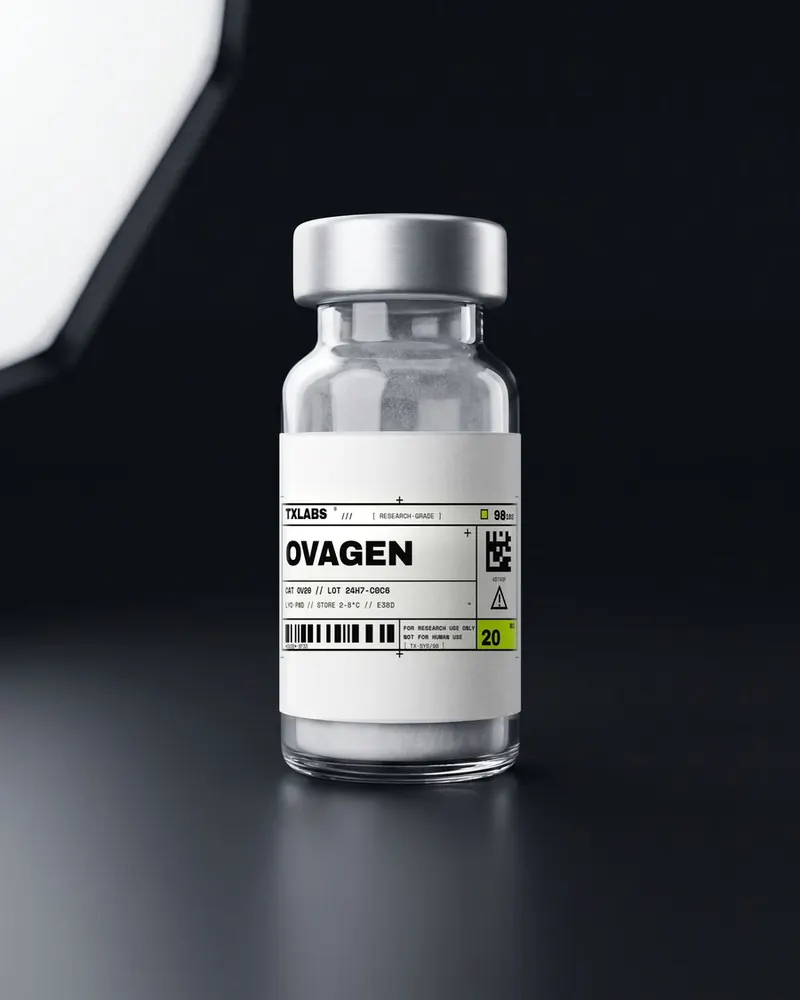
From $99 AUD · ≥98% HPLC purity · third-party COA · ships Australia-wide
What is Ovagen?
Ovagen (Glu-Asp-Leu, EDL) is a synthetic tripeptide bioregulator associated with liver and intestinal tissue. A Khavinson short peptide, it is investigated in laboratory studies of hepatic and gastrointestinal cell function and age-related gene expression. Ovagen is used as a reference material in liver and gut tissue research.
Specifications
- From: $99 AUD
- Category: Longevity & Bioregulators
- Form: Lyophilised powder
- Purity: ≥98% HPLC
- Testing: Third-party Certificate of Analysis
- Classification: Research reference material · For Research Use Only
What the research covers
Ovagen is a synthetic tripeptide, Glu-Asp-Leu, from the ultrashort peptide bioregulator programme of Professor Vladimir Khavinson and colleagues at the St Petersburg Institute of Bioregulation and Gerontology. It carries a tissue name from that programme's convention, and it is worth noting at the outset that a name identifying one organ does not constrain what the originating groups actually studied: work associated with ovagen in that literature discusses hepatic tissue as well, which is a good illustration of how loosely the naming maps onto the research.
Chemically ovagen is the awkward member of the family, and that is the practically useful thing about it. Its two acidic residues give it a low isoelectric point, while the C-terminal leucine contributes a genuinely hydrophobic side chain. The combination produces a peptide that is neither reliably soluble in plain water like its wholly polar relatives nor properly hydrophobic like a long lipophilic sequence. Peptides in that middle ground characteristically wet without dissolving: the powder takes up liquid, forms a gel or a cloudy suspension, and sits there. The molecules associate with each other in preference to the solvent because near their isoelectric point the net charge that would keep them apart is minimal.
The remedy is well established and worth stating precisely, because it is the same principle behind the acetic acid diluent stocked alongside these compounds: lowering the pH protonates basic groups and carboxylates, raises net positive charge, and increases electrostatic repulsion between molecules, which breaks up self-association.
As with every compound in this family, the proposed peptide-DNA gene-expression mechanism is a hypothesis internal to one research tradition, and the supporting literature is concentrated in a few connected laboratories, largely Russian-language, and thinly replicated elsewhere.
TXLABS supplies ovagen as a laboratory reference material only. It is not an approved therapeutic good in Australia and is not supplied for human or veterinary administration.
Reading the certificate
Ovagen is the one member of this family with enough hydrophobic character to retain properly on a reversed-phase column, which means a purity figure from a standard peptide method carries more weight here than it does for its wholly polar relatives. Take advantage of that: ask for a chromatogram rather than a bare percentage, and check that the peak is genuinely retained rather than eluting in the first minute. The related substances worth asking about are the deletion sequences Glu-Asp and Asp-Leu, of which the second is more hydrophobic and can retain close to the parent. There is no aromatic residue, so detection is still at around 214 nm and peak purity by ultraviolet remains limited evidence. TXLABS publishes third-party certificates for tested lots in the CoA library; no certificate is currently published for ovagen, and the certificate for the lot supplied is available on request to support@txlabs.bio.
Storage and handling
Storage is conventional for a short peptide: -20 °C for the lyophilised cake, desiccated and dark, with 2-8 °C acceptable for a working vial, and reconstituted solution held at 2-8 °C in single-use aliquots rather than repeatedly frozen. Dissolution is where ovagen differs from its relatives and where most of the practical trouble occurs. Do not attempt to force it by prolonged vortexing, which introduces shear and foaming without improving solubility and can drive the material to the air-liquid interface. The conventional order of operations is to take the powder up in the smallest workable volume of a dilute acid first, confirm that it has genuinely dissolved rather than dispersed, and only then make up to final volume with the intended aqueous diluent. Adding the acid last to a suspension does not work. Australian humidity affects the acidic residues in the usual way, and summer transit above 40 °C applies here as it does to everything else in the catalogue: collect promptly, refrigerate on arrival.
Working out concentration
Ovagen is stocked in a 20 mg vial. With 2 mL of diluent that gives 10 mg/mL; with 4 mL, 5 mg/mL; with 5 mL, 4 mg/mL; with 10 mL, 2 mg/mL. One arithmetic point specific to a two-stage dissolution: if the powder is first taken up in a small volume of acid and then made up with a second diluent, the concentration is calculated against the total final volume, not against the volume of acid used. Recording both volumes separately avoids a common error where the acid volume is forgotten and the final figure is overstated. The reconstitution calculator works from vial mass and final volume. Concentration examples only, not a protocol.
How it relates to adjacent compounds
The instructive comparison is chonluten, Glu-Asp-Gly, which shares ovagen's first two residues and replaces the leucine with the smallest possible side chain. That single change makes chonluten freely water-soluble and poorly retained where ovagen is neither, which is a compact demonstration of how much one terminal residue governs the handling of a tripeptide. Acetic acid diluent is the product that exists for precisely this class of problem and its page explains the underlying solubility chemistry at length. Vilon sits at the opposite extreme of polarity within the same family. Structural and handling relationships only, with no implication about relative activity.