GHK Basic Australia — Copper-Free Gly-His-Lys Peptide
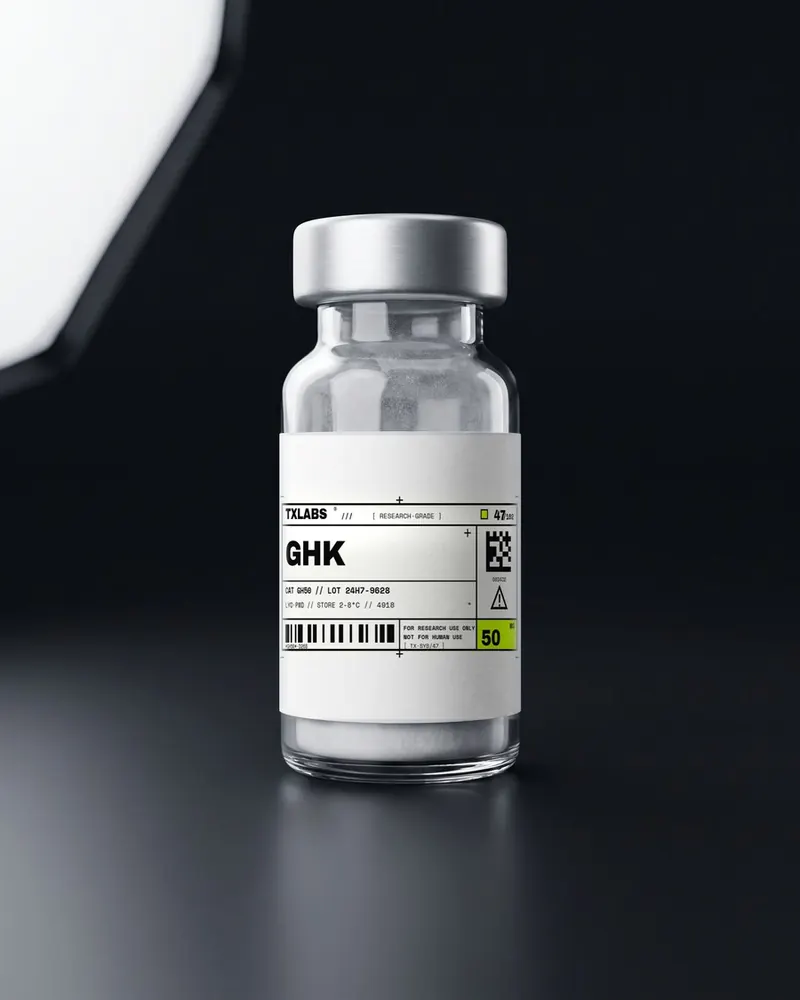
From $159 AUD · ≥98% HPLC purity · third-party COA · ships Australia-wide
What is GHK basic?
GHK (glycyl-L-histidyl-L-lysine) is a naturally occurring human tripeptide that binds copper ions and modulates gene expression. It is investigated in preclinical research on tissue remodelling, extracellular matrix proteins, and skin fibroblast activity.
Specifications
- From: $159 AUD
- Category: Recovery & Repair
- Form: Lyophilised powder
- Purity: ≥98% HPLC
- Testing: Third-party Certificate of Analysis
- Classification: Research reference material · For Research Use Only
What the research covers
GHK basic is the free tripeptide glycyl-L-histidyl-L-lysine, formula C14H24N6O4 and molecular weight 340.38 according to PubChem, supplied without the copper that accompanies it in the more familiar GHK-Cu form. The sequence occurs naturally in human plasma and was identified there decades ago; it is one of the few compounds in this catalogue whose presence in human biology is a matter of straightforward analytical record rather than inference.
The distinction between GHK and GHK-Cu is not a packaging detail. GHK binds copper(II) with high affinity through a three-point arrangement involving the free N-terminal amine, the histidine imidazole nitrogen and a deprotonated backbone amide nitrogen. That affinity is high enough that the apo peptide behaves as a copper scavenger: placed in ordinary laboratory water, in a buffer prepared from reagent-grade salts, or in contact with soda-glass surfaces, it will take up adventitious copper and become partly metallated without anyone adding any. The practical consequence is that the composition of a GHK solution is not fixed by what was weighed out; it depends on what the peptide has since encountered.
Most of the published literature that people cite when discussing GHK was generated with the copper complex in dermal fibroblast systems, extracellular matrix work and gene expression profiling. Reading that literature across to the apo peptide requires care, because the copper is not incidental to most of the proposed mechanisms. The apo form is a useful reference material and a useful starting point for preparing defined complexes; it is not simply GHK-Cu without a colour.
TXLABS supplies GHK as an analytical reference material for laboratory research only. It is not an approved therapeutic good in Australia and is not supplied for human or veterinary administration.
Reading the certificate
The question a certificate for GHK basic has to answer is one that does not arise for most peptides: whether this is actually the apo form. Peptide purity and identity by mass spectrometry establish the sequence, but they do not establish the absence of bound metal, and a partly metallated batch can still report high peptide purity. The measurement that answers it is copper content by an elemental technique, reported as being below a stated limit rather than simply omitted. Visual inspection supports it, since any blue or violet tint indicates copper. Confirm the salt form and net peptide content too, since counterion is a meaningful fraction of the mass for a 340 dalton tripeptide. TXLABS publishes third-party certificates for tested lots in the CoA library; no certificate is currently published for GHK basic, and the lot certificate is available on request to support@txlabs.bio.
Storage and handling
This is the compound in the catalogue where the container matters as much as the temperature. Because the apo peptide scavenges copper from its surroundings, metal-free technique is the substantive control: use high-purity water rather than general laboratory supply, prefer plastic over soda glass for storing solutions, avoid metal spatulas and any equipment that may shed trace copper, and treat reagent-grade buffer salts as a plausible metal source, since many carry enough trace metal to partly metallate a dilute peptide solution. Storage otherwise follows ordinary short-peptide practice: -20 °C for the lyophilised material, desiccated and protected from light, equilibrated to room temperature sealed before opening, and 2-8 °C in the dark once reconstituted, in single-use aliquots. Watch the colour: white to off-white indicates the apo peptide, while any blue or violet tint indicates copper has been taken up. Australian summer transit above 40 °C is a lesser concern for a robust tripeptide than the metal question, but prompt refrigeration remains good practice.
Working out concentration
A 10 mg vial reconstituted with 1 mL of diluent gives 10 mg/mL; with 2 mL, 5 mg/mL; with 5 mL, 2 mg/mL. The same arithmetic applies to whatever vial mass is supplied, so work from the label rather than a remembered figure. Two points are specific to this compound. Molar conversion should use the free peptide mass of 340.38 rather than the mass of the copper complex, and the two are commonly interchanged in secondary sources. And the choice of diluent is not neutral here: water of unknown metal content will partly metallate the peptide as it dissolves, so high-purity water is worth using even for routine work. The calculator handles the division. Concentration examples only, not a protocol.
How it relates to adjacent compounds
GHK-Cu is the same tripeptide as a defined copper(II) complex and is the form most of the published literature actually used, which makes reading the two pages together the fastest way to see what the metal contributes. AHK-Cu is the alanine analogue as a copper complex, so the three products between them vary the peptide sequence and the metallation state independently. The BPC-157, GHK-Cu and TB-500 blend contains the copper form alongside two unrelated peptides and raises a different set of questions again, since there the copper sits alongside two peptides it can act on. These are structural and formulation relationships, set out because they determine how each material has to be stored and characterised, and they imply nothing about comparative activity.