BPC-157 + TB-500 10mg Australia — Co-Lyophilised Blend
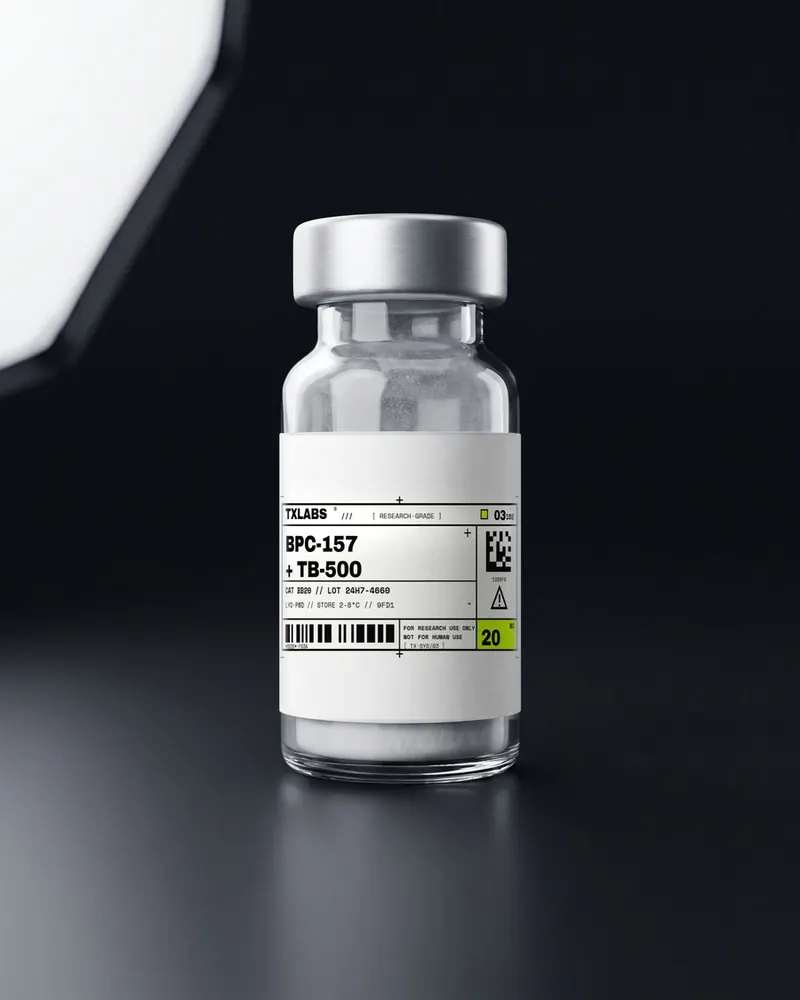
From $149 AUD · ≥98% HPLC purity · third-party COA · ships Australia-wide
What is BPC 10mg + TB 10mg?
BPC 10mg + TB 10mg is a research blend combining BPC-157, a synthetic pentadecapeptide, with TB-500, a fragment of thymosin beta-4. BPC-157 is studied for angiogenesis and tissue-repair signalling, while TB-500 is investigated in research on actin regulation and cell migration.
Specifications
- From: $149 AUD
- Category: Recovery & Repair
- Form: Lyophilised powder
- Purity: ≥98% HPLC
- Testing: Third-party Certificate of Analysis
- Classification: Research reference material · For Research Use Only
What the research covers
This vial holds two structurally unrelated research peptides co-lyophilised into a single cake, nominally 10 mg of BPC-157 and 10 mg of TB-500, 20 mg of peptide in total. It is the double-strength form of the 5 mg plus 5 mg blend also stocked here. The two molecules share no sequence homology and no proposed mechanism; they are combined because preclinical tissue-repair literature has often used them in the same experimental models, not because they are chemically related.
BPC-157 is a pentadecapeptide, sequence GEPPPGKPADDAGLV, with the formula C62H98N16O22 and a molecular weight of 1419.5 Da, described as a partial fragment of a protein identified in human gastric juice. Rodent studies have investigated it in gastrointestinal lesion models and in tendon, ligament, muscle and bone injury models, with proposed mechanisms in the published literature including nitric oxide system modulation, effects on VEGFR2 signalling and angiogenic outgrowth, and interaction with focal adhesion kinase and paxillin signalling. The evidence is overwhelmingly preclinical and concentrated in a small number of research groups.
Thymosin beta-4, catalogued in UniProt as P62328, is a 43-residue N-terminally acetylated peptide of approximately 4963 Da and the major intracellular sequestering protein for monomeric G-actin. Through that role it participates in regulating the actin cytoskeleton and consequently in cell migration. Research has examined it in angiogenesis, corneal and dermal wound-repair models and cardiac and neural injury models.
One caution applies with particular force in a blend. The name TB-500 is used in the supply chain both for full-length thymosin beta-4 near 4963 Da and for the short Ac-LKKTETQ actin-binding fragment near 889 Da. Only the analyte identity and observed mass on a per-component assay establish which is present.
TXLABS supplies this blend as an analytical reference material for laboratory research only. It is not an approved therapeutic good in Australia and is not supplied for human or veterinary administration.
Reading the certificate
Per-component assay is the whole question for a blend. A single combined purity percentage is not a meaningful measurement when a vial contains two different molecules, and a certificate offering one should prompt questions about what was actually measured. The two components separate easily by reversed-phase HPLC and mass spectrometry, so there is no technical obstacle to quantifying each independently. Confirm specifically which TB-500 species the assay identifies, since the full-length protein near 4963 Da and the fragment near 889 Da are both sold under the name, and in a blend the ambiguity is compounded rather than reduced. TXLABS publishes third-party certificates for tested lots in the CoA library; no certificate is currently published for this blend. The lot certificate is available on request to support@txlabs.bio.
Storage and handling
A co-lyophilised blend is stored on the terms of its least stable component. Which component that is depends on which TB-500 species the vial actually contains: full-length thymosin beta-4 at 43 residues is considerably more susceptible to aggregation and freeze-thaw damage than either the pentadecapeptide BPC-157 or the seven-residue fragment. Store the cake at -20 °C, desiccated and protected from light, and equilibrate the vial to room temperature before opening so that condensation does not wet a hygroscopic powder. Once reconstituted the two peptides are in one solution and cannot be separated, so every handling decision applies to both: hold at 2-8 °C in the dark, add diluent gently down the vial wall, swirl rather than shake, and aliquot before freezing. The specific risk in a blend is that differential degradation shifts the ratio of the two components with no visible sign at all. Australian summer transit above 40 °C is precisely the condition that produces that silent shift, so prompt collection and refrigeration matter.
Working out concentration
For a blend, concentration has to be tracked per component or the record is meaningless. This vial holds nominally 10 mg of BPC-157 and 10 mg of TB-500, 20 mg of peptide in total. Reconstituted with 2 mL of bacteriostatic water it gives 5 mg/mL of each peptide and 10 mg/mL of total peptide; with 4 mL, 2.5 mg/mL of each and 5 mg/mL total; with 1 mL, 10 mg/mL of each and 20 mg/mL total. Recording only the total is the common error, because it doubles the apparent concentration of either component. Note also that the 5 mg plus 5 mg blend at the same diluent volume gives exactly half these figures. The reconstitution calculator handles the arithmetic. Concentration examples only, not a protocol.
How it relates to adjacent compounds
Both components are stocked individually: BPC-157 in 10 mg and 20 mg vials, and TB-500 as full-length thymosin beta-4 in 10 mg and 20 mg vials, with the short actin-binding fragment listed separately as TB-500 fragment. The same pairing is also stocked at half strength as BPC-157 5 mg with TB-500 5 mg. The larger multi-component vials listed elsewhere in the catalogue raise the same per-component assay question and should be read on the same terms. Choosing between the blend and two single vials is a matter of experimental design, record-keeping and per-component traceability rather than of chemistry, since the molecules are identical whichever vial they arrive in.