BPC-157 Australia — Batch-Verified Research Peptide
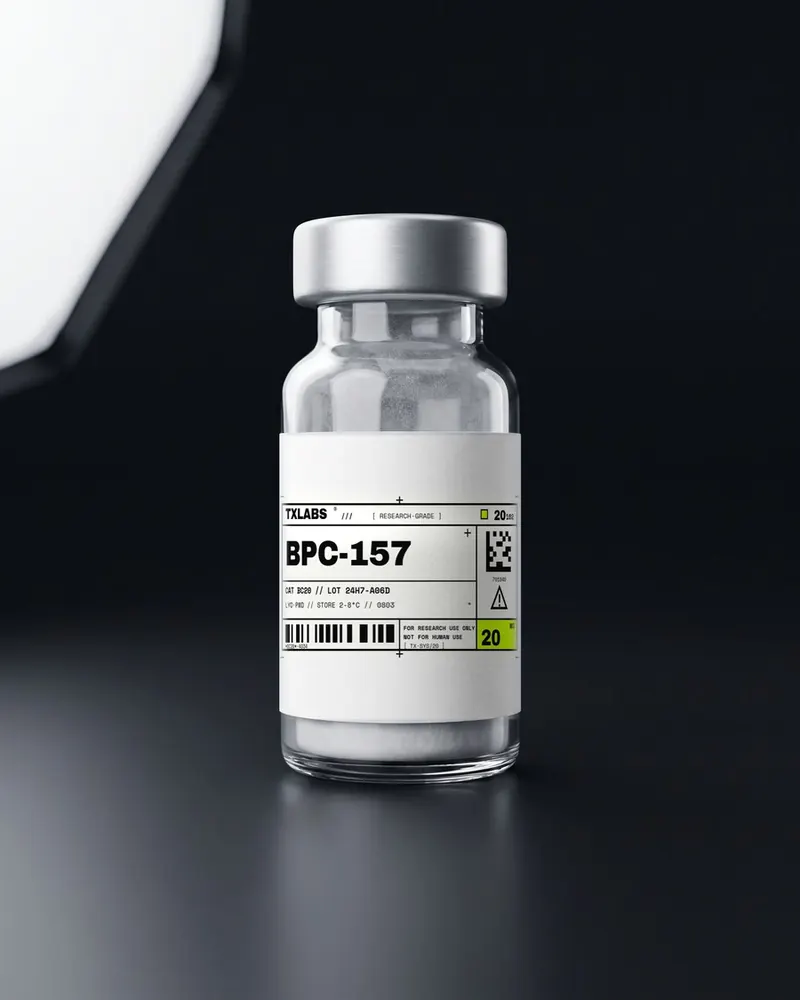
From $89 AUD · ≥98% HPLC purity · third-party COA · ships Australia-wide
What is BPC 157?
BPC 157 (Body Protection Compound 157) is a synthetic pentadecapeptide derived from a sequence found in human gastric juice. It has been studied in preclinical research on angiogenesis, growth-factor signalling, tendon and gut tissue-repair mechanisms, and the gut-brain axis. BPC 157 is a widely used reference peptide in tissue-healing models.
Specifications
- From: $89 AUD
- Category: Recovery & Repair
- Form: Lyophilised powder
- Purity: ≥98% HPLC
- Testing: Third-party Certificate of Analysis
- Classification: Research reference material · For Research Use Only
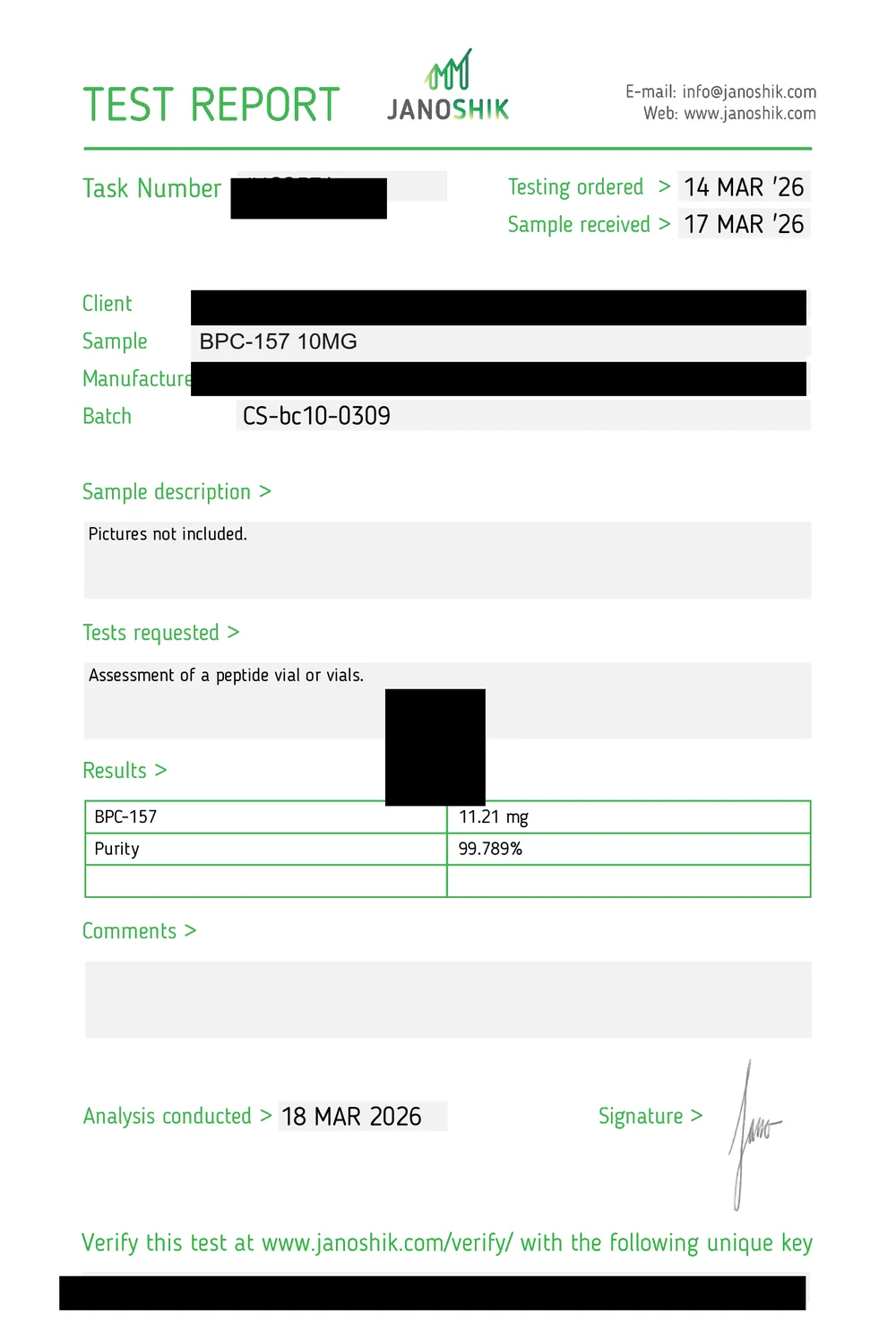 View full report ↗
Report ID and verification key are redacted on our copy of this certificate. Request the unredacted report, or see the full CoA library.
What the research covers
BPC-157 is a synthetic pentadecapeptide with the sequence Gly-Glu-Pro-Pro-Pro-Gly-Lys-Pro-Ala-Asp-Asp-Ala-Gly-Leu-Val, molecular formula C62H98N16O22 and molecular weight 1419.5 Da. Its name derives from body protection compound, and the sequence corresponds to a partial fragment of a protein described in human gastric juice. It is built entirely from L-amino acids and contains neither cysteine nor methionine nor tryptophan, a composition directly relevant to how it behaves analytically and on storage.
The preclinical literature on BPC-157 is substantial and originates largely from a single research group in Croatia, with a growing body of independent work since. Rodent studies have investigated effects on gastrointestinal mucosal integrity in chemically induced lesion models, and separately on tendon, ligament, muscle and bone injury models. Cell-based work has examined migration and survival of tendon fibroblasts and endothelial cells, and proposed mechanisms discussed in the literature include modulation of the nitric oxide system, effects on vascular endothelial growth factor receptor 2 signalling and angiogenic outgrowth, and interaction with the focal adhesion kinase-paxillin pathway. Other reports have examined central nervous system endpoints in rodent models, including dopaminergic and serotonergic systems.
The important qualification is that this evidence base is overwhelmingly preclinical. Controlled human clinical trial data is very limited, mechanistic accounts remain contested, and reviewers have repeatedly noted concentration of the literature within a small number of groups. Researchers evaluating BPC-157 should read the primary sources rather than secondary summaries.
TXLABS supplies BPC-157 as an analytical reference material for laboratory research only. It is not an approved therapeutic good in Australia and is not supplied for human or veterinary administration.
Reading the certificate
For BPC-157 the specific things to read on a certificate are identity and the impurity picture around the aspartyl motifs. Aspartimide-derived isomers have the same nominal mass as the parent peptide, so mass spectrometry alone cannot exclude them and the reversed-phase HPLC trace is where they would appear as shoulders or minor peaks near the main band. Confirm the observed mass matches 1419.5 Da, check the assay in milligrams against label, and verify the certificate names a batch rather than a product line. TXLABS publishes the Janoshik Analytical report for BPC-157 in the CoA library: batch CS-bc10-0309, tested 18 March 2026, 99.789% purity with a 10 mg sample assaying 11.21 mg. That report has the task number and verification key redacted by the supplier, which the library states rather than glossing over.
Storage and handling
BPC-157 is among the more forgiving peptides in this catalogue on paper: fifteen residues, no cysteine to form disulfides, no methionine or tryptophan to oxidise. Its notable liability is sequence-based, since the Ala-Asp-Asp-Ala-Gly region contains aspartyl-glycine and aspartyl-alanine motifs that can undergo aspartimide formation and isomerisation in aqueous solution, particularly at elevated temperature or non-neutral pH. That makes solution storage conditions worth more attention than the peptide's short length would suggest. Hold the lyophilised cake at -20 °C, desiccated and protected from light, and bring it to room temperature before opening so moisture does not condense onto cold glass. Reconstituted in bacteriostatic water, keep at 2-8 °C and protected from light; the benzyl alcohol preservative is what supports repeated withdrawal from one vial. Aliquot before freezing rather than cycling. For Australian transit, the dry cake tolerates short warm excursions, but summer letterbox and delivery-vehicle temperatures above 40 °C accelerate exactly the aspartimide chemistry described above once any moisture is present, so collect promptly and refrigerate on arrival.
Working out concentration
Concentration is vial mass divided by diluent volume. A 10 mg BPC-157 vial reconstituted with 2 mL of bacteriostatic water gives 5 mg/mL; with 1 mL it gives 10 mg/mL; with 5 mL, 2 mg/mL. The 20 mg vial with 2 mL gives 10 mg/mL, and with 4 mL, 5 mg/mL. At 1419.5 Da the molar arithmetic is straightforward: 5 mg/mL is approximately 3.5 mM, which is the figure needed when a published in vitro method specifies molarity rather than mass concentration. The reconstitution calculator resolves any vial and volume pairing. These are worked concentration examples only and do not describe a protocol.
How it relates to adjacent compounds
BPC-157 is the most frequently cited member of the repair-and-regeneration group in this catalogue, and it is routinely studied alongside TB-500 / thymosin beta-4, an unrelated 43-residue actin-sequestering peptide. There is no sequence homology between them and their proposed mechanisms are distinct: one is discussed in terms of angiogenic and nitric oxide signalling, the other in terms of actin dynamics and cell migration. Their frequent pairing in the literature reflects overlapping experimental models rather than shared chemistry, and that pairing is why the combination vial BPC-157 5 mg with TB-500 5 mg exists. KPV, a tripeptide fragment of alpha-MSH, appears in some of the same gastrointestinal inflammation models but through melanocortin-related signalling. Structural and mechanistic relationships only.