GHK-Cu Australia — Batch-Verified Copper Peptide
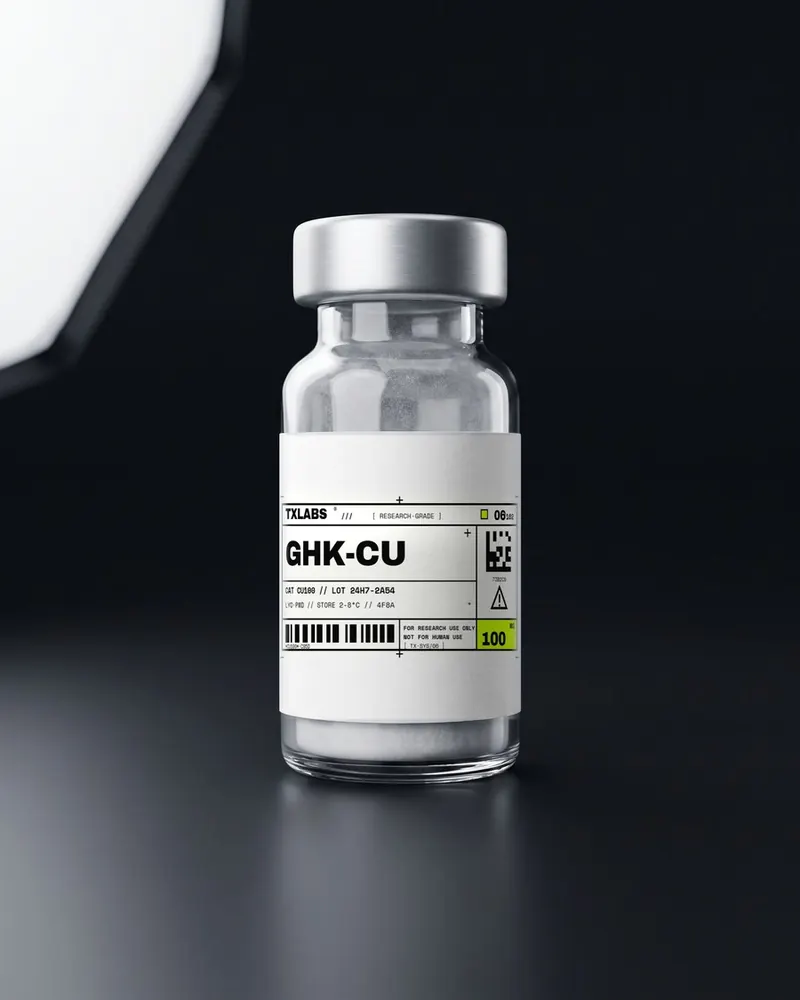
From $59 AUD · ≥98% HPLC purity · third-party COA · ships Australia-wide
What is GHK-CU?
GHK-Cu (copper tripeptide-1, glycyl-L-histidyl-L-lysine copper complex) is a copper-binding peptide that modulates tissue remodelling. It is studied in research on collagen synthesis, wound-repair signalling and antioxidant pathways.
Specifications
- From: $59 AUD
- Category: Recovery & Repair
- Form: Lyophilised powder
- Purity: ≥98% HPLC
- Testing: Third-party Certificate of Analysis
- Classification: Research reference material · For Research Use Only
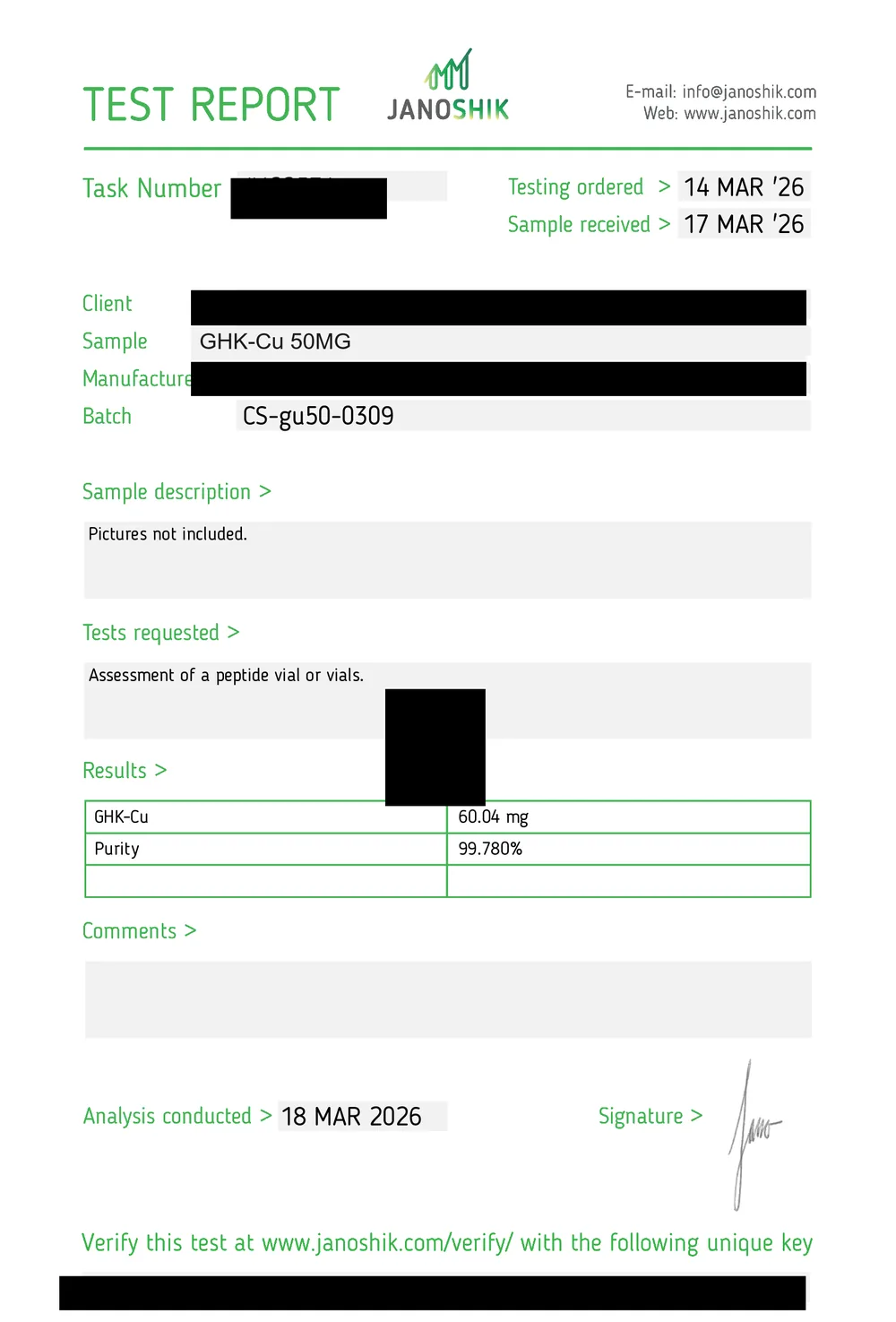 View full report ↗
Report ID and verification key are redacted on our copy of this certificate. Request the unredacted report, or see the full CoA library.
What the research covers
GHK-Cu is a coordination complex between the tripeptide glycyl-L-histidyl-L-lysine and copper(II). The free tripeptide GHK has molecular formula C14H24N6O4 and molecular weight 340.38 Da; the copper complex is heavier, and PubChem lists related complex species in the region of 400 Da for the mononuclear anion. The peptide binds Cu(II) with high affinity through the imidazole nitrogen of histidine and adjacent backbone nitrogens, and the resulting complex is intensely coloured, a deep blue to violet in solution, which is a useful visual identity cue that plain peptides do not offer.
GHK was originally isolated from human plasma in work by Loren Pickart, initially in the context of a plasma factor affecting hepatocyte behaviour in culture, and reported to decline in plasma with age. Subsequent literature has examined the complex in several directions. Copper transport and delivery is one: GHK is described as a physiological copper carrier capable of exchanging Cu(II) with albumin and with cellular uptake systems. Extracellular matrix biology is another, with cell culture and animal studies examining effects on collagen, elastin, glycosaminoglycan and metalloproteinase expression in fibroblasts. Wound-repair models in rodents and rabbits have been used to examine angiogenesis and granulation tissue formation. A separate line of work has applied gene-expression profiling to GHK-treated cells and reported broad transcriptional changes, though the interpretation of those datasets is debated.
Because the copper ion is redox-active, some of the described biology is inseparable from copper chemistry itself, and careful studies distinguish effects of the complex from those of the free peptide or of copper salts.
TXLABS supplies GHK-Cu as an analytical reference material for laboratory research only. It is not an approved therapeutic good in Australia and is not supplied for human or veterinary use.
Reading the certificate
A copper peptide certificate should answer questions a plain peptide certificate does not. The peptide component can be assayed by reversed-phase HPLC as usual, but the informative additional question is copper content and stoichiometry: whether the complex is present at the expected peptide-to-copper ratio, or whether the material is largely free GHK with copper deficiency, or conversely carries excess uncomplexed copper salt. Colour intensity at the point of reconstitution is a crude but real cross-check. Confirm the analyte on the certificate is identified as GHK-Cu rather than GHK, and read the assay in milligrams against the label. TXLABS publishes the Janoshik Analytical report for GHK-Cu in the CoA library: batch CS-gu50-0309, tested 18 March 2026, 99.780% purity with a 50 mg sample assaying 60.04 mg.
Storage and handling
GHK-Cu differs from the plain peptides in this catalogue because the copper ion introduces coordination chemistry into every handling decision. Store the lyophilised material at -20 °C, desiccated and protected from light, and equilibrate the vial to room temperature before opening. Once in solution the complex is pH-sensitive: copper coordination shifts with pH and the complex can dissociate or precipitate outside a neutral range, so avoid acidic diluents such as acetic acid solutions unless the method specifically calls for them. Avoid contact with chelating agents including EDTA, and with reducing agents, since both will strip or reduce the copper and alter the species present. Colour is a genuine diagnostic here: a distinct blue-violet solution indicates the intact complex, while fading toward colourless or the appearance of a precipitate signals a change worth investigating. Keep solution at 2-8 °C, protected from light, and aliquot before freezing. For Australian transit, the dry complex is thermally reasonable, but summer letterbox and vehicle temperatures above 40 °C combined with humidity are best avoided by prompt collection and refrigeration.
Working out concentration
GHK-Cu is stocked in 50 mg and 100 mg vials, larger than most peptides here, so the arithmetic runs at higher concentrations. A 50 mg vial reconstituted with 5 mL of bacteriostatic water gives 10 mg/mL; with 2 mL, 25 mg/mL; with 10 mL, 5 mg/mL. A 100 mg vial with 10 mL likewise gives 10 mg/mL. Because the copper complex is a coordination species rather than a simple peptide salt, molar conversion should be based on the mass of the complex rather than of the free tripeptide. The reconstitution calculator resolves vial mass against diluent volume. These are worked concentration examples only, not a protocol.
How it relates to adjacent compounds
GHK-Cu is the only metal-coordinated compound in this catalogue, which sets it apart in handling terms from every other product listed. Structurally it is a tripeptide, placing it in the same size class as KPV, though the two share no sequence and no origin: KPV derives from alpha-melanocyte-stimulating hormone, GHK from a plasma factor. Within the repair-and-regeneration category it is stocked alongside BPC-157 and TB-500 / thymosin beta-4, which appear in overlapping tissue-repair model literature but through entirely separate proposed mechanisms and with no copper chemistry involved. Structural and mechanistic relationships only, not comparisons of effect. The practical consequence is that GHK-Cu should not be treated as interchangeable in handling terms with any other item in this catalogue, however similar its size.