TB-500 Australia — Thymosin Beta-4, Batch-Verified
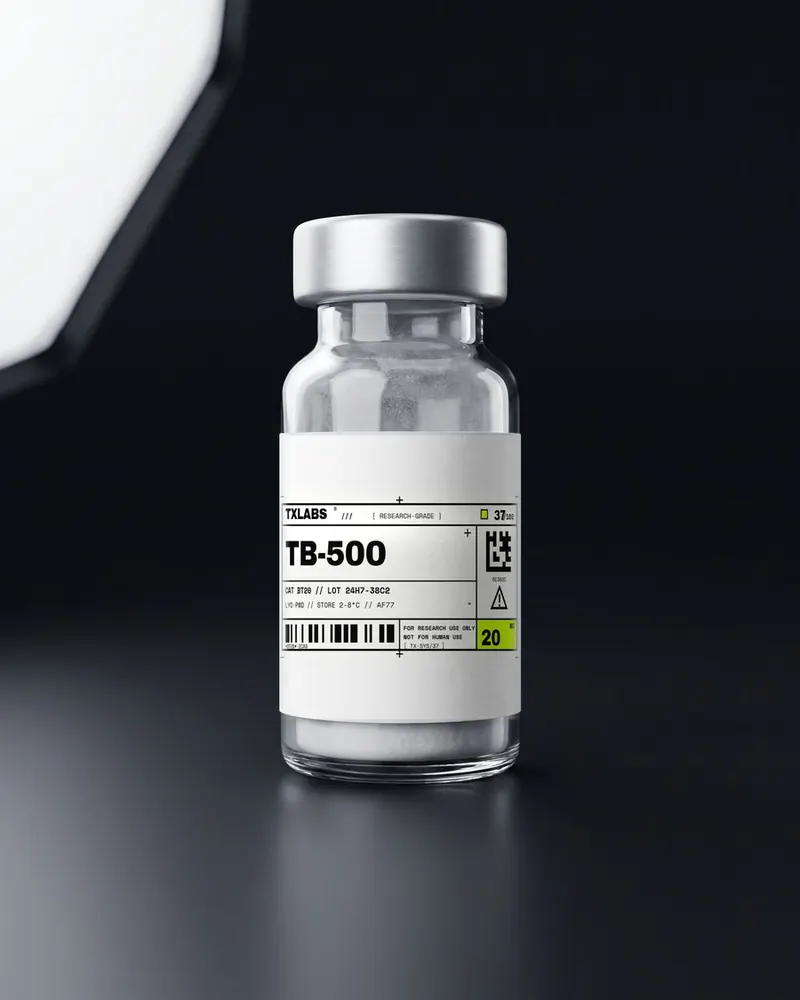
From $89 AUD · ≥98% HPLC purity · third-party COA · ships Australia-wide
What is TB500(Thymosin B4 Acetate)?
TB-500 (Thymosin Beta-4 acetate, Tb4) is a synthetic actin-binding peptide that regulates actin polymerisation and cell migration. It is studied in preclinical research on tissue repair, angiogenesis, inflammation and cytoskeletal organisation.
Specifications
- From: $89 AUD
- Category: Recovery & Repair
- Form: Lyophilised powder
- Purity: ≥98% HPLC
- Testing: Third-party Certificate of Analysis
- Classification: Research reference material · For Research Use Only
 View full report ↗
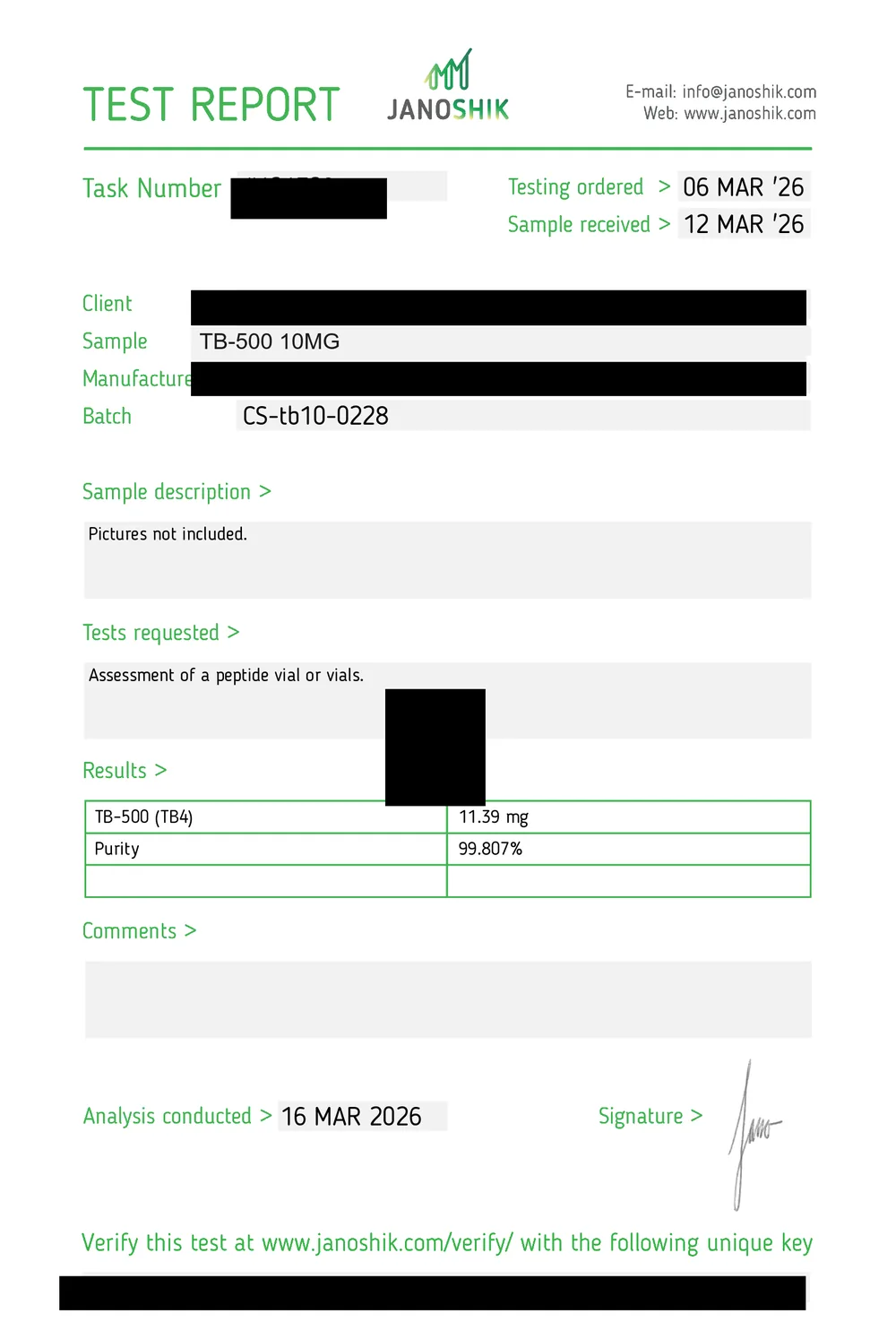
Report ID and verification key are redacted on our copy of this certificate. Request the unredacted report, or see the full CoA library.
What the research covers
Thymosin beta-4 is a 43-residue, N-terminally acetylated peptide with a molecular weight of approximately 4963 Da, catalogued in UniProt as P62328 and present in most mammalian cell types. Its principal characterised function is sequestration of monomeric G-actin: thymosin beta-4 is the major intracellular G-actin-binding protein, and by holding actin monomers in a polymerisation-incompetent complex it participates directly in the regulation of the actin cytoskeleton and therefore in cell motility, shape change and migration. The actin-binding activity is localised to a central motif around the sequence LKKTETQ.
The name TB-500 is used inconsistently in the supply chain, and this matters analytically. In some literature and product listings it denotes the full-length 43-residue thymosin beta-4; in others it denotes the short N-terminally acetylated fragment Ac-LKKTETQ of roughly 889 Da that reproduces the actin-binding motif. These are different molecules with different masses and different chromatographic behaviour, and most of the published efficacy literature was generated with the full-length parent rather than the fragment. The TXLABS certificate identifies the analyte as TB-500 (TB4), and the analyte identity on the certificate is the thing to read rather than the product name.
Research on thymosin beta-4 has examined angiogenesis and endothelial cell migration, corneal and dermal wound-repair models, cardiac and neural injury models in rodents, and its processing to the tetrapeptide AcSDKP, itself a studied hemoregulatory fragment. Clinical trial work has been reported in ophthalmic and dermal wound indications using full-length thymosin beta-4.
TXLABS supplies this material as a laboratory reference material only. It is not an approved therapeutic good in Australia and is not supplied for human or veterinary use.
Reading the certificate
The single most important check on a TB-500 certificate is identity, because the product name is ambiguous across the industry. Confirm what mass the laboratory actually observed: full-length thymosin beta-4 sits near 4963 Da, the Ac-LKKTETQ fragment near 889 Da, and no purity figure resolves that question. Confirm too that N-terminal acetylation is reflected in the observed mass, and that the material is supplied as an acetate salt, which contributes to gross powder weight without contributing peptide. TXLABS publishes the Janoshik Analytical report in the CoA library, identifying the analyte as TB-500 (TB4): batch CS-tb10-0228, tested 16 March 2026, 99.807% purity with a 10 mg sample assaying 11.39 mg. The task number and key are redacted on that report and the library says so.
Storage and handling
At 43 residues this is one of the longer peptides in the catalogue and it should be handled accordingly. Store the lyophilised cake at -20 °C, desiccated and protected from light, and allow the vial to reach room temperature before the seal is broken so that condensation does not settle into a hygroscopic powder. Thymosin beta-4 is highly water-soluble and intrinsically disordered in solution, which means it does not have a compact fold to protect against proteolysis or surface adsorption; add diluent gently down the vial wall, swirl rather than shake, and avoid foaming. Reconstituted material is held at 2-8 °C and protected from light, and should be aliquoted before any freezing rather than cycled repeatedly, since freeze-thaw is the fastest route to loss of a long, flexible peptide. In Australian summer conditions a parcel left in a sun-facing letterbox or a delivery van can sit well above 40 °C for hours. The dry cake tolerates brief excursions, but for a peptide this size prompt collection and refrigeration on arrival is worth the effort.
Working out concentration
Concentration is mass divided by volume. A 10 mg vial reconstituted with 2 mL of bacteriostatic water gives 5 mg/mL; with 1 mL, 10 mg/mL; with 5 mL, 2 mg/mL. The 20 mg vial with 4 mL gives 5 mg/mL. Molar conversion depends entirely on which molecule the vial contains: at 4963 Da for full-length thymosin beta-4, 5 mg/mL is roughly 1 mM, whereas the same mass concentration of the 889 Da Ac-LKKTETQ fragment would be closer to 5.6 mM. Check the certificate analyte before converting. The reconstitution calculator handles mass and volume. Worked concentration examples only, not a protocol.
How it relates to adjacent compounds
Thymosin beta-4 is grouped in this catalogue with the repair-and-regeneration compounds and is most often studied in parallel with BPC-157, with which it shares experimental models but no structural or mechanistic relationship whatsoever. That parallel use is the reason for the combination vial BPC-157 5 mg with TB-500 5 mg. Despite the shared thymosin prefix, thymosin beta-4 is unrelated to thymosin alpha-1: the beta thymosins are actin-binding peptides, the alpha thymosins are immunologically studied peptides with different sequences and different origins, and the shared name is a historical artefact of both having been isolated from thymus extracts. Structural relationships only.