TB-500 Fragment Australia — Ac-LKKTETQ Reference Peptide
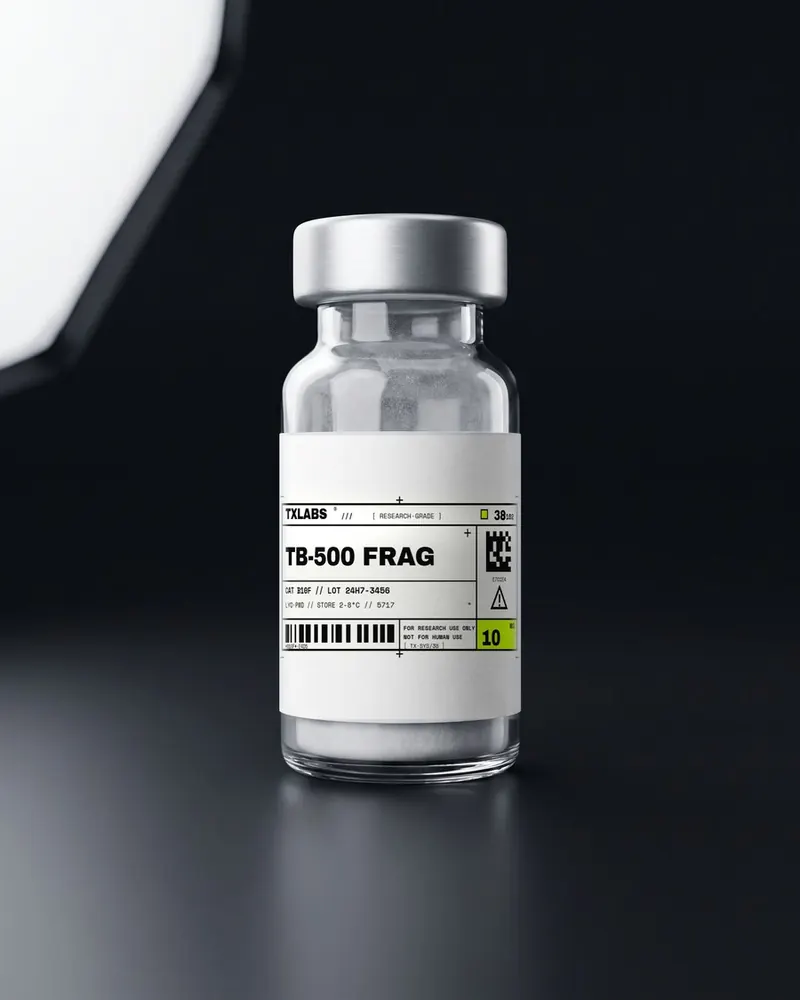
From $89 AUD · ≥98% HPLC purity · third-party COA · ships Australia-wide
What is TB500(FRAG)?
TB-500 (FRAG) is the Thymosin Beta-4 (1-4) fragment (Ac-SDKP), a tetrapeptide derived from thymosin beta-4. This N-acetyl Ser-Asp-Lys-Pro peptide is studied in preclinical research on anti-fibrotic signalling, angiogenesis and haematopoietic stem cell regulation.
Specifications
- From: $89 AUD
- Category: Recovery & Repair
- Form: Lyophilised powder
- Purity: ≥98% HPLC
- Testing: Third-party Certificate of Analysis
- Classification: Research reference material · For Research Use Only
What the research covers
This product is the TB-500 fragment, and the whole point of listing it separately is to make clear which molecule it is. The name TB-500 is used in the peptide supply chain for two entirely different substances: full-length thymosin beta-4, a 43-residue N-terminally acetylated peptide of approximately 4963 Da catalogued in UniProt as P62328, and the short N-terminally acetylated heptapeptide Ac-LKKTETQ, calculated at approximately 889 Da, which reproduces the central actin-binding motif of that parent. This vial is the latter. TXLABS lists the full-length protein under a separate entry precisely so the two do not have to share a page.
The LKKTETQ motif is the region of thymosin beta-4 identified in structural work as the site responsible for binding monomeric G-actin, which is thymosin beta-4's principal characterised function: it is the major intracellular G-actin sequestering protein, holding actin monomers in a polymerisation-incompetent complex and thereby participating in regulation of the cytoskeleton, cell shape change and migration. Isolating that motif as a synthetic heptapeptide is a reasonable chemical strategy, and the published literature includes work on short beta-thymosin-derived peptides in cell and animal models.
What must be said plainly is that the great majority of the thymosin beta-4 research literature, covering angiogenesis, corneal and dermal wound-repair models, cardiac and neural injury models and the clinical trial work that exists, was generated with the full-length 43-residue parent, not with this heptapeptide. Inferring the fragment's behaviour from the parent's literature is not supported by that literature, and a seven-residue peptide and a 43-residue one differ in far more than the shared motif.
TXLABS supplies the TB-500 fragment as an analytical reference material for laboratory research only. It is not an approved therapeutic good in Australia and is not supplied for human or veterinary administration.
Reading the certificate
The single most important item on a certificate for this product is the observed mass, because the product name does not identify the molecule. Full-length thymosin beta-4 sits near 4963 Da and this fragment near 889 Da, a gap of roughly 4 kDa that no analytical method could miss and that no purity percentage addresses. A certificate that names the analyte only as TB-500 without a mass leaves the central question open. Confirm also that the N-terminal acetylation is reflected in the mass, since the free-amine form is 42 daltons lighter, and that the material is supplied as an acetate salt, which adds to gross powder weight without adding peptide. TXLABS publishes third-party certificates for tested lots in the CoA library; none is currently published for the fragment. The lot certificate is available on request to support@txlabs.bio.
Storage and handling
A seven-residue peptide with no cysteine, no methionine and no aromatic residue in the core motif is chemically about as forgiving as peptides get. There is no free thiol to oxidise, no indole to photodegrade and few sites for deamidation, so the fragment tolerates ordinary handling considerably better than its 43-residue parent does. Its practical liabilities are physical: the lyophilised powder is hygroscopic, the two lysine residues make the peptide strongly basic and prone to adsorption onto negatively charged glass and plastic surfaces at dilute concentration, and the N-terminal acetyl group can in principle hydrolyse under strongly acidic or alkaline conditions. Store the lyophilised material at -20 °C, desiccated and protected from light, and equilibrate before opening. Hold reconstituted solution at 2-8 °C and aliquot before freezing. Australian summer transit above 40 °C is less consequential for a short robust peptide than for the full-length protein, but prompt collection and refrigeration remain the sensible default.
Working out concentration
The TXLABS TB-500 fragment vial is 10 mg. Reconstituted with 2 mL of bacteriostatic water it gives 5 mg/mL; with 1 mL, 10 mg/mL; with 5 mL, 2 mg/mL. The molar arithmetic is where the difference from full-length TB-500 becomes obvious: at roughly 889 Da a 5 mg/mL solution is approximately 5.6 mM, whereas 5 mg/mL of the 4963 Da full-length protein is only about 1.0 mM. The same mass concentration therefore delivers more than five times the molar concentration, which matters whenever a published figure is specified in molar terms. The reconstitution calculator resolves vial mass against volume. Concentration examples only, not a protocol.
How it relates to adjacent compounds
TB-500 as full-length thymosin beta-4 is the parent molecule this fragment is derived from, and the pair is the clearest illustration in this catalogue of why an analyte name on a certificate matters more than a product name. The blends BPC-157 with TB-500 at 5 mg each and at 10 mg each contain a TB-500 component whose species is likewise established by per-component assay rather than by the label. BPC-157 appears alongside both in overlapping preclinical model literature while being structurally unrelated. Between them these entries make the general point that the analyte name and the observed mass, rather than the product title, determine what is actually in a vial. Structural relationships only.