KPV Australia — Batch-Verified Research Tripeptide
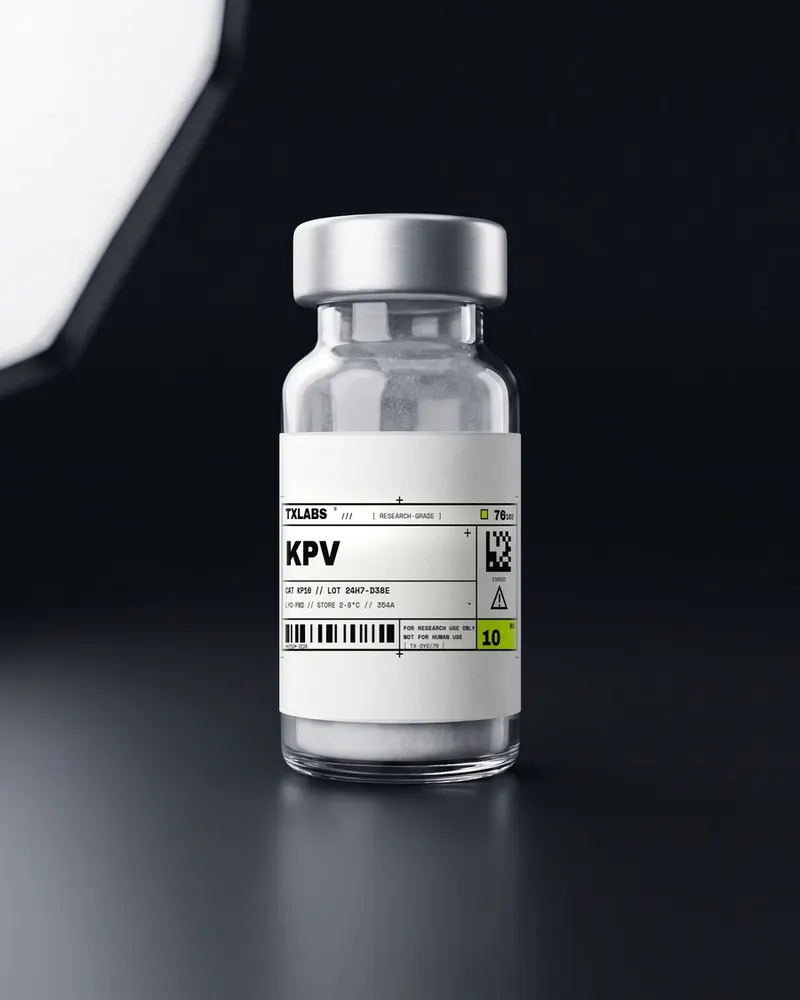
From $59 AUD · ≥98% HPLC purity · third-party COA · ships Australia-wide
What is KPV?
KPV (Lys-Pro-Val) is a tripeptide fragment of alpha-MSH studied for its anti-inflammatory activity. Derived from the C-terminal residues of alpha-melanocyte-stimulating hormone, it is investigated in laboratory research on NF-kB and NLRP3 inflammasome signalling and epithelial inflammation models, without activating melanocortin receptors or producing pigmentation effects.
Specifications
- From: $59 AUD
- Category: Recovery & Repair
- Form: Lyophilised powder
- Purity: ≥98% HPLC
- Testing: Third-party Certificate of Analysis
- Classification: Research reference material · For Research Use Only
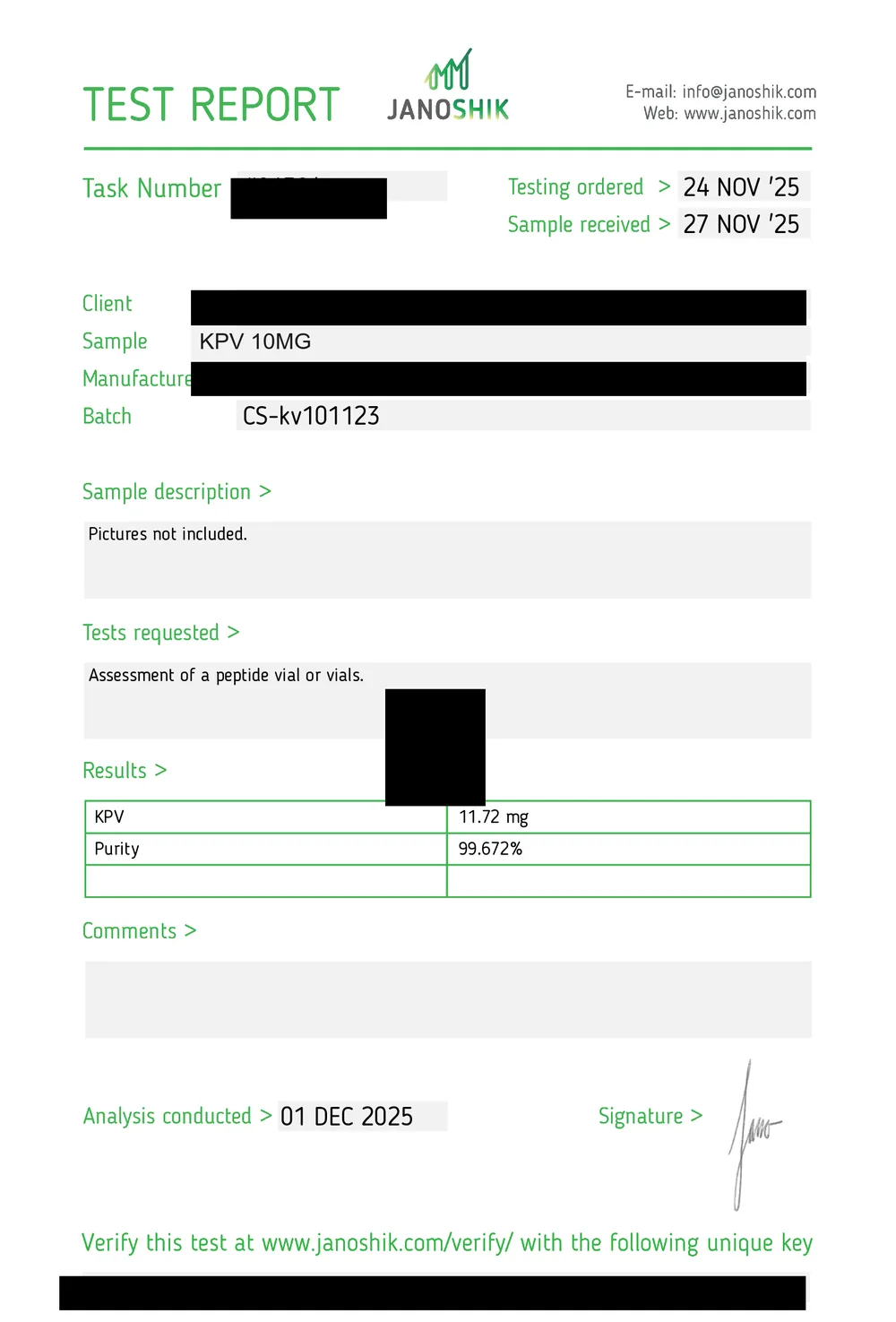 View full report ↗
Report ID and verification key are redacted on our copy of this certificate. Request the unredacted report, or see the full CoA library.
What the research covers
KPV is a tripeptide of L-lysine, L-proline and L-valine, molecular formula C16H30N4O4 and molecular weight 342.43 Da, making it one of the smallest molecules in this catalogue. Its significance in the literature comes from its origin: KPV corresponds to residues 11 to 13 of alpha-melanocyte-stimulating hormone, the C-terminal tripeptide of that 13-residue hormone. Research on alpha-MSH fragments established that anti-inflammatory activity described for the parent hormone could be reproduced by this short C-terminal sequence, which is why KPV became a tool compound in melanocortin-related inflammation research.
Published work has examined KPV predominantly in models of intestinal inflammation. Cell and rodent studies have investigated effects on nuclear factor kappa B signalling and on the production of inflammatory mediators in intestinal epithelial and immune cell lines, and colitis models have been used to examine mucosal endpoints. A distinct strand of literature concerns how the peptide enters cells: uptake via the oligopeptide transporter PepT1, which is expressed on intestinal epithelium and upregulated in inflamed tissue, has been described as a route by which the tripeptide reaches intracellular targets, and this transporter-mediated delivery has itself been the subject of nanoparticle and formulation studies. Separate reports have examined antimicrobial and antifungal activity for alpha-MSH C-terminal fragments in vitro.
Because KPV lacks the receptor-binding core message sequence of alpha-MSH, the literature generally describes its activity as receptor-independent or at least distinct from classical melanocortin receptor agonism, and that distinction is an active question rather than a settled one.
TXLABS supplies KPV as an analytical reference material for laboratory research only. It is not an approved therapeutic good in Australia and is not supplied for human or veterinary administration.
Reading the certificate
Very short peptides raise a different set of certificate questions from long ones. Deletion sequences are essentially not an issue across three couplings, so the informative checks are identity and salt form. Confirm the observed mass corresponds to 342.43 Da for the free peptide, since KPV is supplied as a salt and the counterion, typically acetate, contributes to gross powder weight without contributing peptide. That is precisely why net peptide assay in milligrams is the figure to read rather than the apparent weight of material in the vial. Confirm too that the certificate names a batch. TXLABS publishes the Janoshik Analytical report for KPV in the CoA library: batch CS-kv101123, tested 1 December 2025, 99.672% purity with a 10 mg sample assaying 11.72 mg.
Storage and handling
KPV is a three-residue peptide with no cysteine, methionine, tryptophan or aspartate, which removes most of the common degradation routes: no thiol oxidation, no aspartimide chemistry, no obvious deamidation site. In practice it is among the more robust materials in the catalogue. The lyophilised powder is still hygroscopic and is held at -20 °C, desiccated and protected from light, with 2-8 °C acceptable for short-term working stock, and the vial is brought to room temperature before opening so that moisture does not condense onto cold glass. Its very high aqueous solubility means reconstitution is quick and does not require agitation. Solution is stored at 2-8 °C and protected from light; where bacteriostatic water is used, the benzyl alcohol preservative is what supports repeated withdrawal from a single vial. Australian transit is comparatively low-risk for a tripeptide, and the dry cake tolerates the ambient excursions typical of summer road freight, but leaving a parcel in a sun-facing letterbox or a hot vehicle is still avoidable and worth avoiding.
Working out concentration
The TXLABS KPV vial is 10 mg. Reconstituted with 2 mL of bacteriostatic water it gives 5 mg/mL; with 1 mL, 10 mg/mL; with 5 mL, 2 mg/mL. KPV's low molecular weight makes the molar arithmetic distinctive: at 342.43 Da, a 5 mg/mL solution is approximately 14.6 mM, roughly four times the molarity of the same mass concentration of BPC-157. Since much of the published in vitro work on KPV specifies concentrations in micromolar terms, that conversion is where errors most often creep in. The reconstitution calculator handles vial mass and diluent volume. Worked concentration arithmetic only, not a protocol.
How it relates to adjacent compounds
KPV is the C-terminal fragment of alpha-melanocyte-stimulating hormone, which places it in direct structural relationship with the melanocortin compounds in this catalogue. Melanotan II and PT-141 (bremelanotide) are cyclic analogues built around the His-Phe-Arg-Trp core message sequence of alpha-MSH, which is the segment KPV does not contain; they are melanocortin receptor agonists, whereas KPV's activity is generally described as distinct from classical receptor agonism. Within the repair category, KPV appears in some of the same gastrointestinal inflammation models as BPC-157, despite entirely separate structural lineage. Structural and mechanistic relationships only. Its very low molecular weight also separates it from everything else here in practical terms, since molar concentrations for a given mass run far higher than for the rest of the catalogue.