BPC-157, GHK-Cu, TB-500, KPV Australia — Four Blend
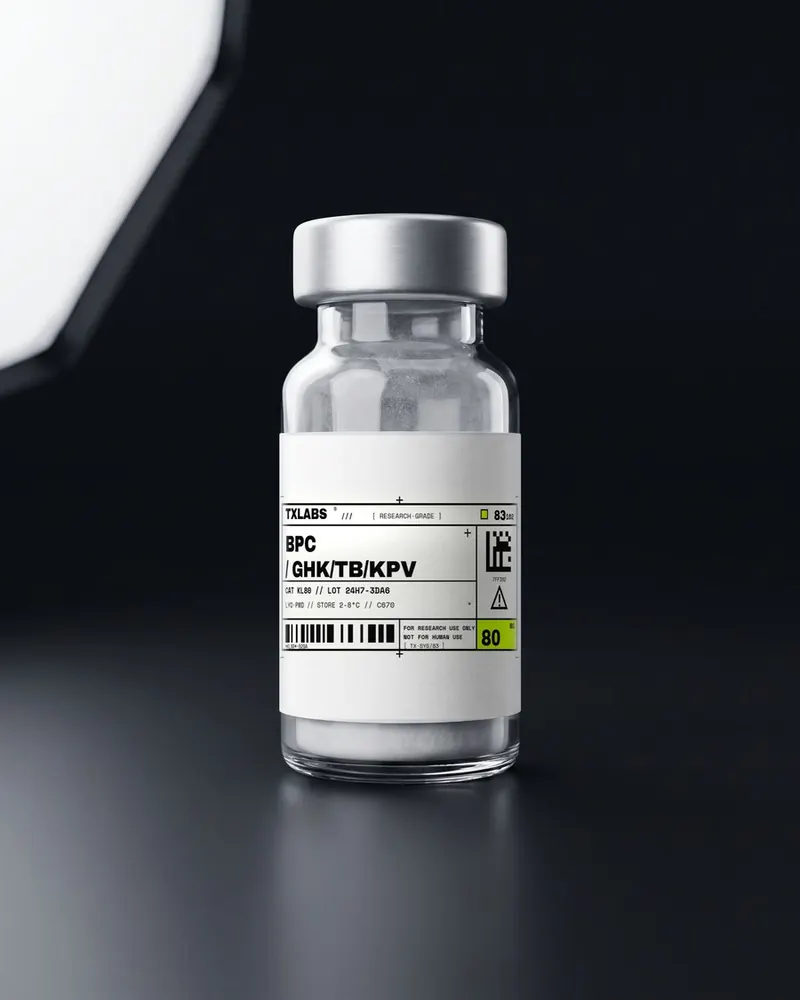
From $429 AUD · ≥98% HPLC purity · third-party COA · ships Australia-wide
What is BPC 157 10mg+GHK-CU 50mg+TB500 10mg+KPV 10mg?
This blend combines BPC 157, GHK-Cu, TB-500 and KPV, four peptides studied together in laboratory research on tissue repair and inflammation. BPC 157 (gastric pentadecapeptide) is studied for vascular and tissue repair, GHK-Cu (copper tripeptide) for matrix remodelling, TB-500 (thymosin beta-4 fragment) for cell migration and angiogenesis, and KPV (alpha-MSH tripeptide) for anti-inflammatory activity.
Specifications
- From: $429 AUD
- Category: Recovery & Repair
- Form: Lyophilised powder
- Purity: ≥98% HPLC
- Testing: Third-party Certificate of Analysis
- Classification: Research reference material · For Research Use Only
What the research covers
This vial holds four unrelated compounds co-lyophilised into one cake: nominally 10 mg of BPC-157, 50 mg of GHK-Cu, 10 mg of TB-500 and 10 mg of KPV, 80 mg of material in total. It is the three-component blend with KPV added, and it is the most analytically demanding item in the catalogue for the simple reason that four different molecules have to be resolved and quantified independently.
BPC-157 is a pentadecapeptide, GEPPPGKPADDAGLV, formula C62H98N16O22, molecular weight 1419.5 daltons, studied preclinically in gastrointestinal and soft-tissue injury models. In Australia it has a Schedule 4 entry in the Poisons Standard, implemented 1 June 2024.
GHK-Cu is glycyl-L-histidyl-L-lysine bound to copper(II), a metal complex rather than a peptide alone, carrying a metal content and a coordination state as well as a sequence.
Thymosin beta-4, UniProt P62328, is a 43-residue N-terminally acetylated peptide near 4963 daltons and the major intracellular G-actin sequestering protein. The name TB-500 is used commercially for both the full-length protein and the short Ac-LKKTETQ fragment near 889 daltons.
KPV is the tripeptide lysine-proline-valine, corresponding to the C-terminal tripeptide of alpha-melanocyte-stimulating hormone. At three residues it is by far the smallest component here, roughly one sixteenth the size of thymosin beta-4, and that size gap is what makes this vial difficult to analyse: a very short polar tripeptide and a 43-residue peptide cannot both be well retained and well resolved by a single generic chromatographic gradient.
TXLABS supplies this blend as an analytical reference material for laboratory research only. It is not an approved therapeutic good in Australia and is not supplied for human or veterinary administration.
Reading the certificate
Four analytes need four measurements, and the chromatography is the hard part. KPV is a very short, very polar tripeptide that is barely retained on a standard C18 column and elutes near the void, while full-length thymosin beta-4 at 43 residues retains strongly and elutes late. Covering both ends of that range in one run requires a deliberately designed gradient rather than a generic peptide method, and a certificate reporting a single chromatogram with four neat peaks is worth examining for whether the earliest peak is genuinely resolved from the solvent front. Add to that a copper content and stoichiometry for the GHK-Cu component by an elemental method, and identity by observed mass for each peptide named individually. TXLABS maintains a CoA library of third-party certificates for lots that have been tested. No certificate has been published for this four-component blend; the documentation held for the lot supplied is provided on request to support@txlabs.bio.
Storage and handling
Four components with four stability profiles in one cake means the storage terms are set by whichever is least stable, in practice full-length thymosin beta-4 if that is the species present. Hold the lyophilised cake at -20 °C, desiccated and dark, and equilibrate the vial sealed to room temperature before opening so that condensation does not wet a hygroscopic mixture. Reconstituted, the four are inseparable in practice, so all handling applies to all of them: 2-8 °C, protected from light, diluent added gently down the wall, swirled not shaken, aliquoted rather than freeze-thaw cycled. Copper(II) is redox active and catalyses oxidation of susceptible residues, so this cake should not sit in solution longer than necessary and should not meet chelating buffers. KPV contains a proline, which contributes conformational behaviour of its own in solution. Australian summer transit above 40 °C accelerates every one of these processes at different rates, silently changing the ratios between four components at once.
Working out concentration
This vial holds nominally 10 mg of BPC-157, 50 mg of GHK-Cu, 10 mg of TB-500 and 10 mg of KPV, 80 mg total. Reconstituted with 5 mL of bacteriostatic water that gives 2 mg/mL of BPC-157, 10 mg/mL of GHK-Cu, 2 mg/mL of TB-500 and 2 mg/mL of KPV, with a total material concentration of 16 mg/mL. With 10 mL each figure halves. Four separate concentrations should be recorded, since a single total conceals that one component is present at five times the level of the other three. The reconstitution calculator handles each nominal mass against the volume. Concentration examples only, not a protocol.
How it relates to adjacent compounds
The three-component version is this vial without the KPV and is the better starting point for understanding the shared components. All four are stocked individually as BPC-157, GHK-Cu, TB-500 in both its forms, and KPV, which is the route to per-component traceability where that matters. The two-component BPC and TB-500 blends demonstrate the same per-component principle with a simpler analytical problem behind it. Choosing between a blend and separate vials is a question of design and record-keeping rather than chemistry, and the four-component vial trades convenience for a harder verification problem. These are formulation relationships described because they govern what a certificate must demonstrate, and they imply nothing about comparative activity.