BPC-157, GHK-Cu, TB-500 Australia — Three-Way Blend
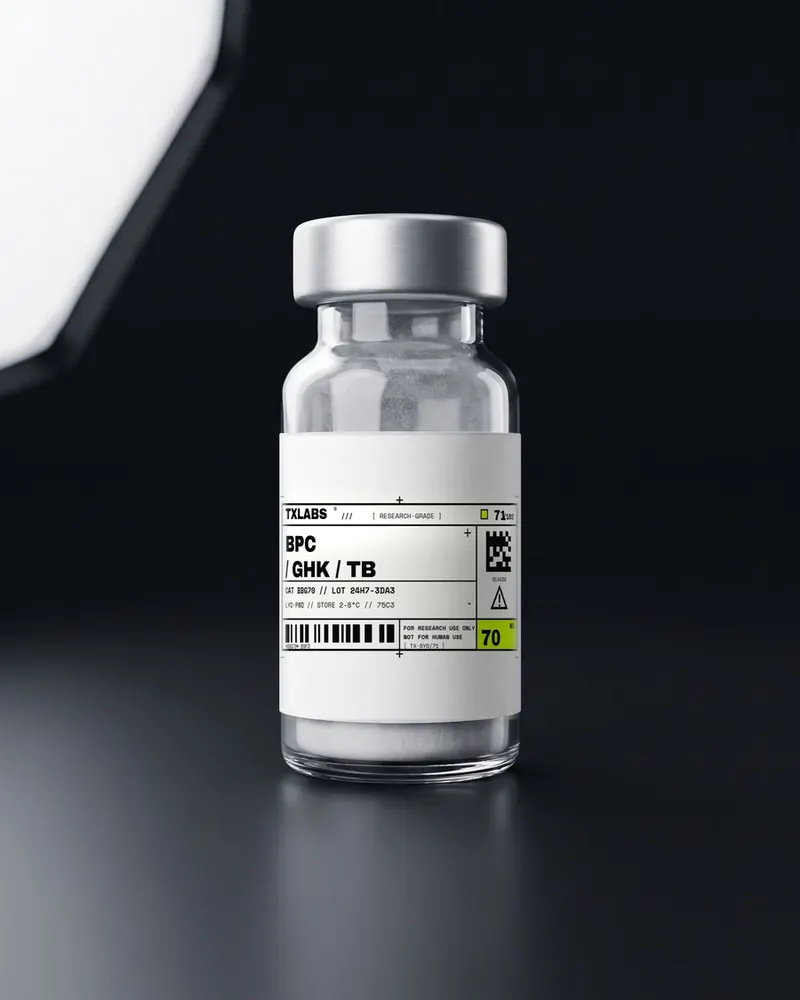
From $379 AUD · ≥98% HPLC purity · third-party COA · ships Australia-wide
What is BPC 157 10mg+GHK-CU 50mg+TB500 10mg?
BPC 157 10mg+GHK-CU 50mg+TB500 10mg is a research blend of three peptides studied for tissue repair and regeneration. It combines BPC-157, a gastric pentadecapeptide investigated in angiogenesis and healing research; GHK-Cu, a copper-binding tripeptide studied in remodelling and skin research; and TB-500, a thymosin beta-4 fragment linked to actin regulation and cell migration.
Specifications
- From: $379 AUD
- Category: Recovery & Repair
- Form: Lyophilised powder
- Purity: ≥98% HPLC
- Testing: Third-party Certificate of Analysis
- Classification: Research reference material · For Research Use Only
What the research covers
This vial holds three unrelated compounds co-lyophilised into one cake: nominally 10 mg of BPC-157, 50 mg of GHK-Cu and 10 mg of TB-500, 70 mg of material in total. They share no sequence homology and no proposed mechanism. They are combined because preclinical tissue-repair literature has used them in overlapping model systems, not because they are chemically related, and one of the three is not a simple peptide at all.
BPC-157 is a pentadecapeptide, sequence GEPPPGKPADDAGLV, formula C62H98N16O22, molecular weight 1419.5 daltons, described as a partial fragment of a protein identified in human gastric juice. Rodent work has examined it in gastrointestinal lesion models and in tendon, ligament, muscle and bone injury models. In Australia BPC-157 has a Schedule 4 entry in the Poisons Standard, implemented 1 June 2024.
GHK-Cu is the tripeptide glycyl-L-histidyl-L-lysine bound to a copper(II) ion. It is a metal complex rather than a peptide alone, which means it has a metal content and a coordination state as well as a sequence, and it is the reason this vial is coloured.
Thymosin beta-4, UniProt P62328, is a 43-residue N-terminally acetylated peptide of approximately 4963 daltons and the principal intracellular sequestering protein for monomeric G-actin. The name TB-500 is used commercially both for the full-length protein and for the short Ac-LKKTETQ fragment near 889 daltons; only an assay establishes which is present.
The copper is the complicating factor. Copper(II) catalyses oxidative chemistry, and in a single vial it sits in intimate contact with two other peptides for the entire life of the product.
TXLABS supplies this blend as an analytical reference material for laboratory research only. It is not an approved therapeutic good in Australia and is not supplied for human or veterinary administration.
Reading the certificate
Three components require three assays, and a single combined purity figure for this vial would be meaningless twice over: once because purity is defined against one intended analyte, and again because one of the three is a metal complex whose characterisation is not a chromatographic measurement at all. What a certificate should show is per-component assay in milligrams against each nominal mass, per-component purity and identity by observed mass for the two peptides, and separately a copper content and stoichiometry for the GHK-Cu component determined by an elemental method. Confirm which TB-500 species is named, since the full-length protein and the short fragment differ greatly in mass. TXLABS publishes third-party certificates for tested lots in the CoA library; no certificate is currently published for this blend, and the certificate for the specific lot supplied is available on request to support@txlabs.bio.
Storage and handling
Three components with different stability profiles in one cake means storing on the terms of the least stable, which here is full-length thymosin beta-4 if that is the species present. Hold the cake at -20 °C, desiccated and protected from light, and equilibrate the vial sealed to room temperature before opening. Once reconstituted the three are in one solution and cannot be separated, so every decision applies to all of them: 2-8 °C in the dark, diluent added gently down the wall, swirl rather than shake, aliquot rather than freeze-thaw cycle. The copper deserves particular attention. Copper(II) is redox active and catalyses oxidation of susceptible residues, so a blend containing it should not sit in solution longer than necessary, should be kept cold, and should not be combined with chelating buffers, which would strip the metal from GHK and change what the vial contains. Australian summer transit above 40 °C accelerates copper-catalysed oxidation as well as ordinary degradation; collect promptly and refrigerate.
Working out concentration
This vial holds nominally 10 mg of BPC-157, 50 mg of GHK-Cu and 10 mg of TB-500, 70 mg total. Reconstituted with 5 mL of bacteriostatic water that gives 2 mg/mL of BPC-157, 10 mg/mL of GHK-Cu, 2 mg/mL of TB-500 and 14 mg/mL of total material. With 10 mL it gives 1, 5 and 1 mg/mL respectively and 7 mg/mL total. Note that the components are not present in equal amounts, so a single total figure conceals a fivefold difference between GHK-Cu and the other two. Record three concentrations, not one. The reconstitution calculator handles each component against the volume. Concentration examples only, not a protocol.
How it relates to adjacent compounds
All three components are stocked individually as BPC-157, GHK-Cu and TB-500 as full-length thymosin beta-4, with the short actin-binding fragment listed separately again. The four-component version of this vial adds KPV to the same three and raises the same questions with one more analyte to resolve. The simpler two-component blends in the catalogue illustrate the per-component principle in isolation. Choosing between a blend and separate vials is a matter of experimental design and traceability rather than chemistry, since the molecules themselves are identical whichever container they arrive in. These are formulation relationships described because they govern what a certificate has to demonstrate, and they imply nothing at all about comparative activity.