DSIP Australia — Batch-Verified Research Nonapeptide
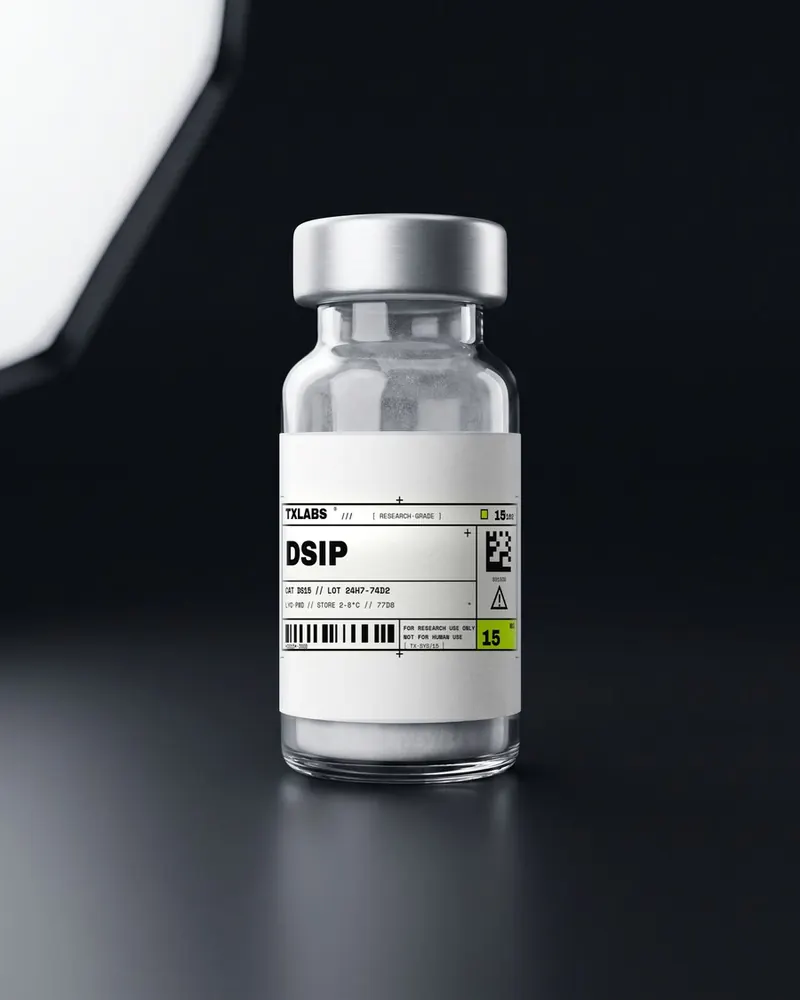
From $79 AUD · ≥98% HPLC purity · third-party COA · ships Australia-wide
What is DSIP?
DSIP (delta sleep-inducing peptide) is a naturally occurring neuromodulatory nonapeptide first isolated from cerebral venous blood. It is investigated in research on sleep regulation, neuroendocrine signalling and stress-response pathways.
Specifications
- From: $79 AUD
- Category: Cognitive & Nootropic
- Form: Lyophilised powder
- Purity: ≥98% HPLC
- Testing: Third-party Certificate of Analysis
- Classification: Research reference material · For Research Use Only
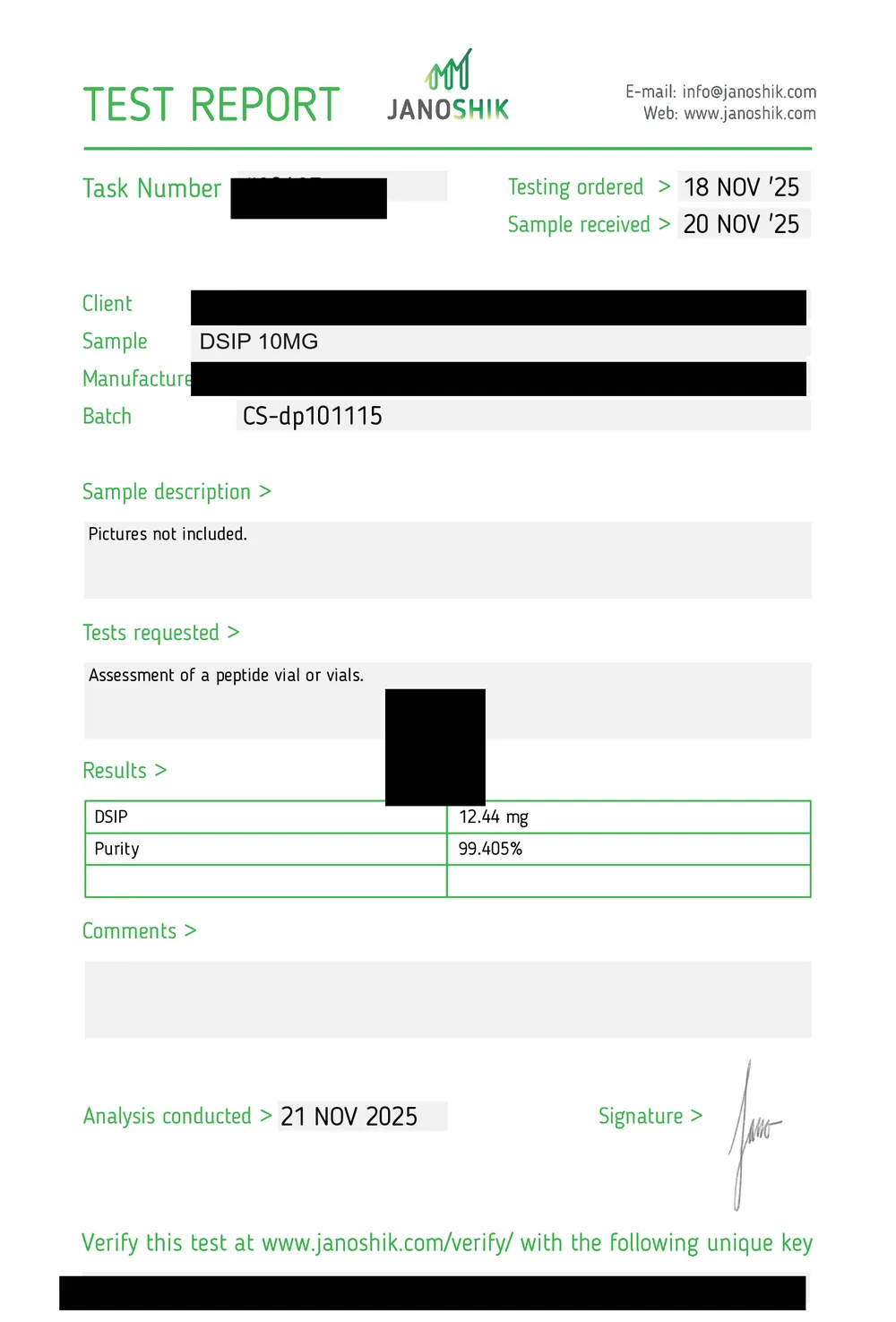 View full report ↗
Report ID and verification key are redacted on our copy of this certificate. Request the unredacted report, or see the full CoA library.
What the research covers
DSIP, delta sleep-inducing peptide, is a nonapeptide with the sequence Trp-Ala-Gly-Gly-Asp-Ala-Ser-Gly-Glu, molecular formula C35H48N10O15 and molecular weight 848.8 Da. Its name comes from its discovery context rather than from an established mechanism. It was isolated in the 1970s from cerebral venous blood of rabbits in work by Monnier, Schoenenberger and colleagues, who reported that the fraction induced delta-wave electroencephalographic activity when transferred to recipient animals, and the peptide was subsequently sequenced and synthesised.
What makes DSIP unusual as a research subject is how little has been resolved in the decades since. No specific receptor has been definitively identified for it, its endogenous distribution and precursor remain incompletely characterised, and replication of the original electroencephalographic findings has been inconsistent across laboratories. The published literature spans reported effects on sleep architecture and circadian parameters in animal models and small human studies, investigations of stress-response endpoints including corticotropin and cortisol measures, work on thermoregulation and on pain thresholds in rodents, and immunoreactivity studies mapping DSIP-like material in brain and peripheral tissue. A recurring theme in review articles is the gap between the volume of reported effects and the absence of an identified molecular target.
For a laboratory buyer, that ambiguity is precisely why a characterised reference material matters: much of the inconsistency in the historical literature has been attributed in part to variability in peptide preparation and stability.
TXLABS supplies DSIP as an analytical reference material for laboratory research only. It is not an approved therapeutic good in Australia and is not supplied for human or veterinary administration.
Reading the certificate
A DSIP certificate should be read with its degradation chemistry in mind. The species to expect are isoaspartate and aspartimide-related isomers, which share the parent's nominal mass and can only be resolved chromatographically, and oxidised tryptophan, which shows as a mass increment. Because the peptide is comparatively labile, the interval between test date and receipt carries more weight for DSIP than for a stable tetrapeptide, and a purity figure describes the material as tested rather than as it will be after months of poor storage. Confirm identity against 848.8 Da and read assay in milligrams against label. TXLABS publishes the Janoshik Analytical report for DSIP in the CoA library: batch CS-dp101115, tested 21 November 2025, 99.405% purity with a 10 mg sample assaying 12.44 mg.
Storage and handling
DSIP is one of the less stable short peptides in this catalogue and its sequence explains why. It contains an aspartyl-alanine and a serine-glycine region, and critically an Asp-Ala motif followed downstream by Ser-Gly and Gly-Glu, giving it multiple sites where aspartimide formation, isomerisation and deamidation-type chemistry can proceed in aqueous solution. It also carries an N-terminal tryptophan, which is photosensitive and oxidation-prone. The practical consequences are specific: keep solutions cold, dark and short-lived, avoid alkaline diluents, and do not leave reconstituted material at bench temperature. Store the lyophilised cake at -20 °C, desiccated and protected from light, and bring the vial to room temperature before opening so condensation does not wet the powder. Aliquot before freezing rather than freeze-thaw cycling. For Australian conditions, DSIP is a compound where transit heat genuinely matters: warmth accelerates both the aspartimide chemistry and tryptophan degradation, so parcels should be collected promptly, unpacked on arrival and refrigerated rather than left in a summer letterbox.
Working out concentration
DSIP is stocked in 10 mg and 15 mg vials. A 10 mg vial reconstituted with 2 mL of bacteriostatic water gives 5 mg/mL; with 1 mL, 10 mg/mL. A 15 mg vial with 3 mL gives 5 mg/mL, and with 1.5 mL, 10 mg/mL. At 848.8 Da a 5 mg/mL solution is approximately 5.9 mM. Because DSIP degrades comparatively quickly in solution, a practical consideration is choosing a diluent volume that suits the intended working period rather than reconstituting a large volume that will sit refrigerated for weeks. The reconstitution calculator handles vial mass against volume. These are worked concentration examples only, not a protocol.
How it relates to adjacent compounds
DSIP sits in the cognitive and nootropic category of this catalogue alongside Selank and Semax, which share the category but almost nothing else: both of those are short synthetic analogues designed within Russian research institutes from defined endogenous parents, tuftsin and ACTH respectively, and both have comparatively well-described proposed mechanisms. DSIP by contrast is an isolated natural nonapeptide with no confirmed receptor, which is the single most important thing to know when comparing them as research tools. Structurally, DSIP shares no homology with either. The relationship is one of catalogue category and research field only, and nothing here compares their effects.