Semax + Selank 10mg Australia — Co-Lyophilised Blend
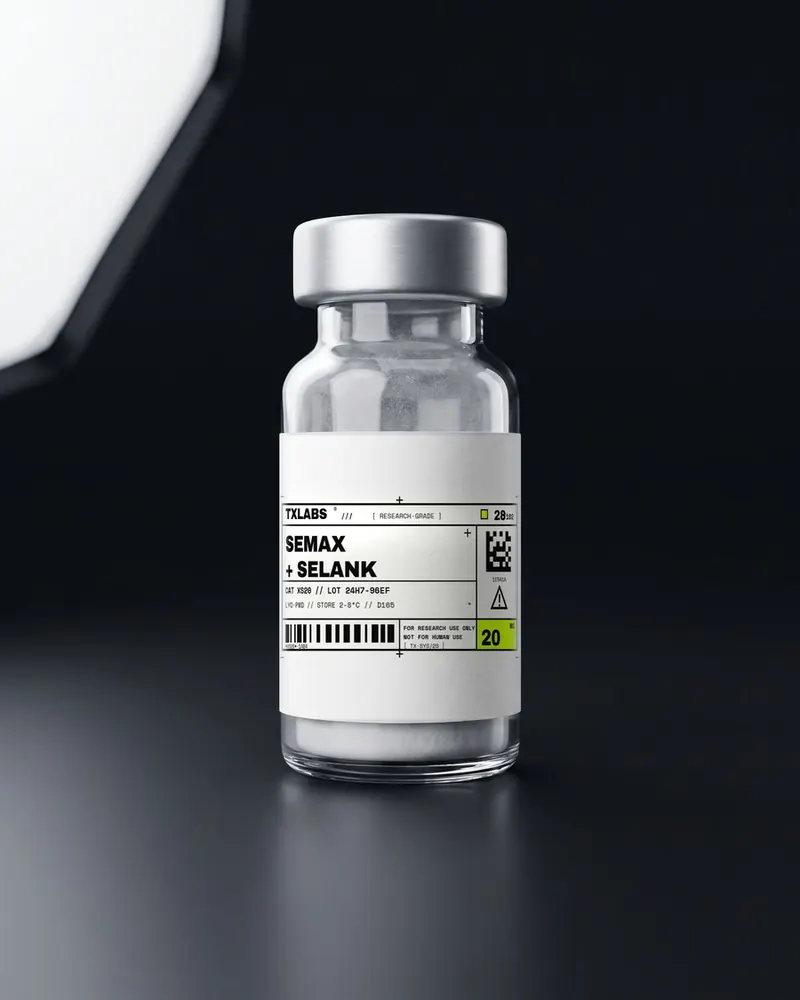
From $239 AUD · ≥98% HPLC purity · third-party COA · ships Australia-wide
What is Semax 10mg+Selank 10mg?
Semax 10mg+Selank 10mg is a research blend pairing the ACTH(4-10)-derived nootropic peptide Semax with the tuftsin-derived anxiolytic peptide Selank, each at 10mg. Semax is studied for neurotrophic and neuroplasticity signalling, and Selank for GABAergic and stress-response modulation. The combination is a reference material in neuropeptide research.
Specifications
- From: $239 AUD
- Category: Cognitive & Nootropic
- Form: Lyophilised powder
- Purity: ≥98% HPLC
- Testing: Third-party Certificate of Analysis
- Classification: Research reference material · For Research Use Only
What the research covers
This vial contains two separate research peptides co-lyophilised into one cake, nominally 10 mg of Semax and 10 mg of Selank, 20 mg of peptide in total. They are paired because they come from the same laboratory and the same design tradition, not because any published work establishes that the combination does something the individual peptides do not.
Semax is the heptapeptide Met-Glu-His-Phe-Pro-Gly-Pro, molecular formula C37H51N9O10S, molecular weight 813.9 Da. Its first four residues correspond to the ACTH(4-7) fragment of adrenocorticotropic hormone, and the appended Pro-Gly-Pro tripeptide slows enzymatic degradation of that short core. Published research on it, largely from Russian institutes, has examined neurotrophic factor expression in rodent brain tissue and cell culture and endpoints in rodent cerebral ischaemia models.
Selank is the heptapeptide Thr-Lys-Pro-Arg-Pro-Gly-Pro, molecular formula C33H57N11O9, molecular weight 751.9 Da. Its first four residues are tuftsin, an endogenous tetrapeptide released from the Fc region of immunoglobulin G, extended by the same Pro-Gly-Pro tail. Published work has examined anxiolytic-like endpoints in standard rodent behavioural paradigms and immunological endpoints reflecting the tuftsin heritage.
Both were developed at the Institute of Molecular Genetics of the Russian Academy of Sciences using the identical design strategy applied to two unrelated cores. Their sequences share only the Pro-Gly-Pro extension. The literature for both is concentrated in Russian-language sources and in publications from the originating institute, with limited independent replication, and there is no body of published work on the pairing as a pairing.
TXLABS supplies this blend as an analytical reference material for laboratory research only. It is not an approved therapeutic good in Australia and is not supplied for human or veterinary administration.
Reading the certificate
Per-component assay is the whole question for a blend. A single combined purity percentage is not a meaningful measurement when a vial contains two different molecules, and a certificate offering one should prompt questions about what was measured. The two peptides separate readily by reversed-phase HPLC, since Semax is markedly less polar than the strongly basic Selank, and their masses of 813.9 and 751.9 Da are easily distinguished, so there is no technical obstacle to quantifying each independently. Ask for two purity figures, two observed masses and two content values, and confirm the ratio matches the label rather than assuming it. Confirm also that the Semax figure accounts for the methionine sulfoxide. TXLABS publishes third-party certificates for tested lots in the CoA library; no certificate is currently published for this blend. The lot certificate is available on request to support@txlabs.bio.
Storage and handling
A co-lyophilised blend is stored on the terms of its least stable component, and here that is unambiguously Semax. Semax carries a methionine residue whose thioether oxidises readily to the sulfoxide, and a histidine that is also oxidation-sensitive; Selank contains neither, no cysteine, no asparagine and no aspartate, and is chemically the more robust of the two by a wide margin. The consequence is specific: conditions that leave Selank essentially untouched can measurably degrade the Semax component, shifting the ratio in the vial with no visible sign at all.
Store the cake at -20 C, desiccated and protected from light, and equilibrate the sealed vial to room temperature before opening so that moisture does not condense onto a hygroscopic powder. Once reconstituted the two peptides are in one solution and every decision applies to both: hold at 2-8 C in the dark, add diluent gently down the vial wall, swirl rather than shake, and aliquot before freezing rather than cycling the vial. Australian summer transit above 40 C is exactly the condition that produces silent, differential loss of the Semax fraction, so prompt collection and refrigeration matter more here than for either peptide alone.
Working out concentration
Concentration in a blend has to be tracked per component or the record is meaningless. This vial holds nominally 10 mg of Semax and 10 mg of Selank, 20 mg of peptide in total. Reconstituted with 2 mL of bacteriostatic water it gives 5 mg/mL of each peptide and 10 mg/mL of total peptide; with 4 mL, 2.5 mg/mL each and 5 mg/mL total; with 1 mL, 10 mg/mL each and 20 mg/mL total. Recording only the total is the common error, because it doubles the apparent concentration of either component. The molar concentrations differ slightly between the two at equal mass, since 813.9 and 751.9 Da are not the same. The reconstitution calculator handles the arithmetic. Concentration examples only, not a protocol.
How it relates to adjacent compounds
Both components are stocked individually as Semax and Selank, and those pages carry the detailed literature for each. The terminally capped analogues of both are also available, as NA Semax amidate and NA Selank amidate, which are different molecules again and are not interchangeable with the peptides in this vial. Choosing between the blend and two single vials is a question of experimental design, record-keeping and per-component traceability rather than of chemistry, since the molecules are identical whichever vial they arrive in; the blend removes the ability to vary the ratio and removes independent control over each component. These are structural and design adjacencies only, and imply nothing about comparable activity.