NA Selank Amidate Australia — Capped Tuftsin Analogue
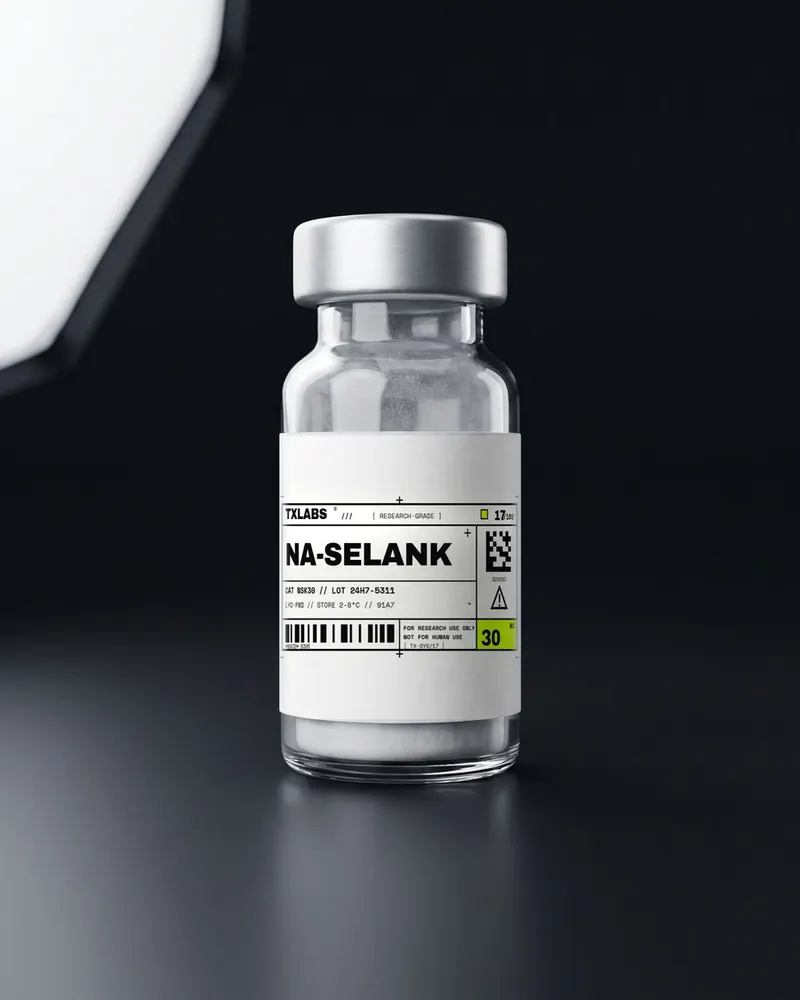
From $309 AUD · ≥98% HPLC purity · third-party COA · ships Australia-wide
What is NA Selank amidate?
NA Selank amidate (N-acetyl Selank amidate) is a chemically modified, terminally protected analogue of the tuftsin-derived heptapeptide Selank. The N-acetylation and C-terminal amidation are studied for their influence on peptide stability, enzymatic resistance and bioavailability. It serves as a research reference in neuropeptide and anxiolytic peptide studies.
Specifications
- From: $309 AUD
- Category: Cognitive & Nootropic
- Form: Lyophilised powder
- Purity: ≥98% HPLC
- Testing: Third-party Certificate of Analysis
- Classification: Research reference material · For Research Use Only
What the research covers
NA Selank amidate is Selank with both termini chemically capped: an acetyl group on the N-terminal amine and a primary amide replacing the C-terminal carboxylic acid. The parent peptide is Thr-Lys-Pro-Arg-Pro-Gly-Pro, molecular weight 751.9 Da, developed at the Institute of Molecular Genetics of the Russian Academy of Sciences by extending the endogenous tetrapeptide tuftsin, TKPR, with a Pro-Gly-Pro tail.
The sequence itself makes this molecule chemically distinctive within the catalogue. It contains lysine and arginine and no acidic residues at all, so it is strongly basic and very highly water-soluble, considerably more so than Semax. It also contains three prolines out of seven residues, which imposes substantial conformational constraint on the backbone and gives rise to slow cis-trans isomerisation about the prolyl amide bonds, a phenomenon that can produce broadened or split peaks in chromatography and in nuclear magnetic resonance without indicating any impurity.
There is a genuine open question worth stating plainly. The parent peptide already terminates in Pro-Gly-Pro, and that motif was itself introduced precisely because it resists enzymatic degradation; proline-rich C-termini are poor carboxypeptidase substrates. Adding a C-terminal amide to a peptide that already ends in a protease-resistant proline motif therefore adds less than the same modification would on an unprotected sequence. Whether the doubly capped analogue behaves measurably differently from Selank has not been demonstrated in published work that we can identify.
The evidence position is accordingly thin. The Selank literature is dominated by Russian-language publications and by output from the originating institute, independent replication is limited, and specific characterisation of the amidated analogue is thinner still.
TXLABS supplies NA Selank amidate as an analytical reference material for laboratory research only. It is not an approved therapeutic good in Australia and is not supplied for human or veterinary administration.
Reading the certificate
Two things need establishing on a certificate for this material and neither is the headline purity figure. The first is that both modifications are present: unmodified Selank at 751.9 Da is cheaper and widely available, and partial products missing one cap differ from the target by 42 or 1 daltons. Ask for the observed mass as a number. The second is that the chromatography has been read correctly. A proline-rich peptide with three prolines in seven residues undergoes slow cis-trans isomerisation about the prolyl bonds, and this routinely produces broadened or split peaks that look like impurities but are the same molecule interconverting on the chromatographic timescale. A low purity figure on this compound may reflect that rather than genuine contamination, and a good report will discuss it. TXLABS publishes third-party certificates for tested lots in the CoA library; no certificate is currently published for NA Selank amidate. The lot certificate is available on request to support@txlabs.bio.
Storage and handling
This peptide has an unusually benign internal chemistry. There is no cysteine, no methionine and no tryptophan, so the oxidation routes that dominate for most of the catalogue are largely absent; there is no asparagine and no aspartate, so deamidation and aspartimide formation are not concerns either. Terminal capping removes exopeptidase susceptibility. What remains is ordinary hydrolysis of the backbone, which is slow at neutral pH and cold temperatures, and hydrolysis of the C-terminal amide back to the free acid under strongly acidic conditions.
The practical issues are physical rather than chemical. The peptide is strongly basic and highly hygroscopic, so the lyophilised cake takes up atmospheric moisture quickly and gains weight; equilibrating the sealed vial before opening is not a formality here. Being highly charged, it also adsorbs to negatively charged surfaces at dilute working concentrations.
Store the powder at -20 C, desiccated and protected from light. Hold solutions at 2-8 C and aliquot rather than freeze-thaw. Australian summer freight is less damaging to this peptide than to most in the catalogue, but warmth plus absorbed moisture is still the combination that causes hydrolytic loss, so prompt dry, cold storage remains the right default.
Working out concentration
The TXLABS NA Selank amidate vial is 30 mg. Thirty milligrams into 3 mL of bacteriostatic water gives 10 mg/mL; into 6 mL, 5 mg/mL; into 1.5 mL, 20 mg/mL. High concentrations are readily achievable here because the peptide is strongly basic and very soluble, which is not true of most of the catalogue. For molar conversion, use the mass of the modified peptide rather than the 751.9 Da parent figure, since acetylation and amidation together shift the mass upward by roughly 41 Da, about five and a half percent, which propagates directly into any molarity calculation. The certificate for the lot supplied is the reference. The reconstitution calculator handles the arithmetic. Concentration examples only, not a protocol.
How it relates to adjacent compounds
The unmodified parent is stocked as Selank, and that page carries the pharmacological literature, essentially all of which concerns the uncapped peptide. NA Semax amidate is the direct sibling, the same two terminal modifications applied to the other heptapeptide from the same institute; the two share a design philosophy and nothing else, since Selank is built on a tuftsin core and Semax on an ACTH fragment. The Semax and Selank blend pairs the unmodified forms in a single vial and raises per-component assay questions that do not apply here. N-acetyl epitalon amidate is the catalogue's other doubly capped peptide. These are design and structural adjacencies only, and imply nothing about comparable activity.