NA Semax Amidate Australia — Doubly Capped Heptapeptide
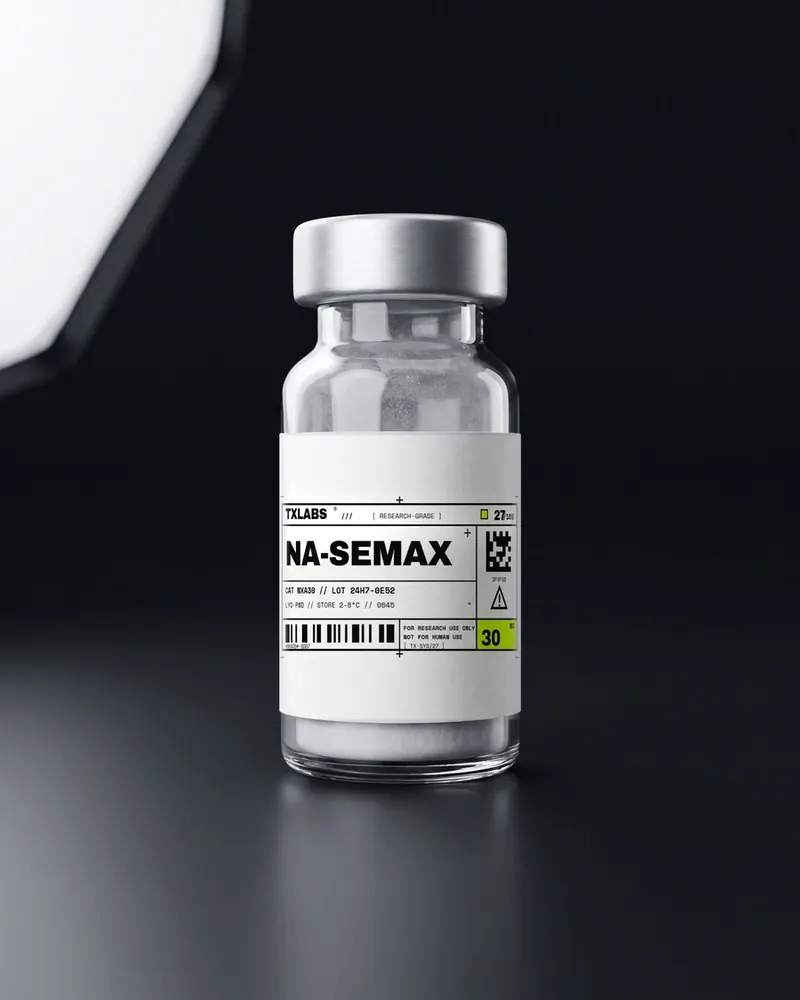
From $319 AUD · ≥98% HPLC purity · third-party COA · ships Australia-wide
What is NA Semax amidate?
NA Semax amidate (N-acetyl Semax amidate) is a chemically modified, terminally protected analogue of the ACTH(4-10)-derived heptapeptide Semax. The N-acetylation and C-terminal amidation are studied for their effect on peptidase resistance, stability and bioavailability. It is used as a research reference in neuropeptide and neuroprotection studies.
Specifications
- From: $319 AUD
- Category: Cognitive & Nootropic
- Form: Lyophilised powder
- Purity: ≥98% HPLC
- Testing: Third-party Certificate of Analysis
- Classification: Research reference material · For Research Use Only
What the research covers
NA Semax amidate is Semax carrying two terminal chemical modifications: an acetyl group on the N-terminal amine and a primary amide in place of the C-terminal carboxylic acid. The underlying peptide is unchanged. Semax is the heptapeptide Met-Glu-His-Phe-Pro-Gly-Pro, molecular weight 813.9 Da, built at the Institute of Molecular Genetics of the Russian Academy of Sciences by appending a Pro-Gly-Pro tripeptide to the ACTH(4-7) fragment. The modified form is described in supply chains as N-acetyl Semax amidate and abbreviated NA Semax amidate.
Both modifications are standard, well-understood peptide chemistry with a clear purpose. Aminopeptidases attack a peptide from the free N-terminal amine and carboxypeptidases from the free C-terminal acid; capping either terminus removes the recognition feature those enzyme families require. Acetylation adds a mass of approximately 42 Da, and converting the C-terminal acid to a primary amide changes the mass by approximately minus 1 Da. Both changes also remove a formal charge, so the modified peptide has a different isoelectric behaviour and different chromatographic retention from the parent.
The evidence has to be described carefully. The chemistry above is not in dispute; it is textbook. What is not established is that the modified peptide behaves differently in any biological system. Essentially the entire pharmacological literature attributed to Semax concerns the unmodified heptapeptide, and that literature is itself concentrated in Russian-language sources and in publications from the originating institute, with limited independent replication outside that tradition. Published characterisation of the doubly capped analogue specifically is very thin. Claims that the modified form is more potent, longer acting or more centrally available should be treated as inference from general peptide chemistry rather than as demonstrated findings for this molecule.
TXLABS supplies NA Semax amidate as an analytical reference material for laboratory research only. It is not an approved therapeutic good in Australia and is not supplied for human or veterinary administration.
Reading the certificate
The specific analytical risk with a terminally capped analogue is substitution with the cheaper parent peptide. Unmodified Semax is widely available and considerably less expensive to make, and it differs from the doubly capped form by only about 41 daltons in total. That is a small proportional difference on a peptide of this size but it is unambiguous on an accurate mass measurement, so ask that the observed mass be reported numerically rather than merely described as consistent. Partial modification is the other realistic failure: material acetylated but not amidated, or the reverse, differs from the target by 42 or 1 daltons respectively and will co-elute closely. Confirm the chromatography resolves the methionine sulfoxide as well. TXLABS publishes third-party certificates for tested lots in the CoA library; no certificate is currently published for NA Semax amidate. The lot certificate is available on request to support@txlabs.bio.
Storage and handling
Capping the termini removes exopeptidase susceptibility but changes none of the chemistry that matters inside the sequence, and this peptide has a good deal of it. The methionine residue at position one oxidises readily to the sulfoxide, adding sixteen daltons and shifting reversed-phase retention; that residue is now acetylated, which does nothing to protect the thioether. The histidine residue is a further oxidation-sensitive site and can also catalyse local degradation. The glutamate side chain makes the peptide pH-sensitive in solution. The C-terminal primary amide can itself hydrolyse back to the free acid under strongly acidic conditions, which would quietly convert the material into a different compound differing by one dalton.
Store the lyophilised powder at -20 C, desiccated and protected from light, and equilibrate the sealed vial to room temperature before opening so condensation does not wet a hygroscopic cake. Add diluent down the vial wall and swirl. Hold reconstituted solution at 2-8 C in the dark and aliquot into single-use volumes. The practical warning specific to this compound is that protease resistance is often read as general stability, which it is not: Australian summer transit above 40 C drives methionine oxidation regardless of how well the termini are capped.
Working out concentration
The TXLABS NA Semax amidate vial is 30 mg, three times the mass of the standard Semax presentation, so the arithmetic is worth checking rather than assuming. Thirty milligrams into 3 mL of bacteriostatic water gives 10 mg/mL; into 6 mL, 5 mg/mL; into 2 mL, 15 mg/mL. Molar conversion should use the mass of the modified peptide rather than the 813.9 Da figure for unmodified Semax, since the two terminal changes together shift the mass by roughly 41 Da upward, an approximately five percent difference that propagates directly into any molarity calculation. The certificate for the lot supplied is the figure to use. The reconstitution calculator handles the pairing. Concentration arithmetic only, not a protocol.
How it relates to adjacent compounds
The unmodified parent is stocked as Semax, and reading that page alongside this one is the most useful comparison available, since almost all of the published pharmacology belongs there rather than here. NA Selank amidate is the direct sibling: the same pair of terminal modifications applied to Selank, a peptide from the same institute built on the same Pro-Gly-Pro design principle but on a tuftsin core rather than an ACTH one. The Semax and Selank blend pairs the two unmodified peptides in one vial. N-acetyl epitalon amidate is the catalogue's other doubly capped analogue and raises identical certification questions. These are structural and design adjacencies only, and imply nothing about comparable activity.