Selank Australia — Batch-Verified Research Peptide
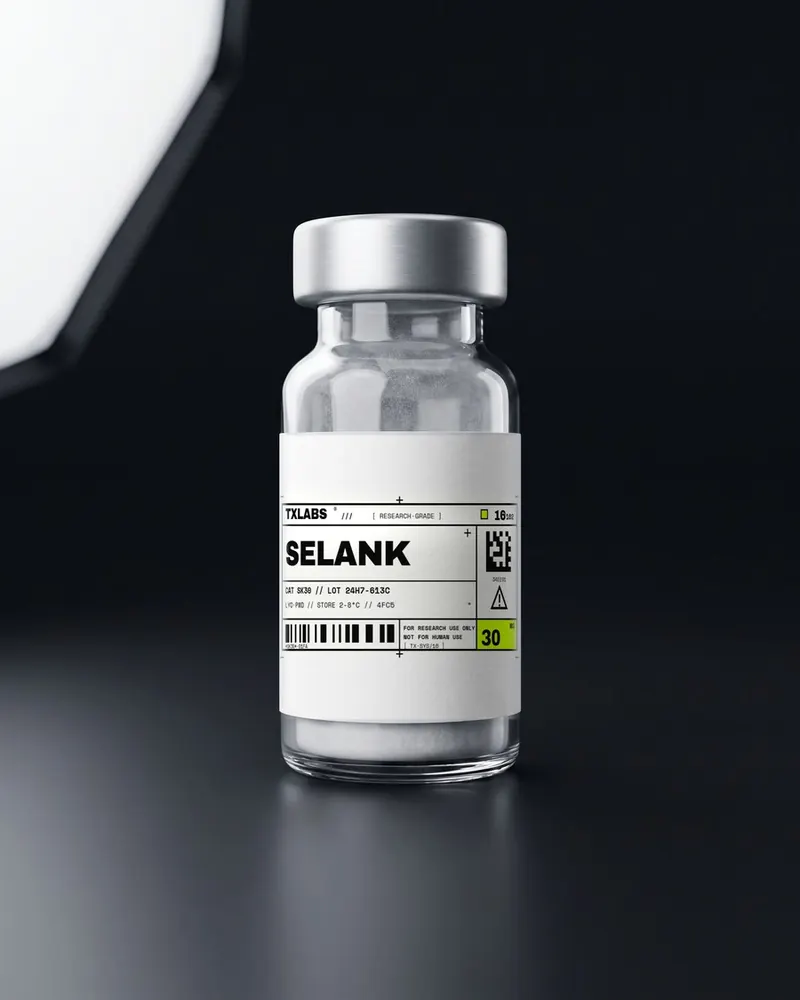
From $59 AUD · ≥98% HPLC purity · third-party COA · ships Australia-wide
What is Selank?
Selank is a synthetic heptapeptide anxiolytic and analogue of the immunomodulatory peptide tuftsin. It has been investigated in preclinical research on GABAergic and serotonergic signalling, brain-derived neurotrophic factor expression, and stress-response modulation. Selank is studied as a reference compound in neuropeptide and behavioural neuroscience models.
Specifications
- From: $59 AUD
- Category: Cognitive & Nootropic
- Form: Lyophilised powder
- Purity: ≥98% HPLC
- Testing: Third-party Certificate of Analysis
- Classification: Research reference material · For Research Use Only
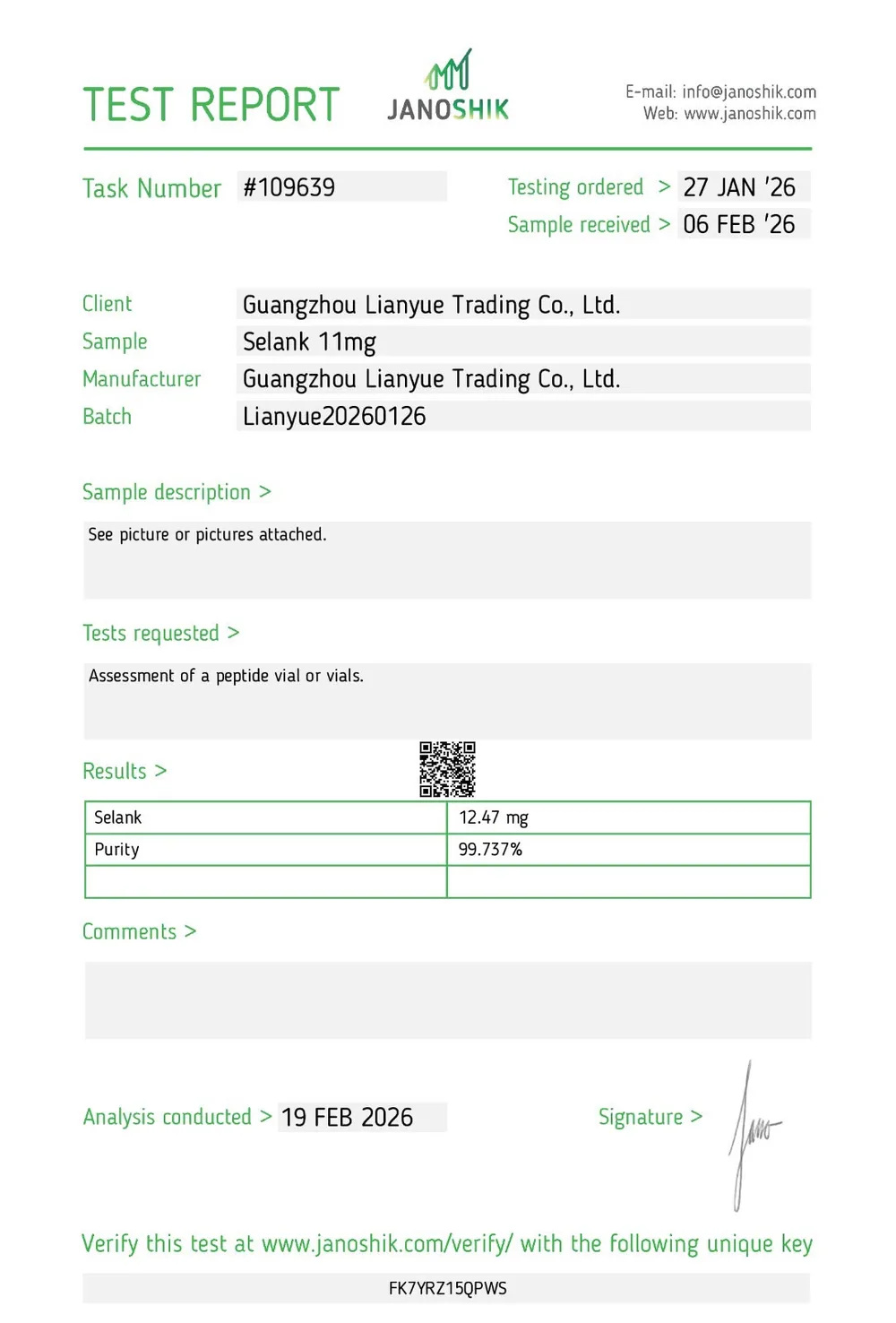 View full report ↗
What the research covers
Selank is a synthetic heptapeptide with the sequence Thr-Lys-Pro-Arg-Pro-Gly-Pro, molecular formula C33H57N11O9 and molecular weight 751.9 Da. Its design is modular and worth understanding: the first four residues, TKPR, are tuftsin, an endogenous tetrapeptide released from the Fc region of immunoglobulin G with a long-standing literature in phagocyte activation. The appended Pro-Gly-Pro tripeptide is a stabilising extension that markedly slows enzymatic degradation of the tuftsin core, a design strategy also used in the related compound Semax. Selank was developed at the Institute of Molecular Genetics of the Russian Academy of Sciences.
Published research on Selank has proceeded along two lines. The first is behavioural pharmacology in rodents, where studies have examined anxiolytic-like endpoints in standard paradigms such as elevated plus maze and open field testing, with comparisons drawn in the literature to benzodiazepine reference compounds. Proposed mechanistic contributions discussed in that work include modulation of GABAergic signalling, effects on monoamine turnover, and changes in expression of brain-derived neurotrophic factor and related genes; gene expression profiling in rodent brain tissue has been reported by the originating groups. The second line concerns the tuftsin heritage: immunomodulatory and interleukin-related endpoints have been examined, reflecting the parent tetrapeptide's documented activity.
As with other compounds from the Russian peptide research tradition, a substantial share of the literature originates from the developing institutes and appears in Russian-language journals, with limited independent replication outside that tradition. Reading the primary sources rather than secondary summaries is advisable.
TXLABS supplies Selank as an analytical reference material for laboratory research only. It is not an approved therapeutic good in Australia and is not supplied for human or veterinary administration.
Reading the certificate
For a proline-rich heptapeptide the informative certificate checks are narrow but real. Proline-containing sequences can present cis-trans amide isomerism, which sometimes shows as peak broadening or shoulder formation on reversed-phase HPLC without indicating a chemical impurity, so a chromatogram is worth reading rather than only the percentage. Confirm identity against 751.9 Da, and confirm the salt form is stated, since counterion and residual water contribute gross weight without contributing peptide, which is why net peptide assay in milligrams is the meaningful figure. TXLABS publishes the Janoshik Analytical report for Selank in the CoA library: an 11 mg sample assaying 12.47 mg at 99.737% purity, and it is one of the reports published with the laboratory task number and verification key intact so it can be checked against Janoshik's own records.
Storage and handling
Selank is chemically well-behaved by the standards of this catalogue. Its seven residues include no cysteine, no methionine, no tryptophan and no aspartate, which removes disulfide chemistry, methionine oxidation, tryptophan photodegradation and aspartimide formation from the list of concerns in one stroke. Three of the seven residues are proline, which constrains the backbone and further limits conformational degradation routes. What remains is conventional: the lyophilised powder is hygroscopic and should be held at -20 °C, desiccated and protected from light, with the vial equilibrated to room temperature before opening so moisture does not condense onto cold glass. Reconstituted in bacteriostatic water it is stored at 2-8 °C, protected from light, with the benzyl alcohol preservative supporting repeated withdrawal from a single vial. Aliquot before freezing rather than cycling. For Australian transit Selank is among the more thermally forgiving items here, tolerating the ambient excursions typical of summer road freight in dry form, though prompt collection and refrigeration on arrival remain best practice.
Working out concentration
Selank is stocked in 10 mg and 30 mg vials, a threefold spread that materially changes the arithmetic. A 10 mg vial reconstituted with 2 mL of bacteriostatic water gives 5 mg/mL; the same 2 mL into a 30 mg vial gives 15 mg/mL. To match concentrations across the two sizes, the 30 mg vial needs 6 mL to reach 5 mg/mL. At 751.9 Da, 5 mg/mL is approximately 6.6 mM, the figure required when a published behavioural or cell-culture method specifies molar rather than mass concentration. The reconstitution calculator resolves any vial and volume combination. These are worked concentration examples only, not a protocol.
How it relates to adjacent compounds
Selank's closest relative in this catalogue is Semax, and the relationship is architectural rather than functional: both were developed in Russian research institutes using the same design strategy of appending a Pro-Gly-Pro tripeptide to a short endogenous fragment to slow enzymatic degradation. Semax builds on an ACTH fragment, Selank on tuftsin, so the cores are entirely different molecules with different parent proteins. DSIP shares the same catalogue category but is a naturally isolated nonapeptide with no confirmed receptor and no design lineage in common. Epithalon comes from the same broad Russian peptide research tradition. Structural and historical relationships only. Reading the two Russian-institute peptides side by side is chiefly useful for understanding a shared synthetic design method, not for inferring anything about how either behaves.