Semax Australia — Batch-Verified Research Peptide
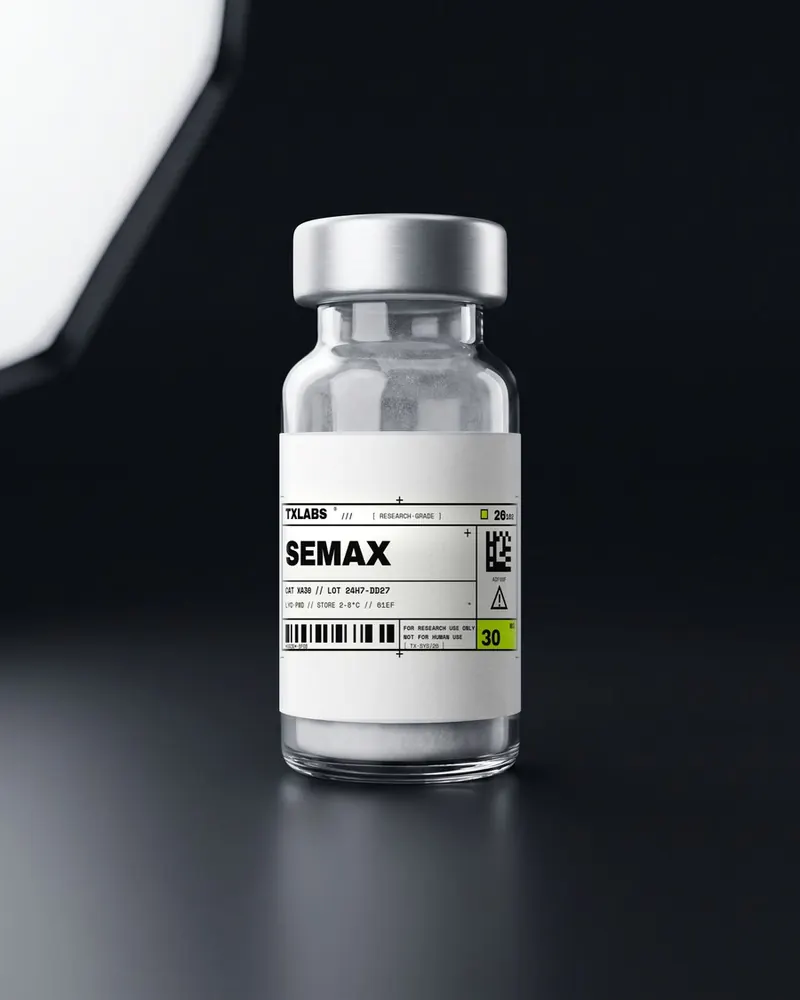
From $59 AUD · ≥98% HPLC purity · third-party COA · ships Australia-wide
What is Semax?
Semax is a synthetic heptapeptide analogue of the ACTH(4-10) fragment with nootropic and neuroprotective research interest. It has been studied in preclinical models of brain-derived neurotrophic factor expression, neuroplasticity, cerebral ischaemia and cognitive function. Semax is a common reference peptide in neuropharmacology research.
Specifications
- From: $59 AUD
- Category: Cognitive & Nootropic
- Form: Lyophilised powder
- Purity: ≥98% HPLC
- Testing: Third-party Certificate of Analysis
- Classification: Research reference material · For Research Use Only
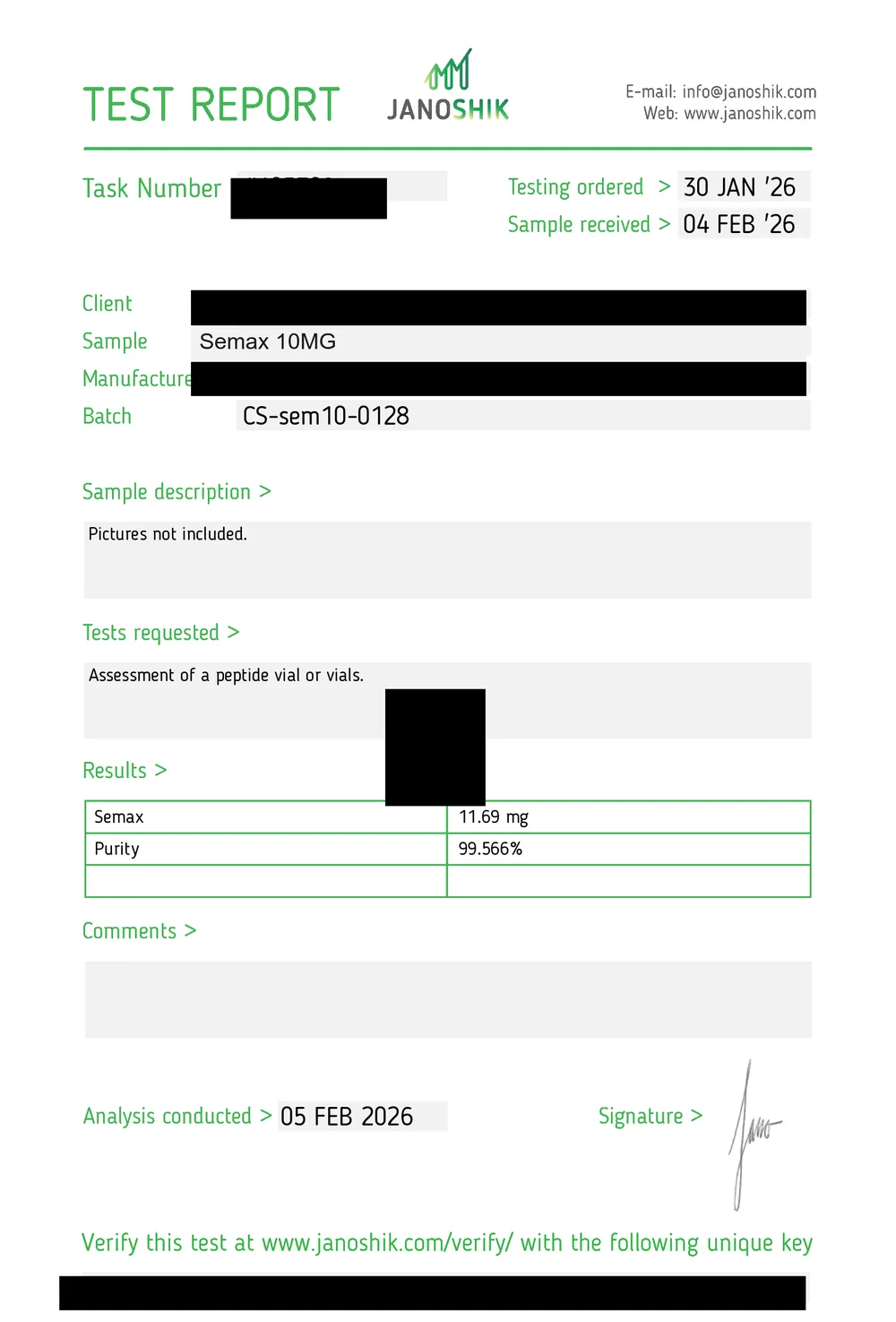 View full report ↗
Report ID and verification key are redacted on our copy of this certificate. Request the unredacted report, or see the full CoA library.
What the research covers
Semax is a synthetic heptapeptide with the sequence Met-Glu-His-Phe-Pro-Gly-Pro, molecular formula C37H51N9O10S and molecular weight 813.9 Da. Its architecture is deliberate: the first four residues, MEHF, correspond to the ACTH(4-7) fragment of adrenocorticotropic hormone, and the appended Pro-Gly-Pro tripeptide is a stabilising extension that greatly slows enzymatic degradation of the short fragment. The same design strategy was applied to tuftsin to produce Selank. Semax was developed at the Institute of Molecular Genetics of the Russian Academy of Sciences. Importantly, the ACTH(4-7) core is a behaviourally studied fragment rather than the corticotropic portion of the parent hormone, so the compound is not described in the literature as a corticosteroid-releasing agent.
The published research spans several areas. Neurotrophic signalling is the most-cited: studies have reported effects on expression of brain-derived neurotrophic factor and nerve growth factor and their receptors in rodent brain tissue and cell culture. Ischaemia and neuroprotection models form a second strand, with rodent middle cerebral artery occlusion and related preparations used to examine infarct volume, neurological scoring and gene expression, and clinical work conducted principally in Russia where the compound has regulatory approval in that jurisdiction. Further work has examined effects on the melanocortin system given the ACTH lineage, on antioxidant and inflammatory gene expression, and on attention and memory endpoints in animal models.
As with other compounds from this research tradition, much of the literature originates from the developing institutes and appears in Russian-language journals, with limited independent replication elsewhere.
TXLABS supplies Semax as an analytical reference material for laboratory research only. It is not an approved therapeutic good in Australia and is not supplied for human or veterinary administration.
Reading the certificate
Methionine sulfoxide is the impurity to look for on a Semax certificate. It appears as an earlier-eluting peak on reversed-phase HPLC and as a plus-sixteen-dalton mass on mass spectrometry, and it is the degradation product that accumulates in poorly stored or air-exposed material rather than a synthesis defect. That makes the test date and the storage history between testing and use as informative as the percentage itself. Confirm identity against 813.9 Da, note that proline-rich sequences can broaden peaks without indicating impurity, and check assay in milligrams against label. TXLABS publishes the Janoshik Analytical report for Semax in the CoA library: batch CS-sem10-0128, tested 5 February 2026, 99.566% purity with a 10 mg sample assaying 11.69 mg.
Storage and handling
Semax carries one clear chemical liability that its sibling Selank does not: an N-terminal methionine. Methionine is readily oxidised to the sulfoxide by dissolved oxygen, and the reaction accelerates with warmth, light and prolonged air exposure, producing a species sixteen daltons heavier than the parent. Handling should therefore limit oxidative exposure: keep the vial open for as short a time as practical, avoid unnecessary headspace air, store solutions cold and dark, and use them within a defined working period rather than indefinitely. The lyophilised cake is held at -20 °C, desiccated and protected from light, and equilibrated to room temperature before opening so condensation does not wet a hygroscopic powder. Reconstituted material is kept at 2-8 °C, shielded from light, and aliquoted before freezing rather than freeze-thaw cycled. For Australian conditions the oxidation risk and the thermal risk compound each other: a parcel held at over 40 °C in a summer letterbox is a worse environment for a methionine-containing peptide, so prompt collection and refrigeration on arrival are worth the effort.
Working out concentration
Semax is stocked in 10 mg and 30 mg vials. A 10 mg vial reconstituted with 2 mL of bacteriostatic water gives 5 mg/mL; with 1 mL, 10 mg/mL. A 30 mg vial with 2 mL gives 15 mg/mL, so matching the smaller vial's 5 mg/mL requires 6 mL. At 813.9 Da, 5 mg/mL corresponds to roughly 6.1 mM. Because the compound is oxidation-sensitive, a practical consideration is choosing a diluent volume matched to the intended working period rather than preparing a large refrigerated stock that will sit for months. The reconstitution calculator handles the arithmetic. Worked concentration examples only, not a protocol.
How it relates to adjacent compounds
Semax and Selank are architectural siblings: both were built at the same Russian institute by appending a Pro-Gly-Pro tripeptide to a short endogenous fragment to confer protease resistance, Semax onto ACTH(4-7) and Selank onto tuftsin. The cores are unrelated molecules from unrelated parent proteins, so the similarity is one of design method only. Through its ACTH lineage Semax has a distant structural connection to the melanocortin compounds in the catalogue, melanotan II and PT-141, which are alpha-MSH analogues; ACTH and alpha-MSH derive from the same proopiomelanocortin precursor. DSIP shares the catalogue category but no lineage. Structural relationships only. The practical difference between Semax and Selank for a laboratory is stability rather than lineage: one carries an oxidation-prone methionine and the other does not.