Ipamorelin Australia — Batch-Verified Research Peptide
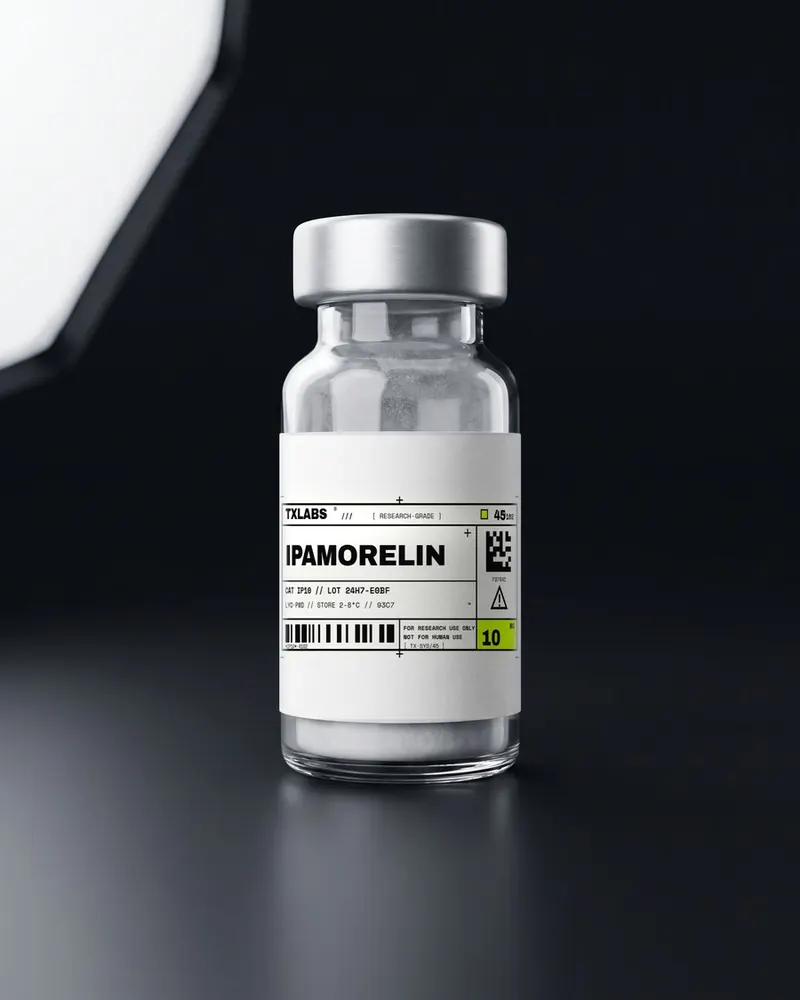
From $89 AUD · ≥98% HPLC purity · third-party COA · ships Australia-wide
What is Ipamorelin?
Ipamorelin is a selective pentapeptide ghrelin receptor (GHS-R) agonist and growth hormone secretagogue that stimulates GH release. It is studied in preclinical research on selective growth hormone secretion with minimal effect on cortisol or prolactin levels.
Specifications
- From: $89 AUD
- Category: GH & Secretagogues
- Form: Lyophilised powder
- Purity: ≥98% HPLC
- Testing: Third-party Certificate of Analysis
- Classification: Research reference material · For Research Use Only
 View full report ↗
What the research covers
Ipamorelin is a synthetic pentapeptide with the sequence Aib-His-D-2-Nal-D-Phe-Lys-NH2, molecular formula C38H49N9O5 and molecular weight 711.9 Da. Three of its five positions are non-proteinogenic or non-natural: alpha-aminoisobutyric acid at the N-terminus, D-2-naphthylalanine and D-phenylalanine, and the C-terminus is amidated. That composition is deliberate and gives the molecule considerable resistance to exopeptidase degradation despite its small size.
Mechanistically, ipamorelin is described in the literature as an agonist at the growth hormone secretagogue receptor type 1a (GHS-R1a), the receptor for ghrelin, expressed in the anterior pituitary and hypothalamus. It was characterised in the late 1990s in work published by researchers at Novo Nordisk, which reported growth hormone release in rat pituitary cell assays and in vivo models. The property emphasised in that literature is selectivity: compared with earlier growth hormone secretagogues such as GHRP-6 and GHRP-2, ipamorelin was reported to stimulate growth hormone release with comparatively little effect on adrenocorticotropic hormone, cortisol or prolactin in the models tested. That selectivity profile is the reason ipamorelin remains a widely used tool compound in GHS-R1a pharmacology.
Subsequent research has used ipamorelin to probe ghrelin receptor signalling, including Gq coupling, beta-arrestin recruitment and the receptor's high constitutive activity, and separately in animal studies of gastrointestinal motility, where GHS-R1a agonism has been examined for prokinetic effects. Its small size, defined stereochemistry and clean receptor profile also make it a common positive control in secretagogue screening assays.
TXLABS supplies ipamorelin as an analytical reference material for laboratory research only. It is not an approved therapeutic good in Australia and is not supplied for human or veterinary administration.
Reading the certificate
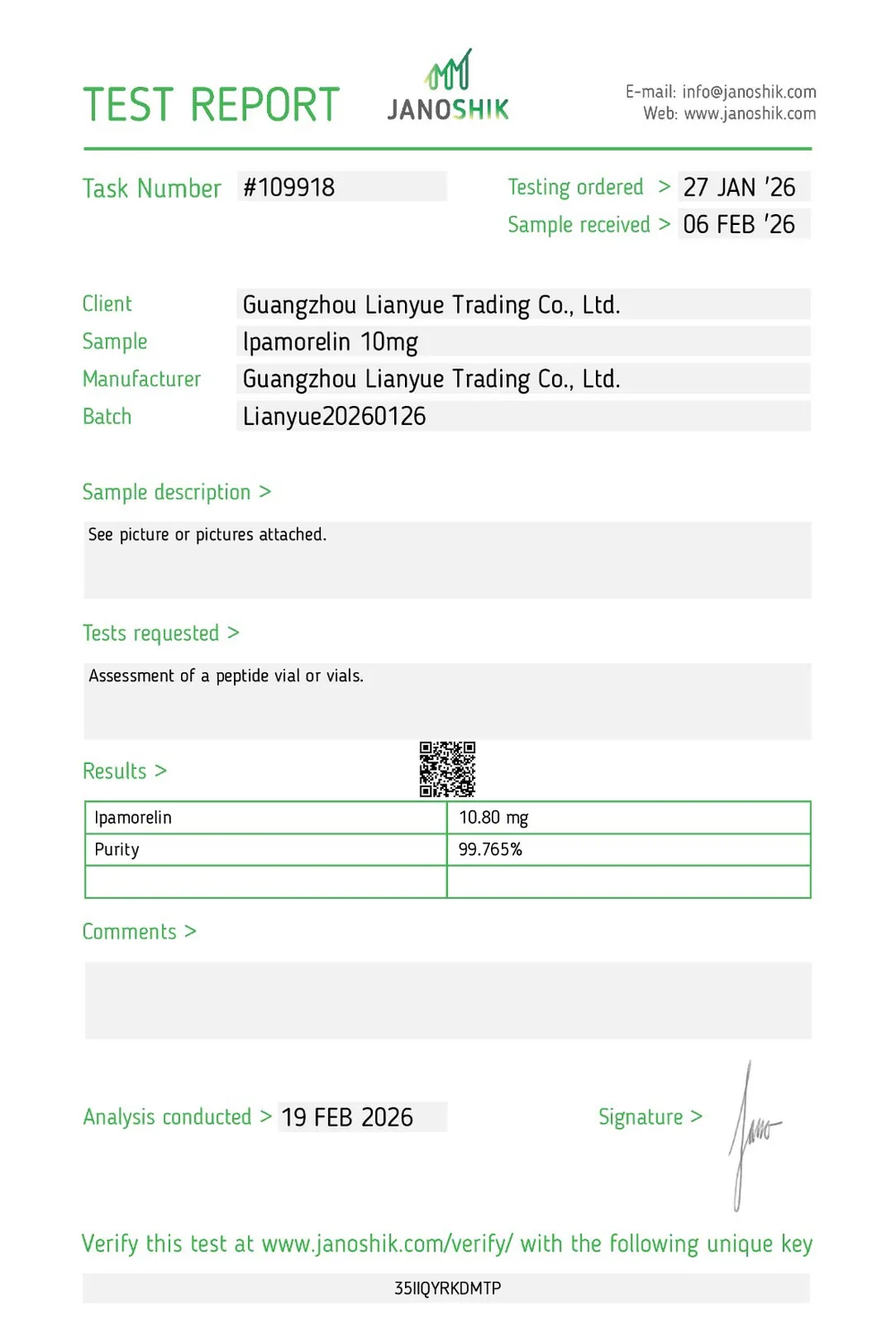
Ipamorelin's unusual composition is what a certificate should reflect. Two residues are D-isomers and one is alpha-aminoisobutyric acid, so the specific risks are stereochemical: D to L epimerisation during synthesis produces diastereomers with near-identical mass that reversed-phase HPLC can resolve but mass spectrometry alone cannot. That makes the chromatographic purity figure genuinely informative here, and a single sharp main peak is the thing to look for. The C-terminal amide should also be reflected in the observed mass. TXLABS publishes the Janoshik Analytical report for ipamorelin in the CoA library: a 10 mg sample assaying 10.80 mg at 99.765% purity. It is one of the reports published with the task number and verification key intact, so it can be confirmed against Janoshik's records.
Storage and handling
Ipamorelin is a short, amidated peptide with no cysteine and no methionine, which makes it comparatively forgiving: it has no free thiol to oxidise and no obvious oxidation-labile residue. The lyophilised powder is nonetheless hygroscopic and is stored at -20 °C, desiccated and protected from light, with 2-8 °C acceptable for short-term working stock. Bring the vial to room temperature before breaking the seal so condensation does not settle on cold glass and wet the cake. Reconstituted in bacteriostatic water, ipamorelin is held at 2-8 °C and protected from light; the benzyl alcohol preservative is what permits repeated withdrawal from the same vial, whereas plain sterile water gives no antimicrobial margin. Freeze-thaw is the main avoidable insult, so aliquot before freezing rather than cycling one container. For Australian conditions, the compact and stable structure gives ipamorelin more thermal tolerance in transit than a 40-residue peptide, but summer letterbox and vehicle temperatures above 40 °C are still worth avoiding: collect the parcel promptly and refrigerate on arrival.
Working out concentration
Concentration is mass divided by volume. The TXLABS ipamorelin vial is 10 mg, so 2 mL of bacteriostatic water yields 5 mg/mL, 1 mL yields 10 mg/mL, and 5 mL yields 2 mg/mL. Because the molecule is only 711.9 Da, molar concentration works out high for a given mass concentration compared with a multi-kilodalton peptide: 5 mg/mL corresponds to roughly 7 mM. Where an assay is specified in molar terms rather than mg/mL, that conversion is the step most often got wrong. The reconstitution calculator handles vial mass and diluent volume. These are worked concentration examples only, not a protocol.
How it relates to adjacent compounds
Ipamorelin is the ghrelin-receptor arm of the growth-hormone-axis group in this catalogue. It is mechanistically distinct from the GHRH analogues tesamorelin and modified GRF(1-29), which bind a different receptor on the same pituitary cell population, and the two receptor systems are studied together precisely because they are separate inputs to the same secretory axis. That pairing is the rationale behind the combination vial CJC-1295 without DAC 5 mg with ipamorelin 5 mg, which contains both compounds in one lyophilised cake. Ipamorelin also sits in the wider secretagogue family alongside GHRP-2 and GHRP-6, from which it differs by its reported receptor selectivity profile. Structural and mechanistic relationships only.