Tesamorelin Australia — Batch-Verified Research Peptide
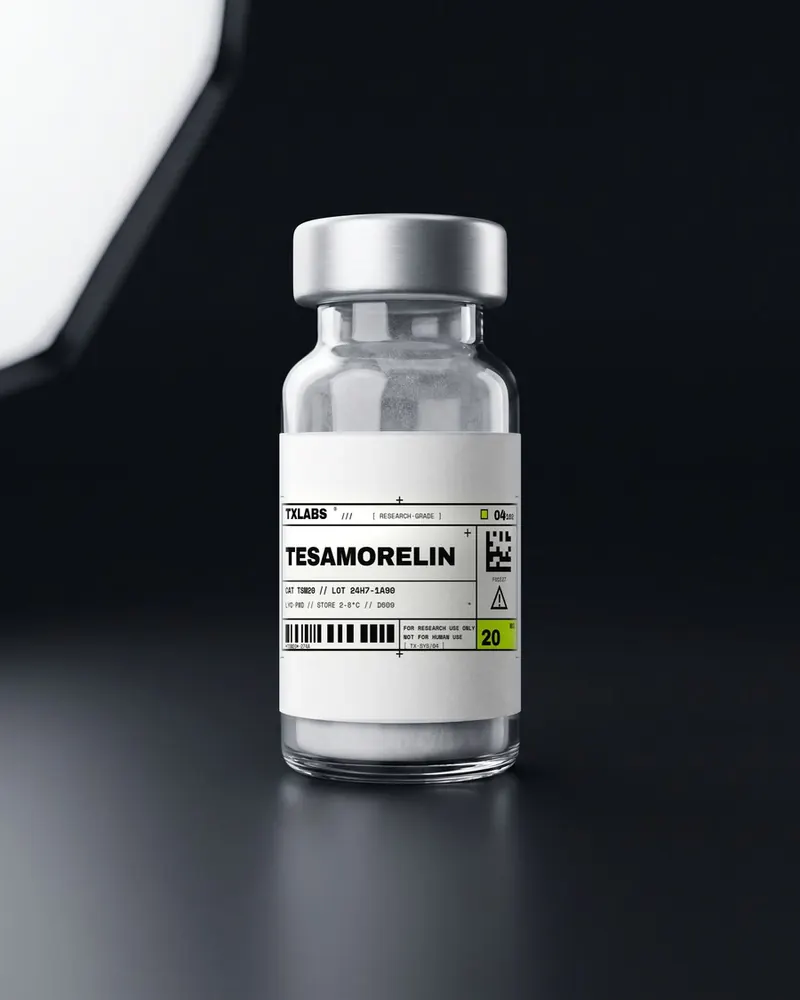
From $229 AUD · ≥98% HPLC purity · third-party COA · ships Australia-wide
What is Tesamorelin?
Tesamorelin (TH9507) is a stabilised growth hormone-releasing hormone (GHRH) analogue that stimulates somatotroph cells of the pituitary. It is studied in preclinical research on the growth hormone and IGF-1 axis and on lipid metabolism.
Specifications
- From: $229 AUD
- Category: GH & Secretagogues
- Form: Lyophilised powder
- Purity: ≥98% HPLC
- Testing: Third-party Certificate of Analysis
- Classification: Research reference material · For Research Use Only
 View full report ↗
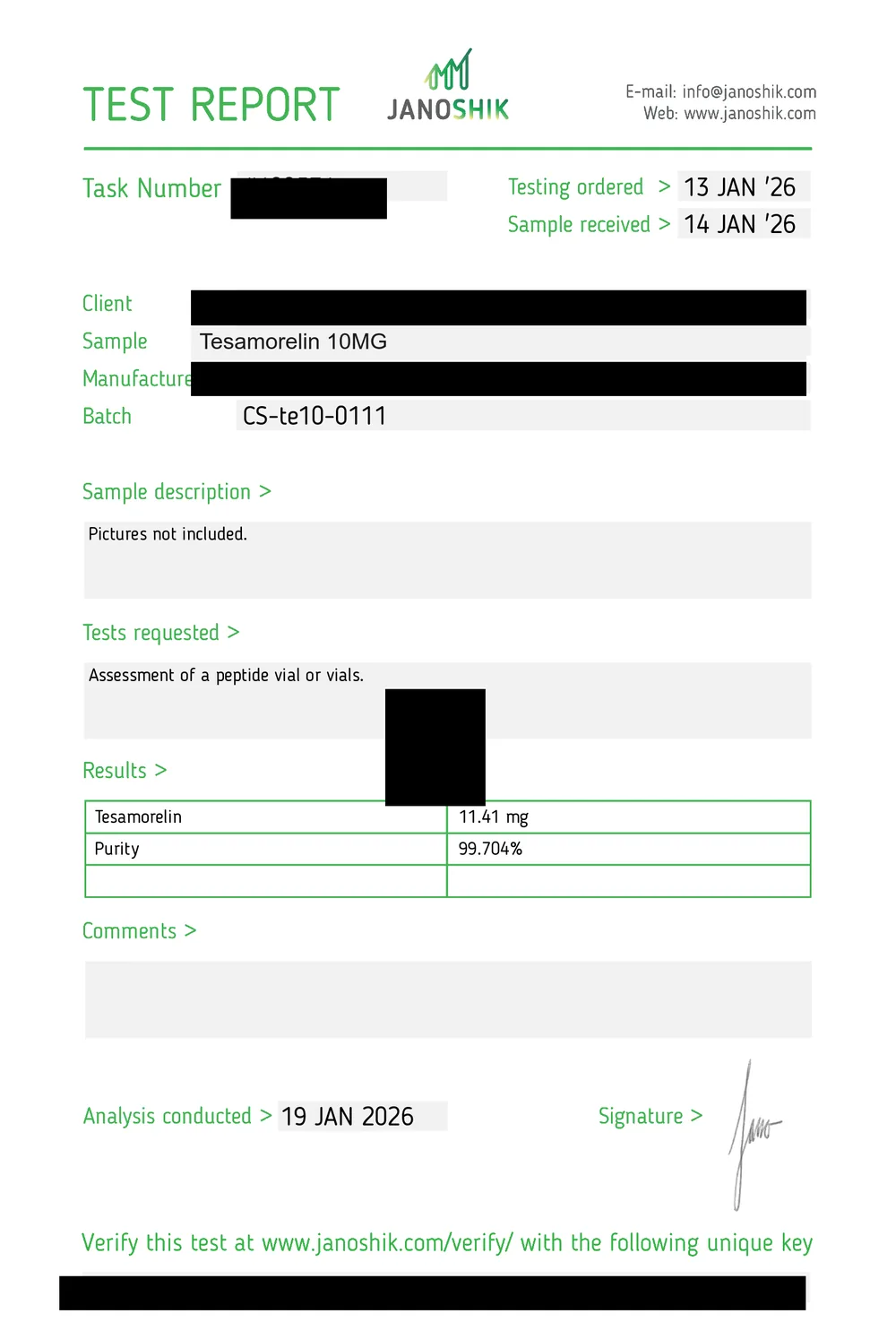
Report ID and verification key are redacted on our copy of this certificate. Request the unredacted report, or see the full CoA library.
What the research covers
Tesamorelin is a synthetic analogue of human growth hormone-releasing hormone (GHRH), constructed on the full 44-residue GHRH(1-44) sequence with a trans-3-hexenoyl group attached to the N-terminal tyrosine. Its molecular formula is C221H366N72O67S and molecular weight approximately 5136 Da, making it one of the larger peptides commonly held as a research reference material. The N-terminal acylation is the functional point of the design: native GHRH is rapidly inactivated by dipeptidyl peptidase-4 cleavage at the N-terminus, and the hexenoyl modification confers substantially greater resistance to that degradation while retaining agonist activity at the GHRH receptor, a class B G-protein-coupled receptor expressed on anterior pituitary somatotrophs.
Mechanistic literature on tesamorelin describes GHRH receptor binding, Gs coupling and cAMP accumulation in pituitary cells, and consequent stimulation of endogenous growth hormone release in a pulsatile pattern rather than the sustained exposure produced by exogenous growth hormone. This distinction, between stimulating a physiological secretory axis and replacing its output, is the reason GHRH analogues are studied separately from growth hormone itself. Clinical research programmes conducted in the 2010s examined tesamorelin in HIV-associated lipodystrophy and reported on visceral adipose tissue measured by imaging, alongside IGF-1 and lipid parameters; the compound is a registered prescription medicine in some jurisdictions on the basis of that work. Later investigator-led studies have examined hepatic fat content and, separately, cognitive endpoints in older adults, in each case with GHRH-axis stimulation as the proposed mechanism.
As a laboratory material, tesamorelin is used in GHRH receptor pharmacology, pituitary cell assays, LC-MS method development and peptide stability work. TXLABS supplies it strictly for those purposes. It is not an approved therapeutic good in Australia and is not supplied for human or veterinary use.
Reading the certificate
Long GHRH analogues carry a characteristic impurity profile worth reading for. Deletion and truncation sequences arising from incomplete coupling during solid-phase synthesis are the main concern at 44 residues, and they can elute close to the parent peak, so mass spectrometric identity confirmation is more important here than for a tetrapeptide. Methionine sulfoxide is the other species to expect if material has been exposed to air in solution. Check that purity is reported by reversed-phase HPLC, that assay in milligrams is stated against label weight, and that the certificate names a batch. TXLABS publishes the Janoshik Analytical report for tesamorelin in the CoA library: batch CS-te10-0111, tested 19 January 2026, 99.704% purity with a 10 mg sample assaying 11.41 mg.
Storage and handling
Tesamorelin is a 44-residue peptide and is meaningfully less robust in solution than the short sequences that dominate this catalogue, so handling discipline matters more. The lyophilised cake is stored at -20 °C, desiccated and protected from light, and reaches room temperature before the vial is opened so that condensation does not wet the powder. It contains a methionine residue and is therefore susceptible to oxidation once in solution; minimise headspace air exposure, keep solutions cold and dark, and avoid leaving reconstituted material at bench temperature. After reconstitution, storage at 2-8 °C is standard and single-use aliquots are preferable to repeated freeze-thaw, since each cycle concentrates solutes at the ice interface and drives aggregation of longer peptides. For Australian conditions, note that tesamorelin's larger size gives it less thermal headroom than a tetrapeptide: a parcel that spends two summer days in a hot delivery vehicle or a sun-facing letterbox is a real risk to a long peptide. Collect promptly, unpack on arrival and refrigerate immediately.
Working out concentration
Concentration follows directly from vial mass and diluent volume. A 10 mg tesamorelin vial reconstituted with 2 mL of bacteriostatic water gives 5 mg/mL; with 1 mL it gives 10 mg/mL; with 5 mL, 2 mg/mL. The 20 mg vial reconstituted with 2 mL gives 10 mg/mL, and with 4 mL, 5 mg/mL. Because tesamorelin is a large peptide that benefits from gentle handling, choosing a diluent volume that avoids repeated small-volume manipulation of the same vial is a practical consideration. The reconstitution calculator handles any vial and volume pairing. These figures are concentration arithmetic only and are not a protocol.
How it relates to adjacent compounds
Tesamorelin is the full-length member of the GHRH-analogue group in this catalogue. CJC-1295 without DAC, also called modified GRF(1-29), is a truncated GHRH(1-29) analogue with four amino acid substitutions rather than an N-terminal acyl group, so both act at the GHRH receptor but arrive at protease resistance by different chemistry. Ipamorelin is mechanistically distinct: a pentapeptide agonist at the ghrelin receptor GHS-R1a, a separate receptor on the same pituitary cells, which is why GHRH analogues and ghrelin-receptor agonists are frequently studied as complementary rather than equivalent tools. These are receptor and structure relationships only. Tesamorelin is also the largest peptide in the growth-hormone group at roughly 5.1 kDa, which is why its storage and reconstitution notes are stricter than those of its shorter catalogue neighbours.