Hexarelin Acetate Australia — GHS-R1a Reference Peptide
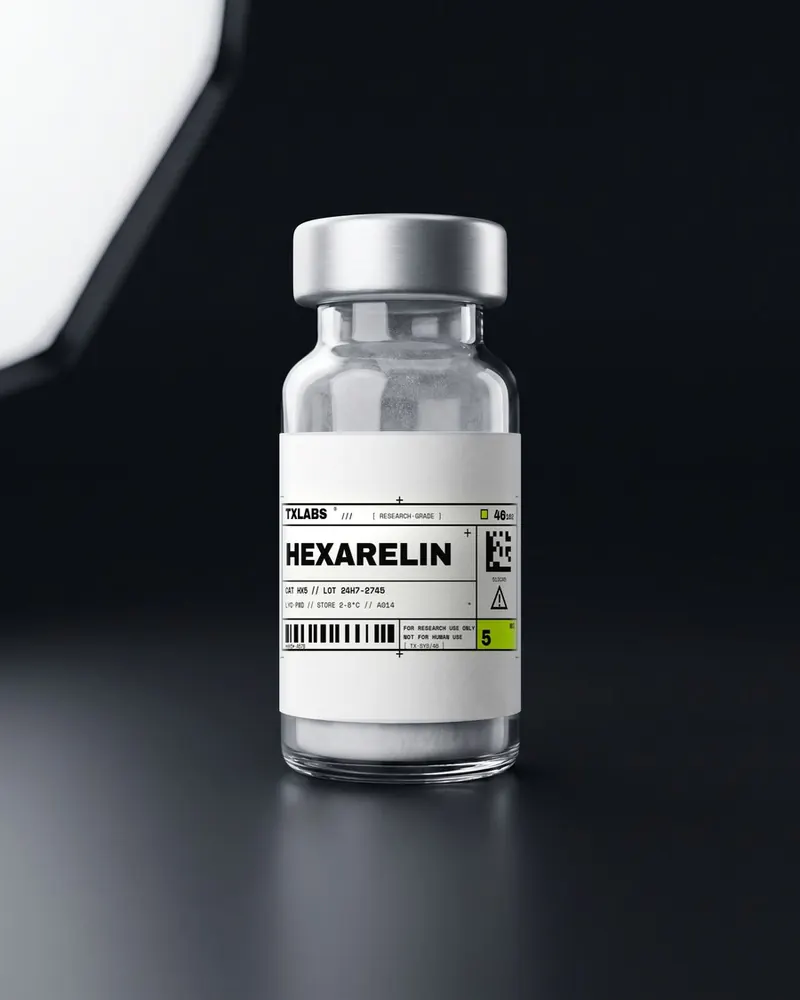
From $69 AUD · ≥98% HPLC purity · third-party COA · ships Australia-wide
What is Hexarelin Acetate?
Hexarelin Acetate (Examorelin) is a synthetic growth hormone secretagogue peptide that activates the ghrelin/GHS-R receptor. This hexapeptide is studied in laboratory research on growth hormone release, cardiac tissue, and GHS-R signalling pathways.
Specifications
- From: $69 AUD
- Category: GH & Secretagogues
- Form: Lyophilised powder
- Purity: ≥98% HPLC
- Testing: Third-party Certificate of Analysis
- Classification: Research reference material · For Research Use Only
What the research covers
Hexarelin is a synthetic hexapeptide growth hormone secretagogue and, despite frequently appearing next to GHRH analogues in supplier catalogues, it is not a GHRH analogue at all. PubChem lists the formula C47H58N12O6 and a molecular weight of 887.0 Da. Its sequence is a C-terminally amidated hexapeptide built around a 2-methyl-tryptophan residue with D-isomer substitutions, placing it structurally in the growth hormone-releasing peptide family alongside GHRP-2 and GHRP-6 rather than in the GHRH lineage. Its principal characterised target is the growth hormone secretagogue receptor type 1a, GHS-R1a, the receptor for ghrelin, expressed in the anterior pituitary and hypothalamus.
What makes hexarelin distinctive in the research literature is a second binding partner. Published work has reported that hexarelin also binds CD36, a scavenger receptor expressed on macrophages, endothelium and cardiac tissue that is unrelated to GHS-R1a. That has generated a separate cardiovascular research literature examining hexarelin in cardiac and vascular models, in which the proposed mechanism is CD36-mediated rather than growth hormone-mediated. Whether the two receptor interactions can be cleanly separated in a whole-animal setting is not settled, but the CD36 finding is the reason hexarelin appears in cardiovascular papers where other secretagogues do not.
The growth hormone secretagogue literature more broadly has used hexarelin in pituitary cell assays, in studies of GHS-R1a signalling and receptor desensitisation on repeated exposure, and as a comparator against the more receptor-selective ipamorelin. Reported effects on adrenocorticotropic hormone, cortisol and prolactin in the models tested are a recurring theme in that comparative work.
TXLABS supplies hexarelin acetate as an analytical reference material for laboratory research only. It is not an approved therapeutic good in Australia and is not supplied for human or veterinary administration.
Reading the certificate
Hexarelin's composition sets the checks. It contains D-isomer residues, so epimerisation during synthesis produces diastereomers of identical mass that mass spectrometry cannot distinguish and only reversed-phase HPLC will resolve, which makes a single sharp main peak genuinely informative here. It contains a non-natural 2-methyl-tryptophan, so the observed mass should be confirmed against 887.0 Da rather than assumed from the sequence letters. Oxidised tryptophan, sixteen daltons heavier, is the expected acquired impurity. The C-terminal amide should also be reflected in the mass, and the acetate counterion means net peptide assay is the figure to read. TXLABS publishes third-party certificates for tested lots in the CoA library; none is currently published for hexarelin. The lot certificate is available on request to support@txlabs.bio.
Storage and handling
Hexarelin is short, amidated and structurally compact, which makes it comparatively forgiving in storage. Its one clear chemical liability is aromatic: the 2-methyl-tryptophan and the phenylalanine residues make the molecule photosensitive and susceptible to oxidation of the indole ring, so light protection is a chemical requirement rather than a formality. Store the lyophilised acetate at -20 °C, desiccated and in light-protected packaging, and equilibrate the vial to room temperature before opening so condensation does not wet a hygroscopic cake. Reconstituted solution is held at 2-8 °C, shielded from light, and aliquoted before freezing rather than cycled. Australian conditions compound the light problem specifically: intense ambient light and summer transit temperatures above 40 °C both accelerate tryptophan degradation, and the outer carton is the only light barrier a parcel has. Collect promptly, unpack indoors and refrigerate on arrival rather than leaving a package in sun.
Working out concentration
Hexarelin is stocked in a 5 mg vial, the smallest in the TXLABS catalogue, so the arithmetic runs lower than for the 10 mg vials that dominate the range. Reconstituted with 1 mL of bacteriostatic water it gives 5 mg/mL; with 2 mL, 2.5 mg/mL; with 5 mL, 1 mg/mL. At 887.0 Da the molar concentrations are correspondingly high for a given mass: 5 mg/mL is approximately 5.6 mM. That conversion is where errors usually creep in, because published GHS-R1a pharmacology is normally specified in nanomolar terms and requires a long dilution series. The reconstitution calculator handles vial mass and volume. Concentration examples only, not a protocol.
How it relates to adjacent compounds
Hexarelin belongs with the ghrelin receptor agonists rather than the GHRH analogues. GHRP-6 is its closest structural relative, a hexapeptide of similar mass differing in sequence, and GHRP-2 is the shorter-sequence member of the same family. Ipamorelin is the pentapeptide in this group most often used as the selectivity benchmark against which the older secretagogues are compared. The GHRH analogues such as sermorelin act at a different receptor on the same pituitary cells, which is why the two families are studied as separate inputs. Its 5 mg vial also sets it apart practically, since every other compound in this receptor group is supplied at 10 mg and the reconstitution arithmetic does not carry across. Structural and receptor relationships only.