HGH 191AA Australia — Somatropin Reference Material
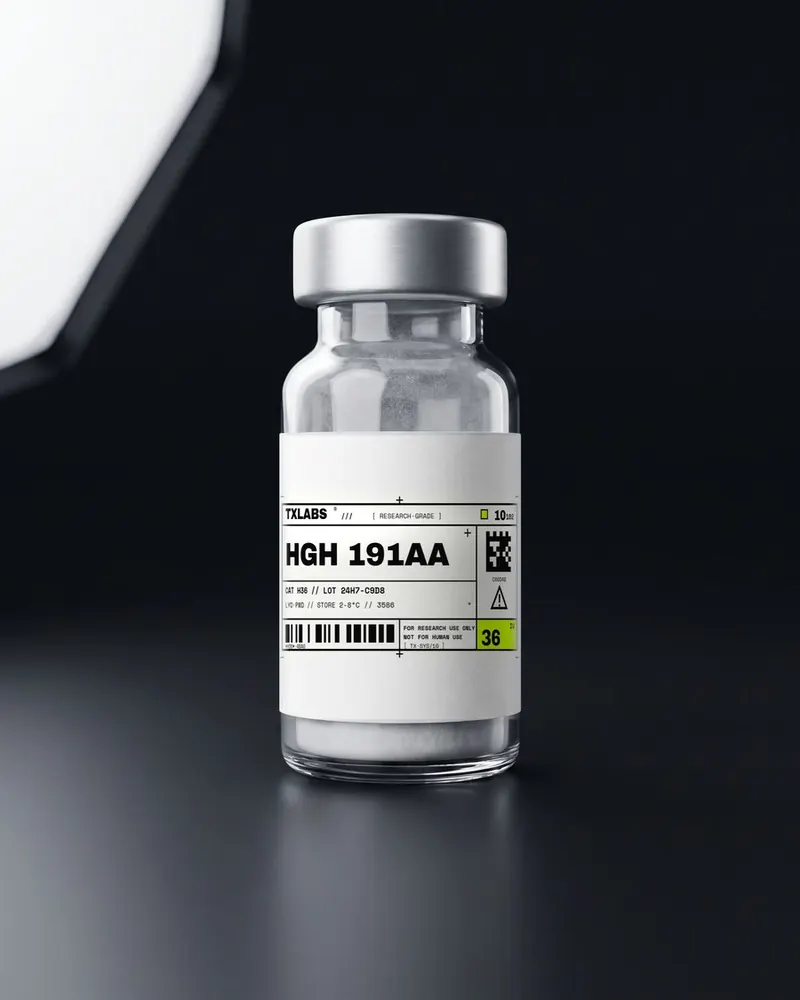
From $269 AUD · ≥98% HPLC purity · third-party COA · ships Australia-wide
What is HGH 191AA(Somatropin)?
HGH 191AA (somatropin, recombinant human growth hormone) is a 191-amino-acid polypeptide identical in sequence to endogenous growth hormone. It is used as a reference material in research on the GH and IGF-1 axis, protein synthesis and cellular growth.
Specifications
- From: $269 AUD
- Category: GH & Secretagogues
- Form: Lyophilised powder
- Purity: ≥98% HPLC
- Testing: Third-party Certificate of Analysis
- Classification: Research reference material · For Research Use Only
What the research covers
Somatropin is a prescription-only medicine in Australia and a registered prescription medicine, and its supply, possession and importation are subject to controls that are actively enforced. TXLABS supplies this material strictly as an analytical reference material for laboratory work. It is not supplied for human or veterinary administration, and this page describes the molecule and its analytical context only. No clinical indication and no effect in humans is described.
Somatropin is recombinant human growth hormone with the authentic human sequence. The mature protein, encoded by GH1 and catalogued in UniProt as P01241, is 191 amino acid residues long with a molecular weight of approximately 22 kDa, and carries two intramolecular disulfide bridges, a large one linking distant parts of the chain and a small one near the C-terminus. It folds as a four-helix bundle in the up-up-down-down topology characteristic of the class 1 helical cytokine family. It is not glycosylated, which is a significant analytical simplification relative to the glycoprotein hormones stocked elsewhere in this catalogue.
The 191AA designation is a historical marker with real meaning. The earliest recombinant growth hormone products carried an additional N-terminal methionine residue left over from bacterial expression, giving a 192-residue methionyl form that is immunologically and chromatographically distinguishable from the natural sequence. Material described as 191AA is asserting the authentic 191-residue sequence without that extra residue. Whether a given lot actually has it is an analytical question, not a labelling one.
The relevant published work is largely methodological. Growth hormone is a long-established immunoassay calibrator and a subject of extensive standardisation effort, since immunoassays for it historically disagreed with one another; it is also central to anti-doping analysis, where isoform ratio methods distinguish the single recombinant 22 kDa species from the mixture of naturally occurring pituitary isoforms. Characterised reference material is a prerequisite for both.
TXLABS supplies somatropin as an analytical reference material for laboratory research only. It is a prescription medicine in Australia, it is not supplied for human or veterinary administration, and it is not offered for any therapeutic purpose.
Reading the certificate
For a 191-residue recombinant protein the certificate should address identity, higher order structure and process impurities separately. Intact mass near 22 kDa confirms very little on its own: the 192-residue methionyl variant differs by roughly 131 daltons, which is a small proportional difference, and deamidated forms differ by about one dalton. Peptide mapping after enzymatic digestion is what establishes the sequence and confirms the absence of the extra N-terminal methionine. Ask for aggregate and dimer content by size exclusion chromatography, since aggregation is the main physical failure mode; for charge variant analysis, which reports deamidation; and for host cell protein and residual DNA, which are recombinant process impurities that a synthetic peptide certificate never has to consider. TXLABS publishes third-party certificates for tested lots in the CoA library; no certificate is currently published for somatropin. The lot certificate is available on request to support@txlabs.bio.
Storage and handling
The two disulfide bridges and the helical fold are what have to be preserved, and both are vulnerable to physical rather than chemical insult. Growth hormone aggregates readily at air-liquid interfaces, so shaking, vortexing or forcing diluent into the cake produces irreversible aggregate that no visual inspection will reveal. Deamidation at asparagine residues and oxidation at methionine are the principal covalent degradation routes in solution, and both generate species that are chromatographically resolvable and near-isobaric or plus-sixteen in mass respectively. Disulfide scrambling under alkaline conditions produces misfolded forms with the same mass as the parent.
Store the lyophilised protein frozen, desiccated and protected from light, and equilibrate the sealed vial to room temperature before opening so that condensation does not wet a hygroscopic cake. Reconstitute by directing diluent slowly down the vial wall and allowing the cake to dissolve without agitation. Hold solutions at 2-8 C and aliquot rather than freeze and thaw. Australian summer freight regularly exceeds 40 C in unrefrigerated transit, which for a 22 kDa protein means aggregation risk rather than simple potency loss, so prompt collection and refrigeration matter.
Working out concentration
Somatropin is presented in international units. TXLABS stocks 24 IU and 36 IU vials. For recombinant somatropin the accepted conversion is approximately 3 IU per milligram of protein, so a 24 IU vial corresponds to roughly 8 mg and a 36 IU vial to roughly 12 mg. On that basis a 24 IU vial taken into 2 mL gives 12 IU/mL, equivalently about 4 mg/mL; into 1 mL, 24 IU/mL or about 8 mg/mL. A 36 IU vial into 3 mL gives 12 IU/mL, again about 4 mg/mL. Note that the two vial sizes at the same diluent volume do not give the same concentration. The reconstitution calculator handles the conversions. Concentration arithmetic only, not a protocol.
How it relates to adjacent compounds
Somatropin sits at the head of the growth hormone group in this catalogue, and the relationship to its neighbours is one of position in a signalling axis rather than of similarity. Sermorelin, tesamorelin and ipamorelin are short synthetic peptides acting at receptors upstream of pituitary secretion, and they are entirely different materials analytically: small, fully defined, characterised by HPLC and mass spectrometry, with no aggregation or host cell protein questions to answer. IGF-1 LR3 sits downstream in the same axis and is a recombinant protein like somatropin, sharing its aggregation and expression-system concerns. Naming these as neighbours describes catalogue structure and endocrine topology only, and says nothing about comparable activity or interchangeable use.