HGH Fragment 176-191 Australia — C-Terminal hGH Peptide
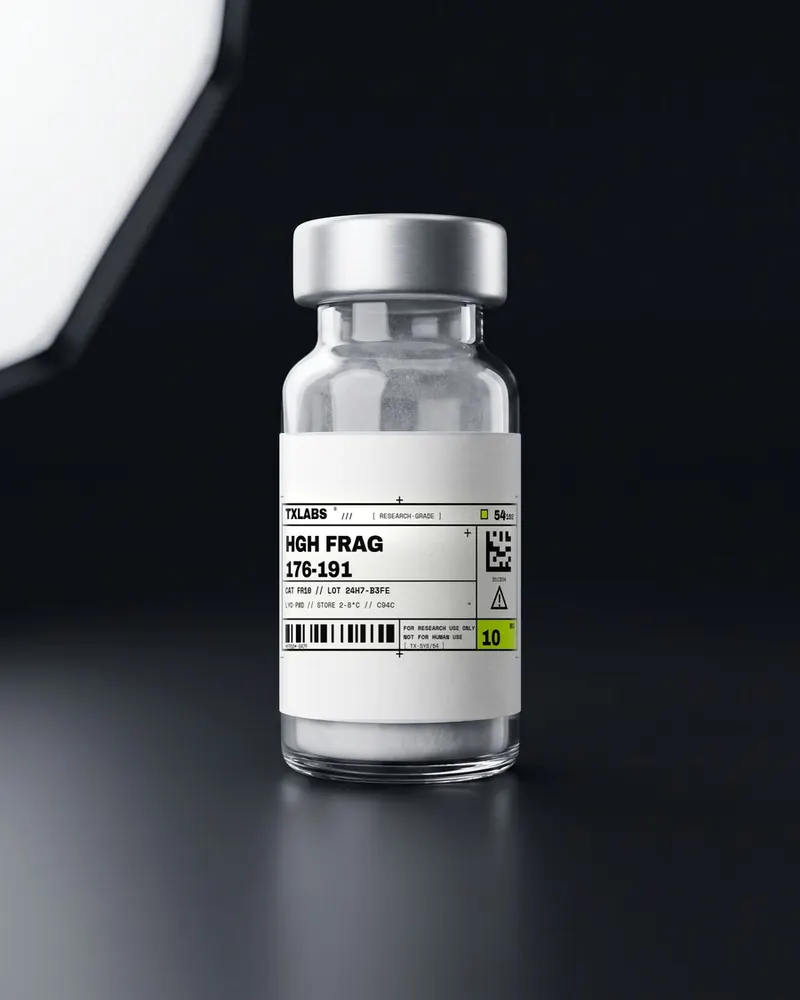
From $369 AUD · ≥98% HPLC purity · third-party COA · ships Australia-wide
What is HGH Fragment 176-191?
HGH Fragment 176-191 is a synthetic C-terminal fragment of human growth hormone studied for its lipolytic activity. This modified peptide is investigated in preclinical research on lipid metabolism, adipose tissue, and fat oxidation pathways.
Specifications
- From: $369 AUD
- Category: GH & Secretagogues
- Form: Lyophilised powder
- Purity: ≥98% HPLC
- Testing: Third-party Certificate of Analysis
- Classification: Research reference material · For Research Use Only
What the research covers
HGH fragment 176-191 is named for a region of the mature human growth hormone sequence, and the naming deserves scrutiny because it is the source of a persistent and genuine confusion in this corner of the peptide market.
In the mature human growth hormone chain, catalogued in UniProt as P01241, residue 176 is phenylalanine and residue 177 is leucine, so the true native 176-191 fragment is the sixteen-residue sequence beginning FLRIVQ, with a calculated mass near 1799 Da in its disulfide-closed form. What is supplied commercially under this name, however, is in practice most often the tyrosine-leading sequence beginning YLRIVQ, in which a tyrosine has been appended to the fifteen-residue hGH(177-191) fragment as a radioiodination handle. That sequence is the same one designated AOD9604, and it corresponds to 1815.1 Da in the disulfide-closed form and approximately 1817 Da when reduced. The frequently quoted figure of 1817 Da for HGH fragment 176-191 therefore describes the tyrosine-leading, free-thiol form rather than a native fragment. The only way to know which molecule is in a particular vial is the observed mass on its certificate.
The fragment retains the cysteines at mature positions 182 and 189, which form a small intramolecular disulfide loop, and that loop accounts for a two-dalton difference between the closed and reduced species.
Research on this region of growth hormone concerns lipid metabolism in adipose tissue models and the hypothesis that its activity is separable from the growth-promoting, IGF-1-mediated actions of the intact hormone. No distinct receptor has been established for the fragment, and the mechanistic literature is incomplete. Most published work is preclinical.
TXLABS supplies this material as an analytical reference material for laboratory research only. It is not an approved therapeutic good in Australia and is not supplied for human or veterinary administration.
Reading the certificate
The observed mass is the only thing that identifies what is in the vial, and the differences are small enough that method resolution matters. Three closely spaced species are in play: the tyrosine-leading sequence with a closed disulfide at 1815.1 Da, the same sequence reduced at approximately 1817 Da, and a true native phenylalanine-leading 176-191 fragment about sixteen daltons lighter again. A purity percentage distinguishes none of them. Ask what mass was observed, whether the disulfide state is reported, and how the analyte is named, since mislabelling between this product and AOD9604 is a documented supply-chain issue rather than a theoretical one. TXLABS publishes third-party certificates for tested lots in the CoA library; none is currently published for this fragment. The lot certificate is available on request to support@txlabs.bio.
Storage and handling
This fragment's chemistry is dominated by its two cysteines and the disulfide loop they form. Disulfides are labile at alkaline pH and in the presence of reducing agents, and free thiols released by reduction can re-pair incorrectly or form intermolecular dimers, none of which is visible in the vial. Keep reducing agents out of the diluent, avoid alkaline conditions unless a method requires them, and do not store solutions for extended periods where slow scrambling can occur. The aromatic residues benefit from light protection. Store the lyophilised material at -20 °C, desiccated and protected from light, and bring the vial to room temperature before opening so condensation does not wet a hygroscopic cake. Hold reconstituted solution at 2-8 °C in the dark and aliquot before freezing rather than cycling. Australian summer transit above 40 °C accelerates disulfide exchange as well as ordinary hydrolysis, so prompt collection and immediate refrigeration are worthwhile.
Working out concentration
The TXLABS vial is 10 mg. Reconstituted with 2 mL of bacteriostatic water it gives 5 mg/mL; with 1 mL, 10 mg/mL; with 4 mL, 2.5 mg/mL. Molar conversion depends on which species the vial actually contains: at approximately 1815 Da a 5 mg/mL solution is about 2.8 mM, and the figure changes only marginally for the reduced or native-sequence forms, since all sit within about sixteen daltons of each other. That closeness is convenient for arithmetic and inconvenient for identification, which is the recurring theme with this compound. The reconstitution calculator resolves vial mass against volume. Concentration examples only, not a protocol.
How it relates to adjacent compounds
AOD9604 is the compound this product is most closely related to, and depending on which sequence a given lot contains the two may be the same molecule or differ by a single N-terminal residue; the mass on the certificate settles it. Somatropin is the intact 191-residue parent hormone from which this region is drawn, and the difference between a sixteen-residue fragment and the folded parent protein is more than a matter of size. Tesamorelin acts on the pituitary rather than being a piece of the hormone. The two fragment entries are written to be read together, since neither product name resolves the identity question on its own. Structural and lineage relationships only.