ACE-031 Australia — ACVR2B-Fc Fusion Protein Standard
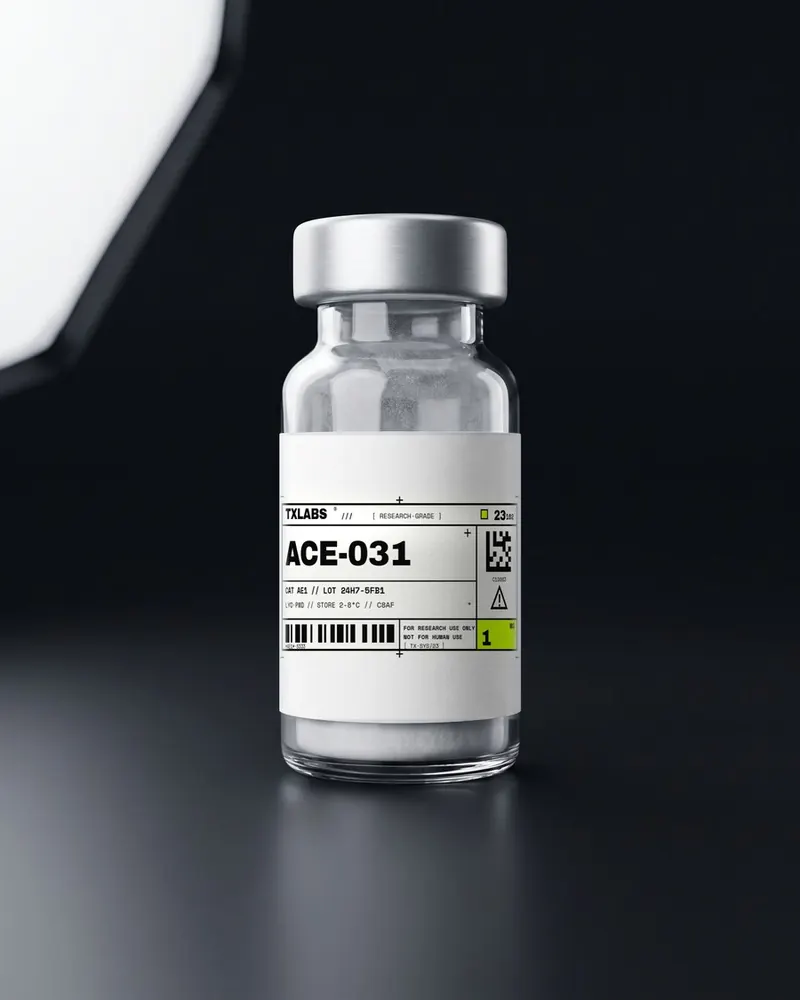
From $149 AUD · ≥98% HPLC purity · third-party COA · ships Australia-wide
What is ACE-031?
ACE-031 (RAP-031) is a soluble activin receptor type IIB (ActRIIB-Fc) fusion protein that acts as a myostatin and activin decoy receptor. It has been investigated in preclinical research on the myostatin-ActRIIB-SMAD pathway, skeletal-muscle mass regulation and TGF-beta superfamily signalling. ACE-031 is a reference protein in muscle-biology studies.
Specifications
- From: $149 AUD
- Category: GH & Secretagogues
- Form: Lyophilised powder
- Purity: ≥98% HPLC
- Testing: Third-party Certificate of Analysis
- Classification: Research reference material · For Research Use Only
What the research covers
ACE-031 is not a peptide. It is a recombinant fusion protein consisting of the extracellular ligand-binding domain of human activin receptor type IIB, encoded by ACVR2B, joined to the Fc region of human immunoglobulin G1. The Fc portion drives dimerisation through the hinge disulfides, so the assembled molecule is a disulfide-linked homodimeric glycoprotein of roughly a hundred kilodaltons, far larger than anything else stocked in this catalogue apart from the controlled protein toxin. It was developed by Acceleron Pharma and is also referred to in the literature as ramatercept.
The design rationale published for molecules of this class is ligand trapping. The activin receptor type IIB extracellular domain binds several members of the transforming growth factor beta superfamily, including myostatin, activin A, activin B and growth differentiation factor 11, and a soluble version of that domain acts as a decoy that sequesters those ligands before they can engage cell-surface receptors. Preclinical work in rodents examined that mechanism in muscle models, and the broader activin receptor trap literature is a substantial and active field.
The clinical history is relevant context and is a matter of public record. ACE-031 entered clinical development and the sponsor discontinued the programme; trials were halted in 2011 and development was permanently discontinued in 2013. The published explanation relates to the breadth of the ligand trap, since the same extracellular domain also engages bone morphogenetic proteins 9 and 10, which have roles in vascular biology. That breadth of binding is the central scientific fact about the molecule and it is why it remains of interest as a research reagent for probing superfamily ligand biology.
The molecule has therefore never been an approved medicine anywhere, and no human use of any kind is described or implied here.
TXLABS supplies ACE-031 as an analytical reference material for laboratory research only. It is not an approved therapeutic good in Australia and is not supplied for human or veterinary administration.
Reading the certificate
A reversed-phase HPLC purity percentage is the wrong instrument for a hundred kilodalton Fc fusion, and a certificate offering only that figure has not characterised the material. The questions that matter are structural. Size exclusion chromatography reports monomer, dimer and aggregate content, and for an Fc fusion the correctly assembled disulfide-linked dimer is the product, so the SEC profile is close to being the identity test. SDS-PAGE run under both reducing and non-reducing conditions confirms that the chains are covalently linked and gives an apparent size. Glycan profiling matters because the receptor domain is glycosylated and glycosylation varies with the expression system. Host cell protein, residual DNA and endotoxin are the process impurities to ask about. TXLABS publishes third-party certificates for tested lots in the CoA library; no certificate is currently published for ACE-031. The lot certificate is available on request to support@txlabs.bio.
Storage and handling
Everything about handling this material follows from it being a large glycosylated Fc-fusion dimer rather than a peptide. The dominant failure mode is aggregation, driven by interfacial stress at air-liquid boundaries and by shear. Shaking or vortexing a vial of an Fc fusion is an error with real consequences: the aggregates are irreversible, they are invisible without size exclusion chromatography or light scattering, and they change what the material does in an assay. Repeated freezing and thawing produces the same result more slowly. The hinge disulfides that hold the dimer together can be reduced by thiol contamination, giving monomer that is present by mass but not by function.
Store the lyophilised protein frozen at -20 C or colder, desiccated and protected from light, and equilibrate the sealed vial to room temperature before opening. Reconstitute by directing diluent slowly down the vial wall and leaving the cake to dissolve without agitation. Hold solutions at 2-8 C, aliquot into single-use volumes and avoid freeze-thaw where possible. At 1 mg the vial holds very little protein, so surface adsorption is proportionally significant. Australian summer transit above 40 C is a genuine aggregation risk, so collect promptly and refrigerate.
Working out concentration
The TXLABS ACE-031 vial is 1 mg, the smallest peptide-or-protein mass in this catalogue by an order of magnitude, which changes the arithmetic. One milligram taken into 1 mL gives 1 mg/mL; into 2 mL, 0.5 mg/mL; into 5 mL, 0.2 mg/mL. Because the assembled dimer is on the order of a hundred kilodaltons, the molar concentrations are correspondingly low: 1 mg/mL is roughly ten micromolar, against millimolar figures for a short peptide at the same mass concentration. Proteins at these dilutions also lose a non-trivial fraction to container surfaces, so carrier protein is often added for that reason. The reconstitution calculator resolves vial mass against volume. Concentration arithmetic only, not a protocol.
How it relates to adjacent compounds
ACE-031 is catalogued alongside the growth hormone and secretagogue group, but analytically it belongs with the recombinant proteins rather than the peptides. IGF-1 LR3 is the nearest relative in that respect, a recombinant protein whose certificate has to address aggregation, expression system and process impurities in the same way. Somatropin raises the same set of questions at 22 kDa. By contrast MGF and PEG-MGF sit in the same catalogue group but are short synthetic peptides characterised entirely differently. The instructive point is that catalogue grouping follows subject matter while analytical requirements follow molecular class, and the two do not coincide. These are structural adjacencies only, and imply nothing about comparable activity or interchangeable use.