MGF Australia — IGF-1Ec E-Domain Peptide Reference Material
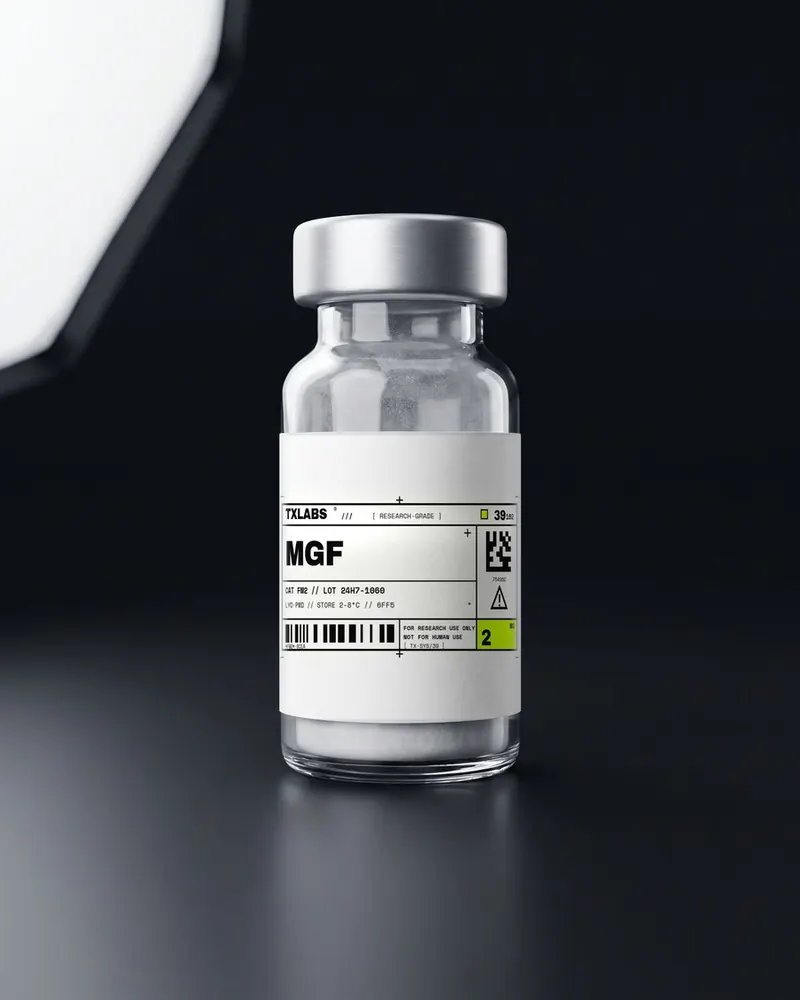
From $49 AUD · ≥98% HPLC purity · third-party COA · ships Australia-wide
What is MGF?
MGF (Mechano Growth Factor, IGF-1Ec) is a splice variant of insulin-like growth factor 1 expressed in response to mechanical loading of muscle. It is studied in preclinical research on satellite cell activation, myogenesis and skeletal muscle repair.
Specifications
- From: $49 AUD
- Category: GH & Secretagogues
- Form: Lyophilised powder
- Purity: ≥98% HPLC
- Testing: Third-party Certificate of Analysis
- Classification: Research reference material · For Research Use Only
What the research covers
MGF, mechano growth factor, is a short synthetic peptide corresponding to the C-terminal E-domain of the IGF-1Ec splice variant. The relationship to IGF-1 is one of alternative splicing rather than proteolytic fragmentation, and the distinction matters: IGF-1Ec is a transcript variant of the IGF1 gene in which alternative splicing produces a distinct C-terminal extension, the Ec or E-domain, which is absent from the mature circulating IGF-1 protein. MGF is that E-domain region, not a fragment cut from mature IGF-1. It is commonly supplied as a 24-residue peptide, with a calculated molecular weight near 2868 Da for the sequence most often quoted.
The naming and the sequence both warrant caution. Human and rodent E-domain sequences differ, several E-peptide sequences appear in the literature under overlapping names, and much of the published research was performed with rodent constructs or with sequences that do not match what is supplied commercially. Anyone reading the MGF literature alongside a commercial vial should confirm which sequence each refers to.
The research literature describes MGF as arising from an alternative splicing response in skeletal muscle following mechanical loading or damage, which is where the name originates. Published work in cell and animal models has examined effects on myoblast proliferation and differentiation, satellite cell behaviour, and, separately, neural and cardiac tissue models. A recurring and unresolved question is whether the E-peptide acts through the type 1 IGF receptor, through a separate uncharacterised receptor, or largely as a consequence of the intact IGF-1Ec pro-peptide rather than the isolated E-domain. The evidence base is comparatively thin, concentrated in a small number of groups, and independent replication is limited.
TXLABS supplies MGF as an analytical reference material for laboratory research only. It is not an approved therapeutic good in Australia and is not supplied for human or veterinary administration.
Reading the certificate
Identity is the first question for MGF, because the name covers more than one sequence. Confirm what the certificate says the analyte is and what mass was observed, and check that against the sequence you intend to work with; a peptide sold as MGF that assays near 2868 Da is consistent with the commonly supplied 24-residue human E-domain sequence, but a different quoted sequence or a rodent construct will not match. Confirm also that the material is the unmodified peptide rather than the pegylated form, since pegylation adds several kilodaltons and a polydisperse mass distribution. Deletion sequences are the expected synthesis impurity. TXLABS publishes third-party certificates for tested lots in the CoA library; none is currently published for MGF. The lot certificate is available on request to support@txlabs.bio.
Storage and handling
MGF is a short unmodified peptide and its handling profile reflects that: no acylation, no disulfides in the commonly supplied sequence, and consequently fewer chemical liabilities than the recombinant proteins alongside it. It is, however, strongly basic in character, with several arginine and lysine residues, which makes it prone to adsorption onto negatively charged glass and plastic surfaces at dilute concentrations. Store the lyophilised cake at -20 °C, desiccated and protected from light, and equilibrate the vial to room temperature before opening so that a hygroscopic powder does not take up condensation. Reconstituted solution is held at 2-8 °C in the dark and used within a short window rather than stored indefinitely; the unmodified peptide backbone is more exposed to hydrolysis and to residual proteolytic activity than the pegylated form. Aliquot before freezing. In Australian conditions, the small vial size means proportionally more of the material is at risk from any single handling error, so prompt collection and refrigeration on arrival are worth the attention.
Working out concentration
MGF is supplied in a 2 mg vial, one of the smallest in the catalogue, so diluent volumes carried over from a 10 mg product will give a fifth of the intended concentration. Reconstituted with 1 mL of bacteriostatic water a 2 mg vial gives 2 mg/mL; with 2 mL, 1 mg/mL; with 0.5 mL, 4 mg/mL. At approximately 2868 Da, a 2 mg/mL solution is roughly 0.7 mM. Because the vial is small, dead volume and adsorptive losses represent a larger proportion of the total than they would in a 10 mg vial, which is worth noting in the record. The reconstitution calculator handles vial mass and volume. Worked concentrations only, not a protocol.
How it relates to adjacent compounds
PEG-MGF is the same peptide carrying a covalently attached polyethylene glycol chain. Pegylation increases hydrodynamic radius and slows renal clearance, which is the standard strategy for extending the very short reported half-life of an unmodified short peptide, and it makes the two products analytically distinct: PEG-MGF is several kilodaltons heavier with a polydisperse rather than single mass. IGF-1 LR3 comes from the same gene by a different route, being a modified recombinant form of the mature IGF-1 protein rather than the spliced E-domain. Both MGF forms are short synthetic peptides and neither carries the folding and disulfide requirements that govern IGF-1 LR3, despite the shared gene of origin. Structural and gene-level relationships only.