Sermorelin Acetate Australia — GHRH(1-29) Reference Material
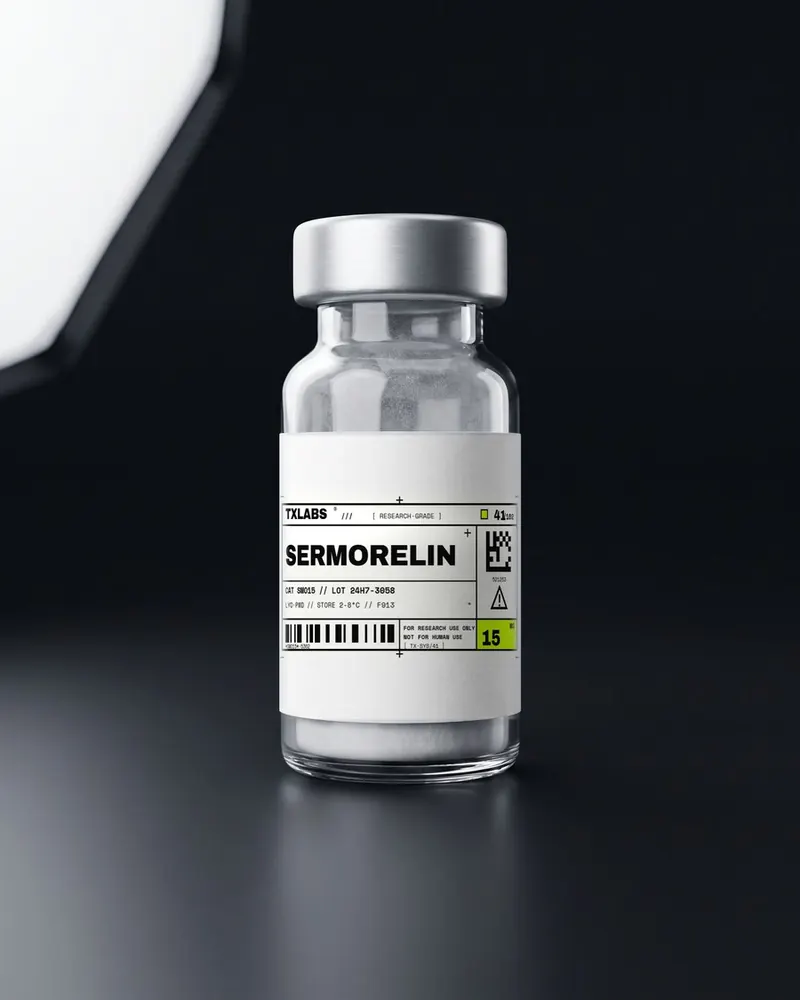
From $89 AUD · ≥98% HPLC purity · third-party COA · ships Australia-wide
What is Sermorelin Acetate?
Sermorelin (GRF 1-29, GHRH 1-29) is a synthetic growth hormone-releasing hormone analogue that stimulates pituitary growth hormone secretion. It is studied in preclinical research on the GHRH receptor, pulsatile GH release and the GH/IGF-1 axis.
Specifications
- From: $89 AUD
- Category: GH & Secretagogues
- Form: Lyophilised powder
- Purity: ≥98% HPLC
- Testing: Third-party Certificate of Analysis
- Classification: Research reference material · For Research Use Only
What the research covers
Sermorelin is the synthetic 29-residue N-terminal fragment of human growth hormone-releasing hormone, GHRH(1-29) with a C-terminal amide, supplied here as the acetate salt. PubChem lists the formula C149H246N44O42S and a molecular weight of 3357.9 Da. Its significance in peptide pharmacology is that GHRH(1-29) was the fragment shown to retain the full biological activity of the 44-residue parent hormone, establishing that the N-terminal third carries the receptor-binding and activating information. Every GHRH analogue that followed, including the tetrasubstituted modified GRF(1-29) and the acylated full-length tesamorelin, is a modification of that finding.
Sermorelin itself carries no protective substitutions. Its position 2 alanine is the native L-isomer, so it is cleaved rapidly by dipeptidyl peptidase-4, and its position 27 methionine is oxidation-prone, both of which are liabilities later analogues were designed to remove. Its reported plasma half-life is correspondingly short, in the range of minutes. Mechanistically it is an agonist at the GHRH receptor, a class B G-protein-coupled receptor on anterior pituitary somatotrophs, coupling through Gs to adenylate cyclase and cAMP accumulation, and stimulating endogenous growth hormone release in a pulsatile rather than sustained pattern.
Sermorelin has a longer regulatory and clinical research history than most compounds in this catalogue. It was studied through the 1980s and 1990s in growth hormone axis investigation, including as a diagnostic stimulation agent for assessing pituitary somatotroph responsiveness, and a product containing it was formerly marketed in some jurisdictions before being withdrawn for commercial reasons. Published research includes receptor pharmacology, pituitary cell assays and endocrine axis work.
TXLABS supplies sermorelin acetate as an analytical reference material for laboratory research only. It is not an approved therapeutic good in Australia and is not supplied for human or veterinary administration.
Reading the certificate
Three species matter on a sermorelin certificate. Methionine sulfoxide, sixteen daltons above the parent, indicates oxidative exposure and is the most likely acquired impurity. Deletion sequences from incomplete coupling across 29 residues are the synthesis-side population, and they can co-elute near the parent peak. Deamidated variants, one dalton heavier, are the slow aqueous degradation product. Confirm the observed mass against 3357.9 Da and confirm it is not near 3368 Da, which would indicate the tetrasubstituted modified GRF(1-29) rather than sermorelin. Note also that the acetate counterion and residual water inflate gross powder weight, so net peptide assay in milligrams is the meaningful figure. TXLABS publishes third-party certificates for tested lots in the CoA library; none is currently published for sermorelin. The lot certificate is available on request to support@txlabs.bio.
Storage and handling
Sermorelin has two specific chemical vulnerabilities and both shape its storage. It contains a methionine at position 27 that oxidises readily in solution, producing a sulfoxide sixteen daltons heavier, so minimise headspace air exposure, work quickly with the vial open, and keep solutions cold and dark. It also contains an asparagine-glycine sequence context in the GHRH N-terminal region that makes deamidation a realistic slow degradation route in aqueous storage, which argues against holding reconstituted material for extended periods at any temperature. Store the lyophilised acetate at -20 °C, desiccated and light-protected, and equilibrate to room temperature before opening. Reconstituted solution is kept at 2-8 °C, protected from light, and aliquoted into single-use volumes rather than freeze-thaw cycled. Under Australian conditions both oxidation and deamidation accelerate with temperature, so a parcel that spends a summer day above 40 °C in a delivery vehicle is a genuine risk to this peptide. Collect promptly and refrigerate.
Working out concentration
Sermorelin is stocked in 10 mg and 15 mg vials. A 10 mg vial reconstituted with 2 mL of bacteriostatic water gives 5 mg/mL; with 1 mL, 10 mg/mL. A 15 mg vial with 3 mL gives 5 mg/mL, and with 1.5 mL, 10 mg/mL. At 3357.9 Da, a 5 mg/mL solution is approximately 1.5 mM, the conversion needed when a published receptor assay specifies molar concentration. Because sermorelin's degradation routes are time-dependent as well as temperature-dependent, the date of reconstitution belongs in the record alongside the concentration. The reconstitution calculator handles vial mass against volume. Concentration arithmetic only, not a protocol.
How it relates to adjacent compounds
Sermorelin is the structural baseline for the GHRH-analogue group in this catalogue, and its neighbours are best read as answers to its weaknesses. Modified GRF(1-29) is the same fragment with four substitutions that block DPP-4 cleavage and remove the oxidisable methionine. CJC-1295 with DAC adds covalent albumin conjugation on top of that. Tesamorelin takes a different route entirely, keeping the full 44-residue sequence and blocking DPP-4 with an N-terminal acyl group. All four bind the same receptor and differ only in how they survive. The methionine at position 27, retained here and substituted away in modified GRF(1-29), is a good illustration of a liability that becomes visible only when the sequences are compared side by side. Structural relationships only.