Tesamorelin + Ipamorelin Australia — 2:1 Research Blend
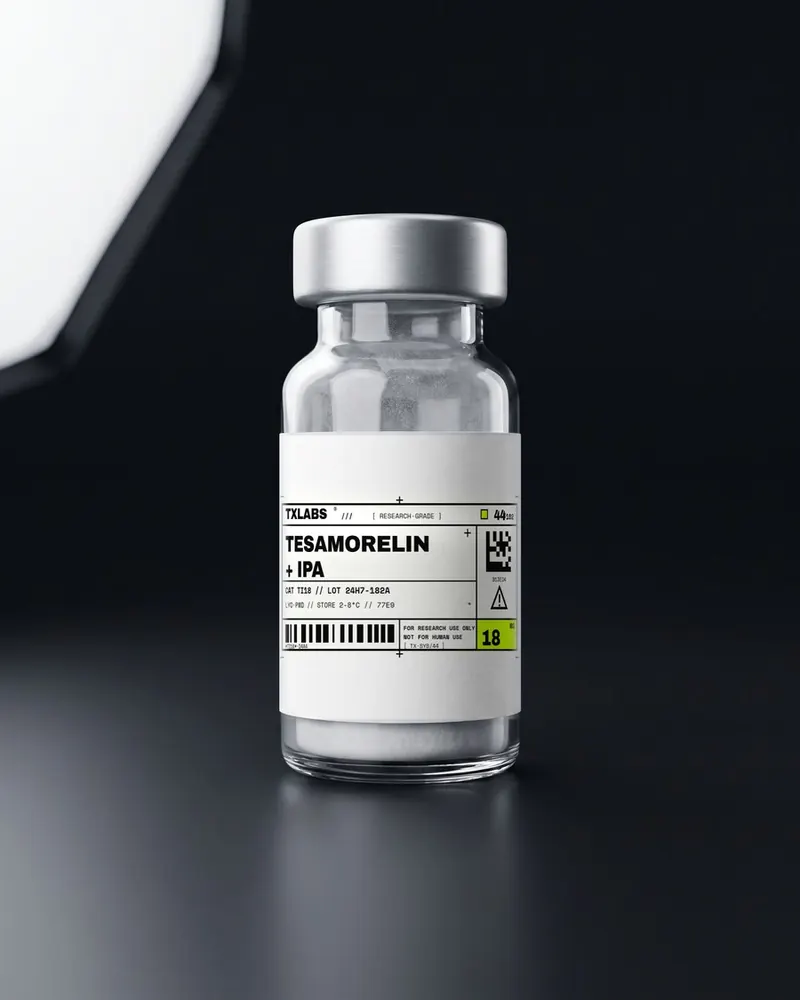
From $229 AUD · ≥98% HPLC purity · third-party COA · ships Australia-wide
What is Tesamorelin 12mg+Ipamorelin 6mg?
Tesamorelin + Ipamorelin is a research blend combining a stabilised GHRH analogue with a selective ghrelin receptor agonist. Tesamorelin acts on the GHRH receptor while Ipamorelin activates the ghrelin/GHS-R pathway, and the combination is studied for complementary stimulation of growth hormone release.
Specifications
- From: $229 AUD
- Category: GH & Secretagogues
- Form: Lyophilised powder
- Purity: ≥98% HPLC
- Testing: Third-party Certificate of Analysis
- Classification: Research reference material · For Research Use Only
What the research covers
This vial contains two distinct research peptides co-lyophilised into a single cake, nominally 12 mg of tesamorelin and 6 mg of ipamorelin, 18 mg of peptide in total. Unlike most blends in this catalogue the ratio is not one to one but two to one by mass, and that asymmetry has to be carried through every calculation rather than assumed away.
Tesamorelin is a synthetic analogue of human growth hormone-releasing hormone, built on the full 44-residue GHRH(1-44) sequence with a trans-3-hexenoyl group attached to the N-terminal tyrosine. Its molecular formula is C221H366N72O67S and its molecular weight approximately 5136 Da, making it one of the larger peptides commonly held as a reference material. The N-terminal acylation is the design point: native GHRH is rapidly inactivated by dipeptidyl peptidase-4 cleavage at the N-terminus, and the hexenoyl modification confers greater resistance to that route while retaining agonist activity at the GHRH receptor, a class B G protein-coupled receptor expressed on anterior pituitary somatotrophs.
Ipamorelin is a synthetic pentapeptide of 711.9 Da acting at the growth hormone secretagogue receptor GHS-R1a, the ghrelin receptor. It has no sequence relationship to GHRH or to ghrelin. The two peptides are paired in research because they represent independent receptor inputs converging on the same somatotroph population, and published cell and animal work has examined whether combined engagement produces additive or synergistic secretory responses.
There is no published evidence for this particular ratio as a ratio. Two to one by mass is a formulation choice, and given the seven-fold difference in molecular weight it corresponds to a molar ratio very far from two to one, which is the more meaningful figure for receptor work.
TXLABS supplies this blend as an analytical reference material for laboratory research only. It is not an approved therapeutic good in Australia and is not supplied for human or veterinary administration.
Reading the certificate
Per-component assay is essential and the asymmetric ratio makes it more so, since a combined figure cannot be unpicked into two unequal parts. The components separate easily, with masses near 5136 Da and 711.9 Da and markedly different reversed-phase retention, so two purity figures, two observed masses and two content values are entirely obtainable. Confirm that the measured ratio matches the stated 12 to 6, because a blend is the one presentation where the label makes a quantitative claim about proportion that a single total cannot verify. For tesamorelin specifically, ask whether the chromatography resolves the methionine sulfoxide and whether the N-terminal hexenoyl modification was confirmed, since unmodified GHRH(1-44) is a different and cheaper molecule. TXLABS publishes third-party certificates for tested lots in the CoA library; no certificate is currently published for this blend. The lot certificate is available on request to support@txlabs.bio.
Storage and handling
The blend is stored on tesamorelin's terms. At 44 residues with an N-terminal acyl modification it is much the more fragile of the two: it carries methionine, which oxidises to the sulfoxide, asparagine and aspartate residues subject to deamidation and isomerisation, and at that length it aggregates readily at high concentration and at air-liquid interfaces. The hexenoyl group also makes it more amphiphilic than an unmodified peptide of the same size, which increases its tendency to adsorb to surfaces. Ipamorelin at five residues has none of these liabilities and is chemically robust.
The consequence for a blend is that the components degrade at different rates and nothing about the vial shows it. Tesamorelin can lose material to oxidation and aggregation while the pentapeptide sits unchanged, moving the ratio away from the stated two to one.
Store the cake at -20 C, desiccated and protected from light, and equilibrate the sealed vial before opening so condensation does not wet a hygroscopic powder. Add diluent gently down the vial wall, swirl rather than shake, hold solutions at 2-8 C in the dark and aliquot before freezing. Australian summer transit above 40 C produces exactly that silent ratio shift.
Working out concentration
Concentration in an asymmetric blend has to be tracked per component or it is actively misleading. This vial holds nominally 12 mg of tesamorelin and 6 mg of ipamorelin, 18 mg of peptide in total. With 2 mL of bacteriostatic water it gives 6 mg/mL of tesamorelin, 3 mg/mL of ipamorelin and 9 mg/mL of total peptide; with 3 mL, 4, 2 and 6 mg/mL respectively; with 6 mL, 2, 1 and 3 mg/mL. In molar terms the picture is quite different, because tesamorelin is roughly 5136 Da and ipamorelin 711.9 Da: at 6 and 3 mg/mL that is approximately 1.17 millimolar against 4.2 millimolar, so the pentapeptide is present in around three and a half times the molar amount despite half the mass. The reconstitution calculator handles the arithmetic. Concentration examples only, not a protocol.
How it relates to adjacent compounds
Both components are stocked individually as tesamorelin and ipamorelin, and those pages carry the detail on each. The CJC-1295 without DAC and ipamorelin blend is the closest comparison in this catalogue: the same secretagogue paired with a different GHRH analogue at a one-to-one rather than two-to-one ratio, which makes the two blends genuinely different products rather than variants. Sermorelin is the unmodified GHRH(1-29) reference point against which both acylated and substituted analogues are usually described, and reading it alongside this blend clarifies how much of the difference between GHRH analogues lies in chain length and how much in terminal modification. Choosing a blend over two single vials is a question of record-keeping and per-component traceability rather than of chemistry, since the molecules are identical whichever vial they arrive in. These are structural and design adjacencies only, and imply nothing about comparable activity.