IGF-1 LR3 Australia — Recombinant Protein Reference Material
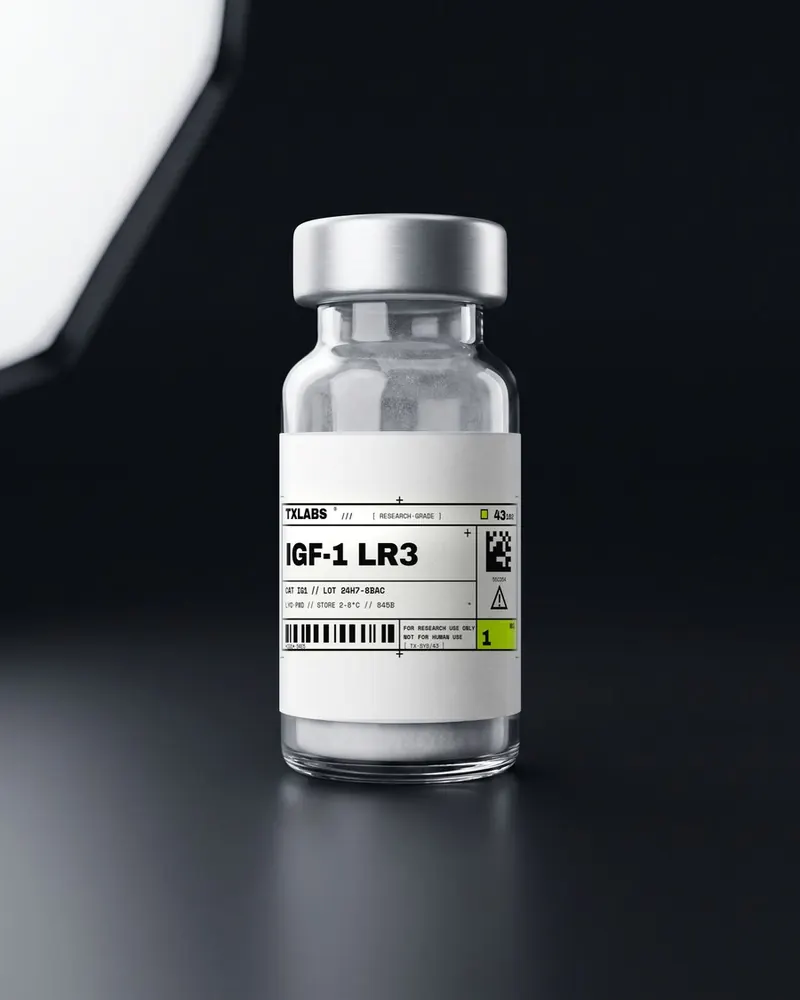
From $149 AUD · ≥98% HPLC purity · third-party COA · ships Australia-wide
What is IGF-1LR3?
IGF-1 LR3 (Long R3 IGF-1) is a modified analogue of insulin-like growth factor 1 with reduced binding-protein affinity and prolonged activity. It is studied in preclinical research on IGF-1 receptor signalling, cell proliferation and protein synthesis.
Specifications
- From: $149 AUD
- Category: GH & Secretagogues
- Form: Lyophilised powder
- Purity: ≥98% HPLC
- Testing: Third-party Certificate of Analysis
- Classification: Research reference material · For Research Use Only
What the research covers
IGF-1 LR3, written in full as Long R3 insulin-like growth factor 1, is not a synthetic peptide and should not be handled as one. It is a modified recombinant protein: an 83-residue analogue of human insulin-like growth factor 1, produced by expression in a host organism rather than by solid-phase chemical synthesis. Two changes distinguish it from the 70-residue native protein. The glutamate at position 3 is replaced by arginine, which is what the R3 in the name denotes, and a 13-residue N-terminal extension is appended, which is what Long denotes. Calculated from the published sequence, the reduced form sits near 9118 Da and the correctly folded form carrying its three disulfide bonds near 9111 Da, the roughly 6 Da difference being the six hydrogen atoms lost in forming those bonds.
The purpose of both modifications is the same: to reduce binding to the insulin-like growth factor binding proteins, the family of carrier proteins that sequester IGF-1 in circulation and in culture media. Native IGF-1 is largely bound in most biological settings, and reduced binding-protein affinity is the reason this analogue became a standard supplement in mammalian cell culture, where it is used to support cell growth in serum-reduced media. That cell culture application is by some margin its largest documented use.
Mechanistically IGF-1 and its analogues act at the type 1 IGF receptor, a receptor tyrosine kinase structurally related to the insulin receptor, engaging the PI3K-Akt and MAPK pathways. Published research using LR3 spans cell culture process development, receptor signalling studies and comparative work on binding-protein interactions.
TXLABS supplies IGF-1 LR3 as an analytical reference material for laboratory research only. It is not an approved therapeutic good in Australia and is not supplied for human or veterinary administration.
Reading the certificate
A reversed-phase HPLC purity percentage is close to the wrong measurement for a recombinant protein. Purity tells you the sample is chemically homogeneous; it does not tell you the three disulfide bonds are correctly paired, and a misfolded disulfide isomer has the same mass and often similar retention behaviour while being biologically different. The meaningful questions for this material are therefore correct disulfide pairing, aggregate content by size-exclusion chromatography, host cell protein and host DNA residuals, and endotoxin. Ask which of those the certificate actually covers, because a peptide-style certificate covers none of them. TXLABS publishes third-party certificates for tested lots in the CoA library; no certificate is currently published for IGF-1 LR3. The lot certificate is available on request to support@txlabs.bio.
Storage and handling
This is a folded protein with three disulfide bonds, and it is the most fragile item in this part of the catalogue. Its structure, not just its sequence, is the product, and heat, shear, extremes of pH and reducing agents will all unfold or misfold it without changing its mass appreciably. Store the lyophilised material at -20 °C, desiccated and protected from light, and equilibrate to room temperature before opening. Reconstitute gently, without vortexing, and keep the solution cold. Surface adsorption is a real and under-appreciated problem at the low concentrations a 1 mg vial implies: proteins are lost onto glass and plastic walls, and low-binding labware or a carrier protein in the working buffer is the standard analytical countermeasure. Freeze-thaw is particularly damaging to folded proteins, so single-use aliquots are not optional advice here. Australian summer transit above 40 °C is more consequential for a folded protein than for a short peptide, since denaturation is irreversible. Collect promptly and refrigerate.
Working out concentration
IGF-1 LR3 is supplied in a 1 mg vial, an order of magnitude smaller than most of the catalogue, so the arithmetic sits in a different range. Reconstituted with 1 mL of bacteriostatic water it gives 1 mg/mL; with 2 mL, 0.5 mg/mL; with 10 mL, 0.1 mg/mL. At approximately 9111 Da, a 1 mg/mL solution is roughly 110 micromolar. Because proteins adsorb to container surfaces, the concentration actually present in a dilute working solution can fall below the calculated figure, which is why low-binding labware and carrier proteins are used in analytical practice. The reconstitution calculator resolves vial mass against volume. Concentration arithmetic only, not a protocol.
How it relates to adjacent compounds
MGF is the closest catalogue relative by biology rather than by chemistry: it is the E-domain peptide of the IGF-1Ec splice variant, so it comes from the same gene while being a short synthetic peptide rather than a folded recombinant protein. PEG-MGF is the pegylated form of that peptide. Further out, the growth hormone axis compounds tesamorelin and ipamorelin act upstream at the pituitary, on GHRH and ghrelin receptors respectively, whereas IGF-1 LR3 acts at the type 1 IGF receptor directly. It is also the only recombinant protein in this part of the catalogue, which is why its storage and certification requirements sit apart from every synthetic peptide shelved beside it. These are pathway and structural relationships only, not comparisons of activity.