PEG-MGF Australia — PEGylated Mechano Growth Factor
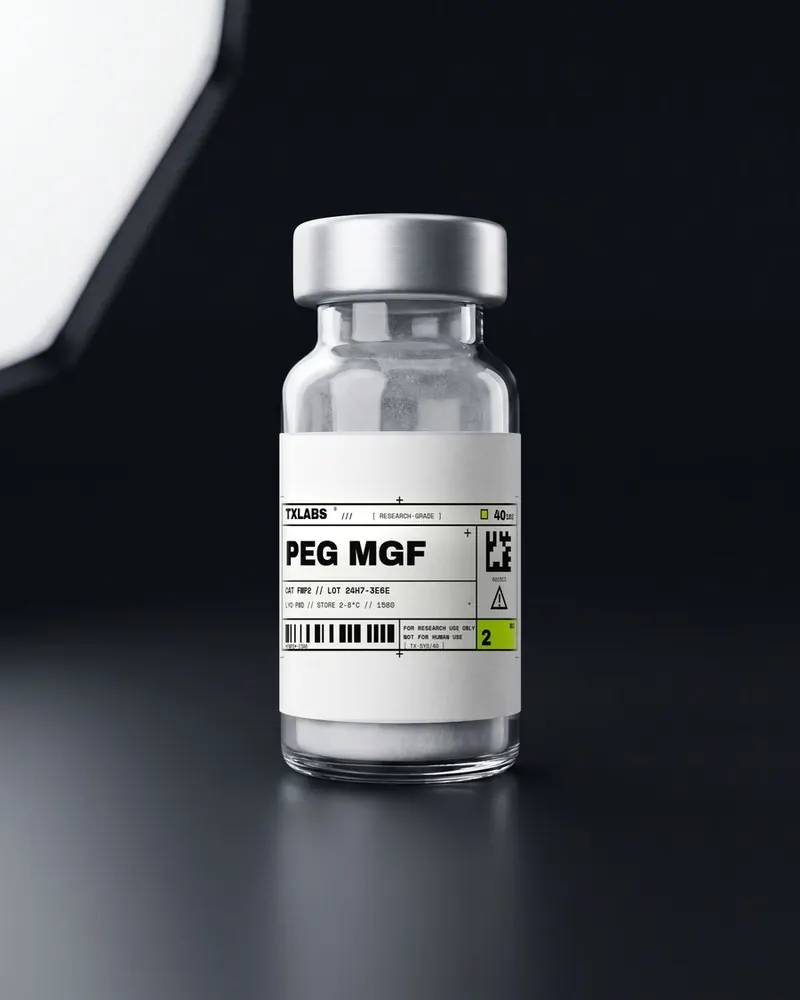
From $59 AUD · ≥98% HPLC purity · third-party COA · ships Australia-wide
What is PEG MGF?
PEG-MGF (PEGylated Mechano Growth Factor) is a polyethylene glycol-conjugated form of the IGF-1Ec splice variant with an extended half-life. PEGylation improves stability for laboratory research on the mechano growth factor pathway, satellite cell activation and muscle tissue repair.
Specifications
- From: $59 AUD
- Category: GH & Secretagogues
- Form: Lyophilised powder
- Purity: ≥98% HPLC
- Testing: Third-party Certificate of Analysis
- Classification: Research reference material · For Research Use Only
What the research covers
PEG-MGF is mechano growth factor peptide carrying a covalently attached polyethylene glycol chain. The underlying peptide corresponds to the C-terminal E-domain of the IGF-1Ec splice variant, commonly supplied as a 24-residue sequence with a calculated molecular weight near 2868 Da for the sequence most often quoted. The relationship to IGF-1 is one of alternative splicing rather than proteolytic fragmentation: IGF-1Ec is a transcript variant of the IGF1 gene in which alternative splicing produces a distinct C-terminal extension absent from the mature circulating protein.
PEGylation is the defining feature of this product. Attaching a polyethylene glycol chain to a peptide increases its hydrodynamic radius, which reduces renal clearance, and it shields the backbone sterically, which slows proteolytic attack. The published rationale for applying it here is that the unmodified E-domain peptide is degraded rapidly in serum, with reported half-lives of only a few minutes, and that conjugation extends that considerably. This is well-established polymer chemistry and it is used across many approved biologics.
Two things should be stated honestly. The first is naming and sequence, and it is the same caution that applies to unmodified MGF: human and rodent E-domain sequences differ, several E-peptide sequences appear in the literature under overlapping names, and much published research used rodent constructs or sequences that do not match commercial material. The second is the conjugate itself. PEGylation is not a single defined modification. The polymer has a molecular weight distribution rather than a molecular weight, the attachment chemistry and the site of attachment vary between manufacturers, and the degree of PEGylation varies within a batch. A product labelled PEG-MGF is therefore substantially less defined than the peptide it is built from, and no published characterisation fixes what any given commercial preparation contains.
TXLABS supplies PEG-MGF as an analytical reference material for laboratory research only. It is not an approved therapeutic good in Australia and is not supplied for human or veterinary administration.
Reading the certificate
A PEG conjugate is the hardest thing in this catalogue to certify properly, because the product is a distribution rather than a molecule. Reversed-phase HPLC of a PEGylated peptide typically gives broad peaks rather than sharp ones, so a high purity percentage is not necessarily meaningful and a low one is not necessarily bad. What a useful certificate provides is the peptide sequence and identity confirmed independently, the nominal polymer molecular weight and the attachment chemistry used, the degree of PEGylation, and the proportion of free unconjugated peptide and free polymer remaining. Size exclusion chromatography is the more informative separation here than reversed-phase. Ask specifically what the stated milligram figure refers to, conjugate mass or peptide content, since they differ substantially. TXLABS publishes third-party certificates for tested lots in the CoA library; no certificate is currently published for PEG-MGF. The lot certificate is available on request to support@txlabs.bio.
Storage and handling
PEGylation changes the physical behaviour of a peptide substantially. The polymer is strongly hydrophilic and hygroscopic, so the lyophilised conjugate takes up atmospheric moisture rapidly and the cake can become tacky; equilibrating the sealed vial to room temperature before opening is important here. In solution the conjugate is very soluble but viscous relative to the free peptide, and it can foam readily, which promotes interfacial aggregation of the peptide portion.
The peptide portion retains its own chemistry, and PEGylation does not protect it from anything chemical. Depending on the sequence supplied this may include oxidation-sensitive residues and amide side chains subject to deamidation. Polyethylene glycol itself is not inert either: it oxidises slowly in air, particularly with trace metals and light, generating peroxides and aldehydes that can modify the peptide. That is a genuine and underappreciated stability route for conjugates.
Store the lyophilised conjugate at -20 C, desiccated and protected from light. Add diluent gently down the vial wall and swirl rather than shake, since foaming is a real risk. Hold solutions at 2-8 C and aliquot rather than freeze-thaw. Australian transit above 40 C accelerates both peptide degradation and PEG oxidation, so refrigerate promptly.
Working out concentration
The TXLABS PEG-MGF vial is 2 mg, one of the smallest peptide presentations in the catalogue. Two milligrams into 1 mL gives 2 mg/mL; into 2 mL, 1 mg/mL; into 4 mL, 0.5 mg/mL. Two cautions apply to the arithmetic. First, the stated mass is of the conjugate, so the peptide content is lower than the label by whatever share the polymer contributes, and that share is not fixed. Second, molar conversion is not straightforward, because polyethylene glycol has a molecular weight distribution rather than a molecular weight, so the conjugate does not have one either. Use the figures on the lot certificate. The reconstitution calculator handles the mass and volume arithmetic. Concentration examples only, not a protocol.
How it relates to adjacent compounds
The unconjugated peptide is stocked as MGF, and its page covers the sequence and naming problems in more detail; those problems apply here in full and are compounded by the conjugation. IGF-1 LR3 is the other product in this catalogue derived from IGF-1 biology, being a modified recombinant form of the mature protein rather than a splice-variant extension, which makes it a useful structural contrast. CJC-1295 with DAC is the catalogue's other example of a peptide deliberately modified to extend circulating persistence, though it achieves this by covalent albumin binding rather than by polymer conjugation, a genuinely different strategy with different analytical consequences. These are structural and design adjacencies only, and imply nothing about comparable activity.