Bronchogen Australia — Khavinson Tetrapeptide Research
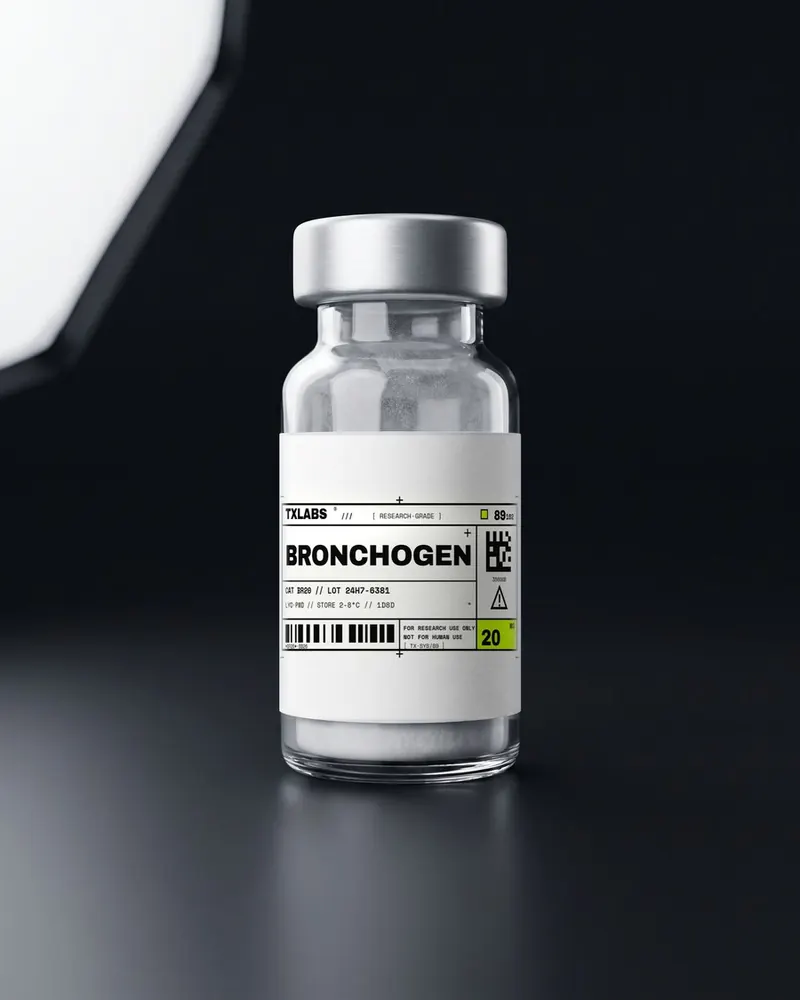
From $99 AUD · ≥98% HPLC purity · third-party COA · ships Australia-wide
What is Bronchogen?
Bronchogen (Ala-Glu-Asp-Leu, AEDL) is a synthetic tetrapeptide bioregulator of the Khavinson class studied in respiratory-tissue research. It is investigated in preclinical studies of bronchial and pulmonary tissue and is described as a tissue-specific short peptide affecting gene expression in lung cells.
Specifications
- From: $99 AUD
- Category: Longevity & Bioregulators
- Form: Lyophilised powder
- Purity: ≥98% HPLC
- Testing: Third-party Certificate of Analysis
- Classification: Research reference material · For Research Use Only
What the research covers
Bronchogen is a synthetic tetrapeptide from the Khavinson peptide bioregulator series, reported as Ala-Glu-Asp-Leu, abbreviated AEDL. It is the member of that family assigned to bronchial and pulmonary tissue, and like the others in the series it was developed at the St Petersburg Institute of Bioregulation and Gerontology as part of a programme that produced short tissue-assigned peptides across many organ systems.
The evidence position needs to be stated before anything else. The sequence attribution above is consistently reported across secondary sources and vendor material but we were not able to trace it to an accessible peer-reviewed primary publication in English, and the searchable literature for this compound is dominated by commercial listings rather than by research. What primary work exists appears to be in Russian-language sources or in output from the originating institute, and independent replication by unaffiliated laboratories could not be identified. This is a compound whose published record is thin to the point that the most useful thing a page can do is say so.
What can be described is the framework the compound belongs to. The bioregulator programme's premise is that very short peptides, in the range of two to four residues, enter cells and interact with specific regions of DNA to modulate transcription in a tissue-selective manner. In Bronchogen's case the described target tissue is bronchial epithelium and alveolar cells. That premise is a distinctive claim of this tradition and is not broadly accepted in mainstream molecular biology, where sequence-specific DNA recognition is understood to require structural complexity a tetrapeptide does not have. The chemistry of the molecule, by contrast, is entirely ordinary: a four-residue peptide with one basic-free, two acidic and one aliphatic residue is unremarkable and straightforward to characterise.
TXLABS supplies Bronchogen as an analytical reference material for laboratory research only. It is not an approved therapeutic good in Australia and is not supplied for human or veterinary administration.
Reading the certificate
For a compound with no accessible published characterisation, the certificate carries most of the identity burden rather than merely confirming it, and that changes what should be asked for. Request the observed mass as a number and the sequence as the manufacturer states it, rather than accepting the trade name, since the name alone is not traceable to a published specification. Because a short peptide of this composition is prone to aspartimide chemistry, ask whether the chromatography resolves the isoaspartate isomer, which is isobaric with the parent and therefore invisible to mass spectrometry. Confirm the salt form and net peptide content, since on a four-residue peptide counterion and residual water can be a substantial share of gross vial weight. TXLABS publishes third-party certificates for tested lots in the CoA library; no certificate is currently published for Bronchogen. The lot certificate is available on request to support@txlabs.bio.
Storage and handling
If the reported Ala-Glu-Asp-Leu sequence is correct, the chemistry to watch is specific and well understood. The aspartate residue sits adjacent to leucine at the C-terminal end, and aspartyl residues followed by small or unhindered neighbours are substrates for aspartimide formation, the cyclisation that proceeds in aqueous solution and resolves to a mixture of aspartate and isoaspartate forms. It accelerates with warmth and with pH excursions away from neutral, and it produces a species isobaric with the parent. The two acidic side chains make the peptide very soluble in water but sensitive to the pH of the diluent, and there is no cysteine, methionine or tryptophan, so oxidation is not a concern.
Store the lyophilised powder at -20 C, desiccated and protected from light, and equilibrate the sealed vial before opening so condensation does not wet cold material. Hold solutions at 2-8 C near neutral pH and aliquot rather than freeze-thaw cycling. As a dry solid the tetrapeptide tolerates Australian summer freight better than most of this catalogue, but heat plus moisture drives aspartimide chemistry, so dry, cold storage remains the right default.
Working out concentration
The TXLABS Bronchogen vial is 20 mg. Twenty milligrams into 2 mL of bacteriostatic water gives 10 mg/mL; into 4 mL, 5 mg/mL; into 10 mL, 2 mg/mL. A molar figure is not given here because the molecular weight for the commercial material could not be confirmed from an authoritative source, and a tetrapeptide of the reported composition would sit somewhere in the region of 450 daltons, which is close enough to matter but not close enough to state. The mass on the certificate for the lot supplied is the figure to use for any molarity calculation. As a very short peptide it will give high molar concentrations for a given mass. The reconstitution calculator handles the arithmetic. Concentration examples only, not a protocol.
How it relates to adjacent compounds
Bronchogen is one of several Khavinson-tradition bioregulators in this catalogue and should be read alongside its siblings. Cardiogen is its closest relative, a tetrapeptide from the same series assigned to cardiac tissue, differing in a single terminal residue by the reported sequences and sharing every one of its evidentiary limitations. Pinealon is the tripeptide member assigned to brain tissue. Epithalon is the best documented compound in the family and its page discusses the tradition's provenance more fully; anyone assessing Bronchogen would do well to read it first, since it is the member of the series with an actual literature to weigh. These are tradition and design adjacencies only, and imply nothing about comparable activity.