Prostamax Australia — Lys-Glu-Asp-Pro Tetrapeptide
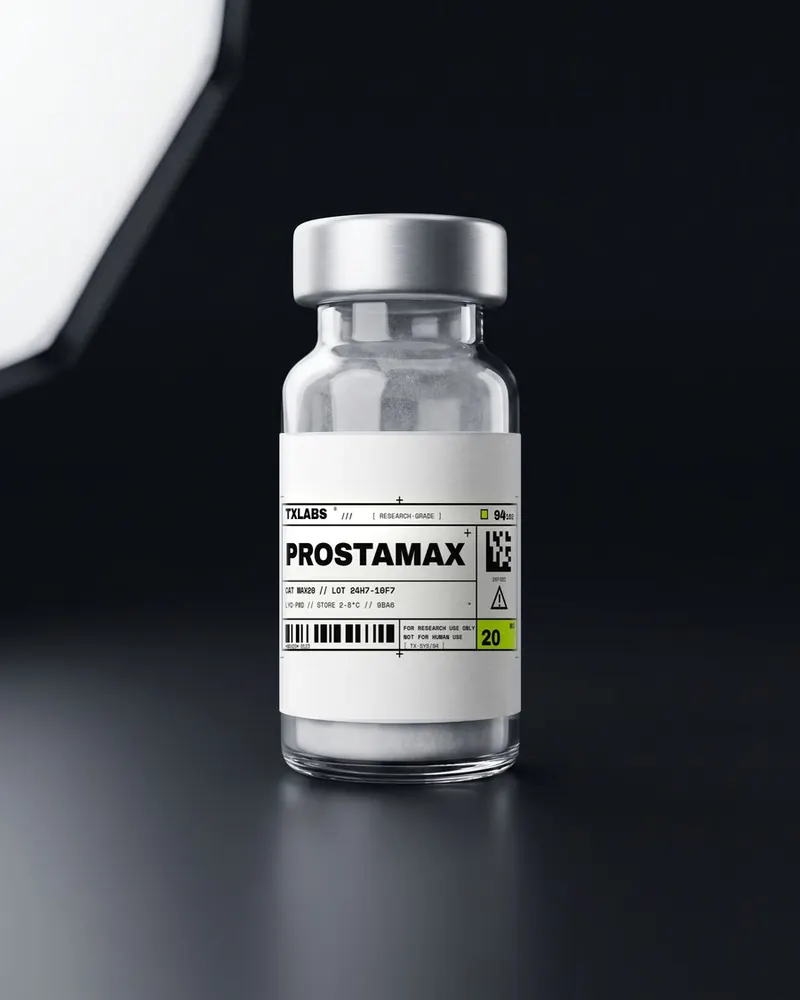
From $99 AUD · ≥98% HPLC purity · third-party COA · ships Australia-wide
What is Prostamax?
Prostamax (Lys-Glu-Asp-Pro, KEDP) is a synthetic tetrapeptide bioregulator associated with prostate tissue. Part of the Khavinson short-peptide class, it is investigated in preclinical models of prostatic cell function and tissue-specific gene expression. Prostamax is supplied as a reference material for prostate tissue research.
Specifications
- From: $99 AUD
- Category: Longevity & Bioregulators
- Form: Lyophilised powder
- Purity: ≥98% HPLC
- Testing: Third-party Certificate of Analysis
- Classification: Research reference material · For Research Use Only
What the research covers
Prostamax is a synthetic tetrapeptide, Lys-Glu-Asp-Pro, from the ultrashort peptide bioregulator programme of Professor Vladimir Khavinson and colleagues at the St Petersburg Institute of Bioregulation and Gerontology. It appears in sources under both Prostamax and Prostomax, a transliteration artefact rather than a chemical distinction, and it carries the prostate name within that programme's tissue-based naming convention.
The prostate corner of this field is where two entirely different categories of material are most routinely confused, and separating them is the most useful work this page can do. Prostamax is a defined synthetic peptide: one sequence, one molecular weight, a purity percentage that means something because there is a single intended analyte to measure purity against, and a molar concentration that can be calculated. Prostatilen and comparable prostate-extract preparations from the same research tradition are something else entirely. They are polypeptide fractions extracted from animal prostate tissue, mixtures of peptides of varying lengths with no single sequence and no single mass. For such a preparation a purity percentage is close to meaningless, molarity cannot be calculated at all, and an entirely separate set of provenance questions becomes material: source species, geographical origin of the source animals, and documentation addressing viral and transmissible spongiform encephalopathy safety.
These two categories are discussed interchangeably in secondary sources and are not interchangeable in any respect. Anyone reading claims about prostate bioregulators should establish which kind of material a given study used before carrying the conclusion across.
Prostamax also contains a proline, so it shows the slow cis-trans amide isomerism common to proline-containing peptides, a topic treated in detail on the cortagen page.
The proposed peptide-DNA mechanism remains a hypothesis internal to this tradition, whose literature is concentrated in a few connected laboratories, largely Russian-language, and sparsely replicated externally.
TXLABS supplies prostamax as an analytical reference material for laboratory research only. It is not an approved therapeutic good in Australia and is not supplied for human or veterinary administration.
Reading the certificate
The first thing to establish from a certificate for anything sold as a prostate bioregulator is which category of material it describes. A certificate for a defined synthetic tetrapeptide reports a named analyte, an observed mass consistent with Lys-Glu-Asp-Pro, a purity percentage against that single analyte, and a lot number. A certificate for a tissue-derived fraction cannot legitimately report any of those in the same way, and one that does is describing something other than what is in the vial. For prostamax specifically, check the mass, ask whether the neighbouring KED-core relatives were excluded, and expect proline-related peak broadening rather than reading it as an impurity. TXLABS publishes third-party certificates for tested lots in the CoA library; no certificate is currently published for prostamax, and the lot certificate is provided on request to support@txlabs.bio.
Storage and handling
As a defined synthetic peptide, prostamax is handled on straightforward terms: -20 °C for the lyophilised cake, desiccated and protected from light, 2-8 °C for a vial in active use, and 2-8 °C in the dark once reconstituted, aliquoted into single-use volumes rather than freeze-thaw cycled. Two acidic side chains make the powder hygroscopic, so bring a cold vial to room temperature sealed before opening. That simplicity is itself the point of contrast with a tissue extract, which must be stored on the terms of its least stable and least characterised constituent and for which aseptic technique carries additional weight because residual biological material may be present. Nothing of that kind applies here. On Australian delivery, the relevant exposure is a summer parcel held above 40 °C in a vehicle or letterbox followed by opening in humid coastal air; a sealed vial collected promptly and refrigerated avoids both halves of that.
Working out concentration
Prostamax is stocked in a 20 mg vial. Reconstituted with 2 mL of bacteriostatic water it gives 10 mg/mL; with 4 mL, 5 mg/mL; with 5 mL, 4 mg/mL; with 10 mL, 2 mg/mL. Because prostamax is a single defined molecule with one molecular weight, molar concentration can be calculated from these figures, which is not true of the tissue-extract preparations it is often discussed alongside. Any molarity quoted for a prostate polypeptide fraction should be treated as an error rather than as extra precision, since there is no single mass to divide by. The calculator handles mass against volume. Concentration examples only, not a protocol.
How it relates to adjacent compounds
Thymalin is the catalogue's example of the tissue-extract category this page distinguishes prostamax from: a bovine thymus polypeptide fraction with no single sequence, whose page sets out exactly why purity and molarity behave differently for a mixture. Cortagen is the other proline-containing member of this family and treats the conformational chromatography question at length. Vesugen is the Lys-Glu-Asp core prostamax extends by a single proline, and is therefore both the expected truncation species in a prostamax batch and the compound whose page explains why that whole sub-family shares an identity problem. These are categorical and structural relationships within one research tradition, described because they govern how each material must be stored and characterised, and they carry no implication about comparative activity.