Livagen Australia — Lys-Glu-Asp-Ala Tetrapeptide
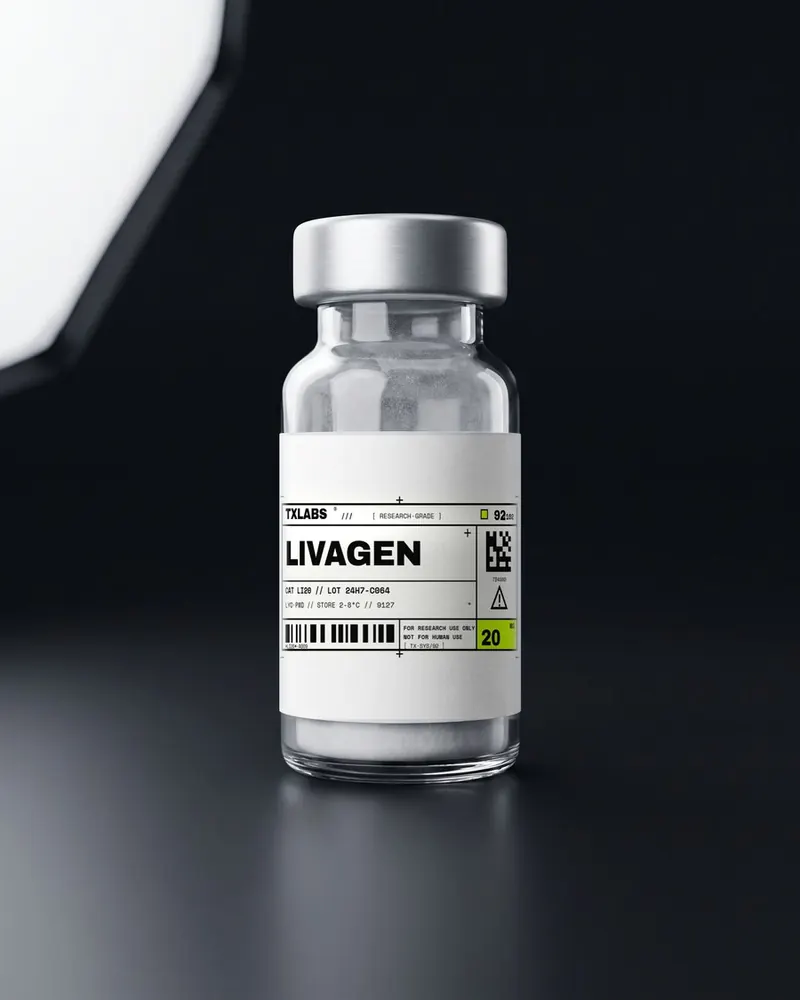
From $109 AUD · ≥98% HPLC purity · third-party COA · ships Australia-wide
What is Livagen?
Livagen (Lys-Glu-Asp-Ala, KEDA) is a synthetic tetrapeptide bioregulator associated with liver tissue. A member of the Khavinson short-peptide family, it is investigated in laboratory studies of hepatic cell function and age-related gene expression. Livagen is used as a reference material in research on liver tissue regulation.
Specifications
- From: $109 AUD
- Category: Longevity & Bioregulators
- Form: Lyophilised powder
- Purity: ≥98% HPLC
- Testing: Third-party Certificate of Analysis
- Classification: Research reference material · For Research Use Only
What the research covers
Livagen is a synthetic tetrapeptide, Lys-Glu-Asp-Ala, from the ultrashort peptide bioregulator programme run by Professor Vladimir Khavinson and colleagues at the St Petersburg Institute of Bioregulation and Gerontology. It carries the hepatic name within that programme's tissue-based naming scheme, and the liver-related characterisation attached to it was performed by the originating groups rather than independently.
Structurally it is the shared Lys-Glu-Asp core, which is also stocked here in its own right as vesugen, extended by a single alanine. That places livagen in a tight cluster of one-residue variants, and one relationship inside that cluster is worth stating precisely because it is the source of most identity confusion in this family. Alanine is glycine with a methyl group. Livagen, Lys-Glu-Asp-Ala, and testagen, Lys-Glu-Asp-Gly, therefore differ by exactly one methylene unit, fourteen daltons, across the whole molecule. They are the same length, carry the same charge, and have almost the same polarity, which means they behave nearly identically on a routine chromatographic method and are separated with difficulty if at all.
The mechanism proposed in the originating literature is not receptor binding but direct interaction with DNA or chromatin-associated proteins, producing tissue-selective changes in gene expression. That proposal has been argued chiefly through molecular modelling and through the programme's own experimental work; it has not been established by independent structural or pharmacological study and is presented here as a hypothesis within one tradition.
The corresponding limitation on the evidence is real and should not be smoothed over. The publications come from a small number of connected laboratories, are largely Russian-language, span several decades, follow reporting conventions that differ from international peer-reviewed practice, and have attracted very limited independent replication.
TXLABS supplies livagen as an analytical reference material for laboratory research only. It is not an approved therapeutic good in Australia and is not supplied for human or veterinary administration.
Reading the certificate
The specific question a livagen certificate must answer is whether the material is livagen and not testagen. Fourteen daltons separates Lys-Glu-Asp-Ala from Lys-Glu-Asp-Gly, which a unit-resolution mass spectrometer distinguishes without difficulty, but only if the analysis was performed and the analyte was named precisely. A certificate reporting purity against an unnamed reference, or describing the material as a tetrapeptide without stating which, has not answered it. Chromatography alone will not: the two co-elute or nearly co-elute on generic reversed-phase gradients where both are barely retained. Look for a named analyte, an observed mass, and a method with genuine retention rather than a void-volume peak. TXLABS publishes third-party certificates for tested lots in the CoA library; none is currently published for livagen, and the lot certificate is available on request to support@txlabs.bio.
Storage and handling
Livagen has one basic and two acidic side chains, making it highly water-soluble and correspondingly hygroscopic in the dry state. Equilibrate a cold vial fully to ambient temperature while it is still sealed, because opening chilled glass in a humid room condenses water directly onto a cake that will absorb it. Store the lyophilised material at -20 °C, desiccated and protected from light; 2-8 °C is adequate for a vial in active use over a short period. Once in solution, hold at 2-8 °C in the dark and divide into single-use aliquots rather than freezing and thawing one tube repeatedly. There is no aromatic residue, no thiol and no methionine, so oxidation is not the leading concern it would be for a longer sequence. On Australian delivery, the exposure that matters is the last leg: a parcel left through a summer afternoon in a delivery van or a metal letterbox sits well above 40 °C, and a sealed vial collected promptly and refrigerated avoids the question entirely.
Working out concentration
Livagen is stocked at 10 mg and 20 mg. The 10 mg vial reconstituted with 1 mL of bacteriostatic water gives 10 mg/mL; with 2 mL, 5 mg/mL; with 5 mL, 2 mg/mL. The 20 mg vial with 2 mL gives 10 mg/mL, and with 4 mL, 5 mg/mL. Because two vial masses exist for this compound and the family's other members are stocked at different masses again, the safest record is the vial mass and the diluent volume rather than the resulting concentration on its own, since a concentration figure alone cannot be checked afterwards. The reconstitution calculator converts any vial and volume pair. Concentration examples only, not a protocol.
How it relates to adjacent compounds
Testagen is the compound livagen is most easily confused with, differing by a single methylene, and its page approaches the same relationship from the other direction. Vesugen is the Lys-Glu-Asp core both are built on, and is therefore the expected truncation product of either. Pancragen completes the picture as the same core carrying an amidated tryptophan, and is the only member of the group with an ultraviolet chromophore worth using, which makes it the easiest of the four to quantify. These are sequence and provenance relationships within a single research programme and imply nothing about comparative activity.