Cortagen Australia — Ala-Glu-Asp-Pro Tetrapeptide
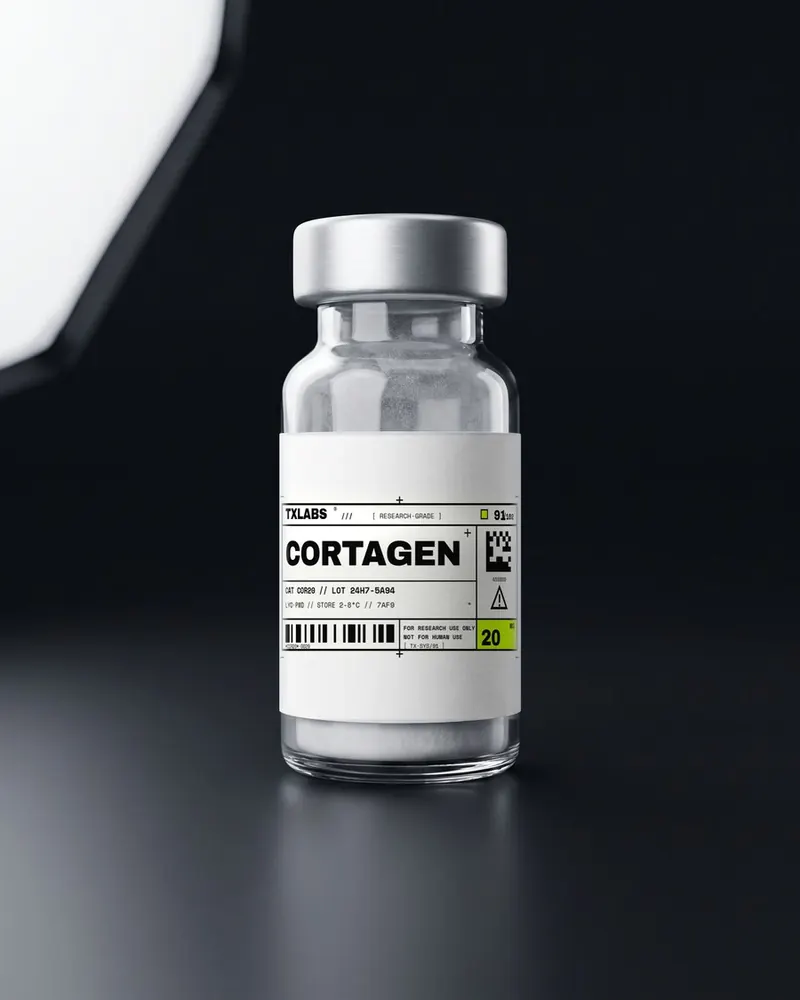
From $99 AUD · ≥98% HPLC purity · third-party COA · ships Australia-wide
What is Cortagen?
Cortagen (Ala-Glu-Asp-Pro, AEDP) is a synthetic tetrapeptide bioregulator associated with the brain and cerebral cortex. Part of the Khavinson short-peptide class, it is studied in preclinical research on neuronal tissue and gene-expression regulation. Cortagen is supplied as a research reference material for investigations into cortical peptide signalling.
Specifications
- From: $99 AUD
- Category: Longevity & Bioregulators
- Form: Lyophilised powder
- Purity: ≥98% HPLC
- Testing: Third-party Certificate of Analysis
- Classification: Research reference material · For Research Use Only
What the research covers
Cortagen is a synthetic tetrapeptide, Ala-Glu-Asp-Pro, produced within the ultrashort peptide bioregulator programme of Professor Vladimir Khavinson and colleagues at the St Petersburg Institute of Bioregulation and Gerontology. It is the member named for the cerebral cortex, and the neurological characterisation associated with it originates in that programme.
Two naming problems attach to this compound and both are worth settling before anything else. The first is transliteration. Russian-language sources render the name in Latin script inconsistently, and the compound appears as both Cortagen and Korthagen, including in tabulations produced by the originating group itself. Trade names from this programme are not chemical identifiers: there is no international nonproprietary name, no consistent CAS practice across suppliers, and nothing preventing two vendors selling different material under one label. The sequence is the identifier. The second is a different confusion entirely: Cortexin is a polypeptide fraction extracted from animal brain tissue, an undefined mixture with no single sequence, no single molecular weight and no meaningful purity figure. Cortagen is a defined synthetic tetrapeptide. They are routinely discussed together and they are not the same kind of material.
On mechanism, the originating literature proposes direct interaction with DNA or chromatin-associated proteins producing tissue-selective changes in gene expression rather than classical receptor binding. That is a hypothesis internal to one research tradition, argued chiefly from modelling and from that tradition's own experiments, and it has not been established independently.
The evidence caveat is unavoidable here as elsewhere in the family: a small number of originating laboratories, largely Russian-language publication over several decades, reporting conventions unlike the international literature, and very limited independent replication.
TXLABS supplies cortagen as an analytical reference material for laboratory research only. It is not an approved therapeutic good in Australia and is not supplied for human or veterinary administration.
Reading the certificate
Proline complicates chromatography in a way that is worth anticipating on a certificate. The bond preceding a proline residue interconverts slowly between cis and trans conformations, and when that interconversion is slow relative to the chromatographic timescale it produces broadened or genuinely split peaks that are conformational, not compositional. A chromatogram showing a shoulder on the main peak may therefore be reporting one molecule in two conformations rather than an impurity, and equally a real related substance can hide beneath the broadening. Variable-temperature runs, which sharpen the peak as interconversion speeds up, and mass spectrometry taken across the peak both distinguish the two cases. Ask which was done. TXLABS publishes third-party certificates for tested lots in the CoA library; none is currently published for cortagen, and the certificate for the lot supplied is available on request to support@txlabs.bio.
Storage and handling
Cortagen is a short, polar, acidic tetrapeptide, so the routine storage principles apply: -20 °C for the lyophilised cake, desiccated and dark, with 2-8 °C acceptable for a vial in current use, and 2-8 °C in the dark once reconstituted with single-use aliquots in preference to repeated freeze-thaw. It is hygroscopic on account of the two acidic side chains and should be equilibrated to room temperature sealed before the closure is broken. The proline gives it one distinctive property worth knowing about in solution: proline-containing peptides interconvert slowly between cis and trans forms of the preceding amide bond, and that equilibrium is temperature-dependent. A solution that has just been warmed from refrigeration has not necessarily reached its equilibrium distribution, which matters for anyone running comparative chromatography. In Australian conditions the usual advice holds and is worth repeating for a compound often bought in summer: parcels left in vehicles or unshaded letterboxes routinely exceed 40 °C, so collect promptly and refrigerate on receipt.
Working out concentration
Cortagen is supplied in a 20 mg vial. Reconstituted with 2 mL of bacteriostatic water it gives 10 mg/mL; with 4 mL, 5 mg/mL; with 5 mL, 4 mg/mL; with 8 mL, 2.5 mg/mL. The arithmetic is the same division for every vial in the catalogue, but the vial masses in this family vary between 10 and 20 mg from compound to compound, so a volume copied from a neighbouring product will give the wrong figure. Record the vial mass alongside the volume rather than the concentration alone. The reconstitution calculator performs the conversion for any combination. Concentration examples only, not a protocol.
How it relates to adjacent compounds
Cortagen is cartalax with a proline appended, and crystagen is cortagen with its N-terminal alanine removed, so the three form a short chain of single-residue relationships that also makes each a plausible synthesis-related impurity of the others. Prostamax is the other proline-containing member of the family and shares the same conformational chromatography behaviour. Further out, thymalin is the catalogue's example of the tissue-extract category that Cortexin belongs to, and reading it clarifies why an undefined fraction and a defined tetrapeptide cannot be assessed on the same terms. These are structural and categorical relationships and say nothing about comparative activity.