Pancragen Australia — Lys-Glu-Asp-Trp Amide, 20 mg
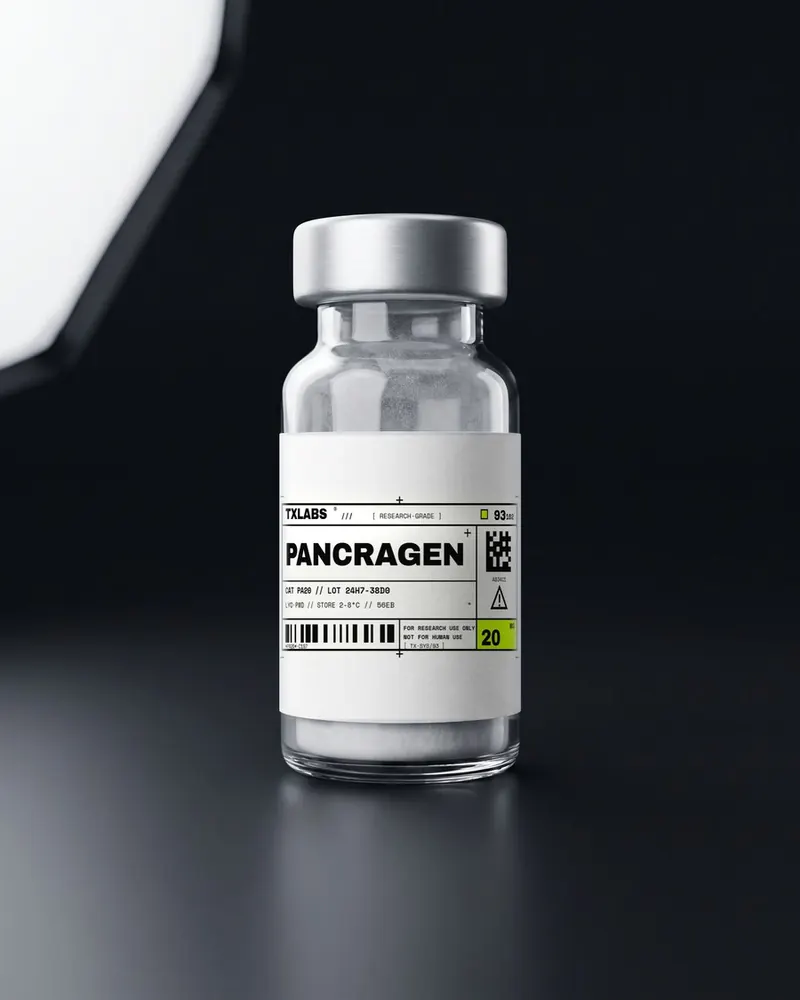
From $109 AUD · ≥98% HPLC purity · third-party COA · ships Australia-wide
What is Pancragen?
Pancragen (Lys-Glu-Asp-Trp, KEDW) is a synthetic tetrapeptide bioregulator associated with pancreatic tissue. One of the Khavinson short peptides, it is studied in preclinical research on pancreatic cell function and tissue-specific gene expression. Pancragen serves as a research reference for studies of pancreatic peptide regulation.
Specifications
- From: $109 AUD
- Category: Longevity & Bioregulators
- Form: Lyophilised powder
- Purity: ≥98% HPLC
- Testing: Third-party Certificate of Analysis
- Classification: Research reference material · For Research Use Only
What the research covers
Pancragen is a synthetic tetrapeptide, Lys-Glu-Asp-Trp with a C-terminal amide, from the ultrashort peptide bioregulator programme of Professor Vladimir Khavinson and colleagues at the St Petersburg Institute of Bioregulation and Gerontology. It is the member named for pancreatic tissue, and the characterisation associated with it comes from those groups.
Among the eleven bioregulators stocked here, pancragen is the analytical outlier, and for once that works in the buyer's favour. It is the only one carrying tryptophan. Tryptophan absorbs strongly in the near ultraviolet with a maximum around 280 nm, which means pancragen is the only compound in this family whose concentration can be estimated spectrophotometrically against a known extinction coefficient, and the only one for which a selective detection wavelength is available in chromatography. Its Trp-free relatives are confined to peptide-bond absorbance near 214 nm, a wavelength at which solvents, buffer components and most organic contaminants also absorb, so their chromatograms are far less informative.
That advantage comes with a matching liability. Tryptophan is the most photolabile and among the most oxidation-prone of the common residues. Light exposure and dissolved oxygen degrade it in ways that the other members of this family simply do not experience, which changes the storage priorities for this one compound.
Pancragen is also the only C-terminally amidated member of the group, a modification that blocks carboxypeptidase cleavage and is standard practice for short peptides.
The mechanism proposed in the originating literature, direct interaction with DNA or chromatin-associated proteins altering gene expression, is a hypothesis within that tradition rather than an established finding. As with the whole family, the literature is concentrated in a few connected laboratories, largely Russian-language, and has limited independent replication.
TXLABS supplies pancragen as an analytical reference material for laboratory research only. It is not an approved therapeutic good in Australia and is not supplied for human or veterinary administration.
Reading the certificate
Two checks matter here that do not apply to the rest of the family. First, oxidation: tryptophan gives characteristic mass additions of sixteen and thirty-two daltons as it oxidises, and those species are the expected degradation products for this compound. A certificate that reports purity without addressing them has left the most likely impurity class unexamined. Second, the amide: a C-terminal amide differs from the free acid by roughly one dalton, which is small enough that a coarse mass measurement cannot confirm the amidation the product name asserts. Ask what mass accuracy was achieved. On the positive side, tryptophan gives a genuine 280 nm chromophore, so a purity figure from a selective wavelength is available here and is worth more than a 214 nm figure. TXLABS publishes third-party certificates for tested lots in the CoA library; none is published for pancragen, and the lot certificate is supplied on request to support@txlabs.bio.
Storage and handling
Light protection is not a formality for this compound. Tryptophan photodegrades, and an indole side chain exposed to laboratory lighting in solution will accumulate oxidation products over hours rather than months. Keep the lyophilised cake at -20 °C in amber glass or in a closed box, desiccated, and equilibrate to room temperature sealed before opening so that the hygroscopic acidic residues do not draw in condensate. Reconstituted solution is held at 2-8 °C, wrapped or in amber, and prepared in aliquots so that a single tube is not repeatedly opened and re-exposed. Minimising headspace and avoiding vigorous agitation both reduce dissolved oxygen, which is the other half of the tryptophan problem. In Australian conditions the combination that does real damage is a summer parcel that sits in direct sun in a clear or light delivery bag: for this one compound, light exposure in transit matters as much as temperature. Collect promptly, store dark, refrigerate.
Working out concentration
Pancragen is stocked in a 20 mg vial. With 2 mL of bacteriostatic water that gives 10 mg/mL; with 4 mL, 5 mg/mL; with 5 mL, 4 mg/mL; with 10 mL, 2 mg/mL. Pancragen is the one compound in this family where the concentration you calculate can be checked independently, because the tryptophan gives a measurable absorbance near 280 nm and a spectrophotometric estimate against a known extinction coefficient can be compared against the arithmetic. Any large discrepancy points to an incorrect vial mass, an incomplete dissolution, or material that is not what the label says. The calculator handles the division. Concentration examples only, not a protocol.
How it relates to adjacent compounds
Pancragen is the Lys-Glu-Asp core stocked here as vesugen, extended by an amidated tryptophan, so vesugen is the expected truncation species in a pancragen batch and the natural comparison for what the fourth residue changes. Livagen and testagen extend the same core with alanine and glycine respectively and demonstrate the opposite case: neighbours so similar that identity has to be established by mass rather than by chromatography. Outside this family, N-acetyl epitalon amidate applies the same C-terminal amidation strategy to a different bioregulator sequence. These are structural relationships within and adjacent to one research programme and imply nothing about comparative activity.