Epithalon Australia — Batch-Verified Research Tetrapeptide
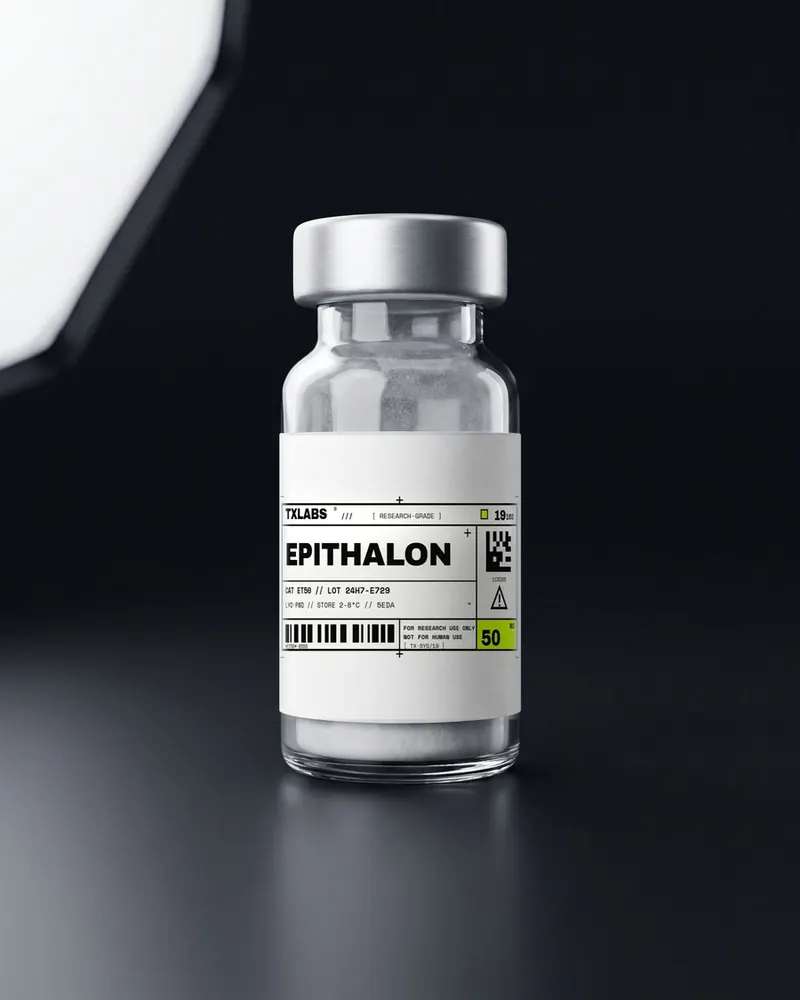
From $49 AUD · ≥98% HPLC purity · third-party COA · ships Australia-wide
What is Epithalon?
Epithalon (Epitalon, Ala-Glu-Asp-Gly) is a synthetic tetrapeptide modelled on the pineal peptide epithalamin. It has been investigated in research on telomerase activity, telomere dynamics, circadian and pineal regulation, and cellular senescence. Epithalon is studied as a reference compound in ageing and gerontology models.
Specifications
- From: $49 AUD
- Category: Longevity & Bioregulators
- Form: Lyophilised powder
- Purity: ≥98% HPLC
- Testing: Third-party Certificate of Analysis
- Classification: Research reference material · For Research Use Only
 View full report ↗
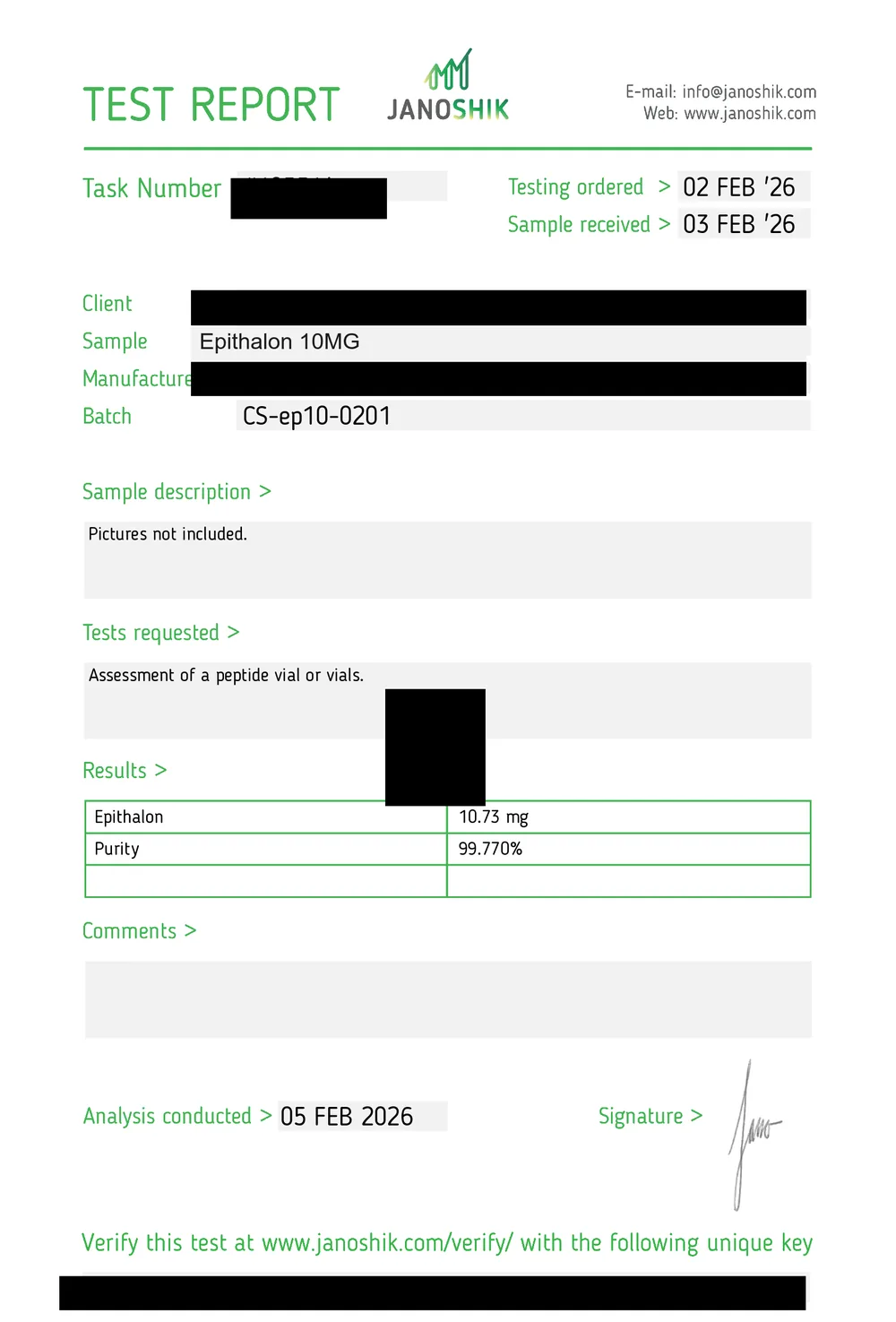
Report ID and verification key are redacted on our copy of this certificate. Request the unredacted report, or see the full CoA library.
What the research covers
Epithalon, also written epitalon or epithalone, is a synthetic tetrapeptide with the sequence Ala-Glu-Asp-Gly, molecular formula C14H22N4O9 and molecular weight 390.35 Da. It is the smallest peptide in this catalogue by residue count and among the smallest by mass. Its design origin is specific: epithalon was created as a synthetic analogue reproducing what was proposed to be the active fragment of epithalamin, a peptide preparation extracted from bovine pineal gland, in a programme of peptide bioregulator research conducted in the Soviet Union and later Russia and associated principally with Vladimir Khavinson at the St Petersburg Institute of Bioregulation and Gerontology.
The published literature on epithalon should be read with its provenance in mind. A substantial proportion appears in Russian-language journals or in translated summaries, much of it from the originating institute, and independent replication outside that tradition is limited. Within that literature, reported research directions include effects on telomerase activity and telomere length in cultured human somatic cells, effects on melatonin secretion and circadian parameters in animal models, studies in senescence-accelerated and tumour-prone rodent strains examining lifespan and tumour incidence, and proposed interactions with DNA at the level of gene expression, sometimes framed as short peptides binding specific promoter sequences. The last of these is a distinctive theoretical claim of the peptide bioregulator school and is not broadly accepted in mainstream molecular biology.
Epithalon is therefore best treated as a compound with an interesting but methodologically uneven literature, which is exactly the reason a well-characterised reference material matters for anyone attempting replication work.
TXLABS supplies epithalon as an analytical reference material for laboratory research only. It is not an approved therapeutic good in Australia and is not supplied for human or veterinary administration.
Reading the certificate
For a tetrapeptide, synthesis-related deletion sequences are a negligible concern, so a certificate's value lies elsewhere. The specific species to consider is the aspartimide-derived isomer arising from the Asp-Gly motif, which carries the same nominal mass as the parent and therefore cannot be excluded by mass spectrometry alone; reversed-phase HPLC resolution is what would reveal it, typically as a shoulder or a closely eluting minor peak. Confirm the observed mass matches 390.35 Da, check that the salt form is stated, since counterion and residual water add gross weight without adding peptide, and confirm the certificate names a batch. TXLABS publishes the Janoshik Analytical report for epithalon in the CoA library: batch CS-ep10-0201, tested 5 February 2026, 99.770% purity with a 10 mg sample assaying 10.73 mg.
Storage and handling
At four residues epithalon has few degradation routes, but the ones it has are worth knowing. Its sequence contains an aspartyl-glycine motif at the C-terminal end, the classic substrate for aspartimide formation and subsequent isomerisation to isoaspartate in aqueous solution, and that chemistry accelerates with temperature and with pH excursions away from neutral. It also carries two acidic side chains, so it is very soluble but sensitive to the pH of the diluent. Store the lyophilised powder at -20 °C, desiccated and protected from light, and bring the vial to room temperature before opening so moisture does not condense onto cold glass. Reconstituted material is held at 2-8 °C and shielded from light, with aliquoting preferred over repeated freeze-thaw. In Australian conditions the dry tetrapeptide is thermally robust and tolerates the ambient excursions of summer road freight better than most of the catalogue, but the same warmth accelerates aspartimide chemistry the moment any moisture is present, so prompt collection and dry, cold storage on arrival remain the sensible defaults.
Working out concentration
Epithalon is stocked in 10 mg, 40 mg and 50 mg vials, a wide spread that makes checking the arithmetic worthwhile. A 10 mg vial with 2 mL of bacteriostatic water gives 5 mg/mL; a 40 mg vial with 2 mL gives 20 mg/mL; a 50 mg vial with 5 mL gives 10 mg/mL. Because the molecule is only 390.35 Da, the molar concentrations are high for a given mass: 5 mg/mL is approximately 12.8 mM, which matters when published cell work specifies micromolar or nanomolar concentrations and a substantial dilution series is required. The reconstitution calculator handles any vial and volume pairing. Concentration arithmetic only, not a protocol.
How it relates to adjacent compounds
Epithalon belongs to the longevity and bioregulator group in this catalogue and comes from a distinct research tradition, the Russian peptide bioregulator school, rather than from Western pharmaceutical development. Within that same tradition sit Semax and Selank, both developed in Russian institutes as short synthetic analogues of endogenous peptide fragments, though those act on the nervous system and share no sequence with epithalon. Its catalogue neighbours MOTS-c and NAD+ also appear in ageing research but from entirely separate structural and mechanistic starting points, mitochondrial peptide signalling and redox coenzyme biochemistry respectively. Shared subject matter only, not comparable mechanisms or effects.