Pinealon Australia — Khavinson Tripeptide Bioregulator
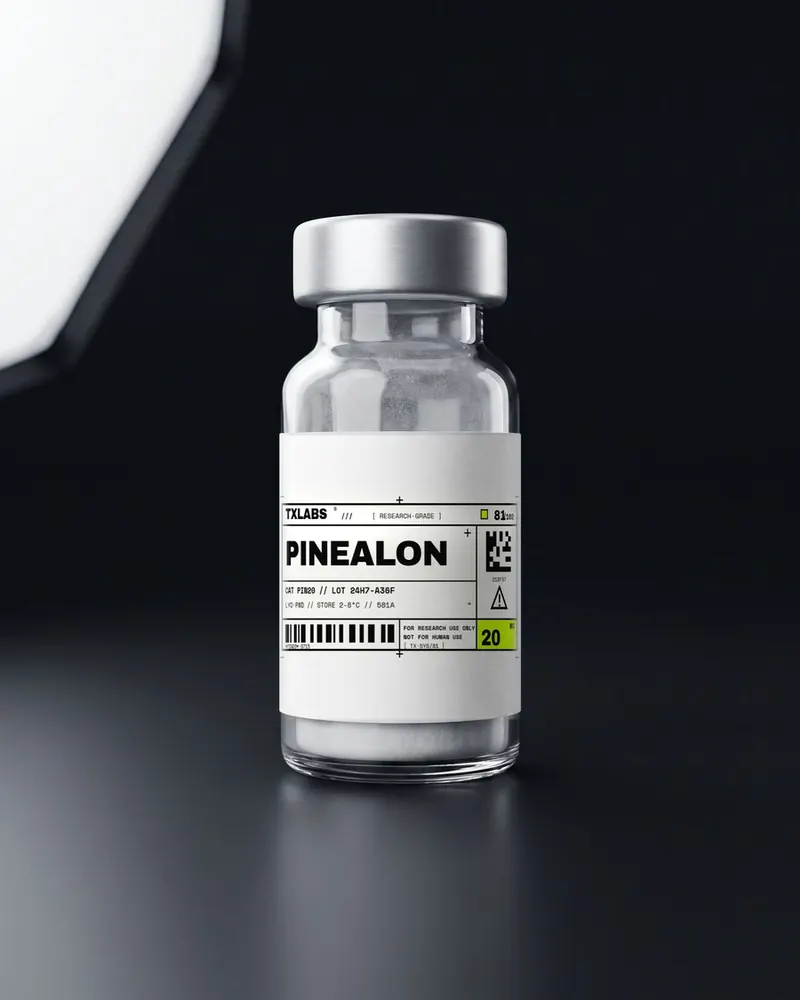
From $69 AUD · ≥98% HPLC purity · third-party COA · ships Australia-wide
What is Pinealon?
Pinealon (Glu-Asp-Arg, EDR) is a short peptide bioregulator of the Khavinson class studied in research on brain function. A synthetic tripeptide, it is investigated in preclinical models of central nervous system activity, neuronal protection against oxidative stress and cognition.
Specifications
- From: $69 AUD
- Category: Cognitive & Nootropic
- Form: Lyophilised powder
- Purity: ≥98% HPLC
- Testing: Third-party Certificate of Analysis
- Classification: Research reference material · For Research Use Only
What the research covers
Pinealon is a synthetic tripeptide reported as Glu-Asp-Arg, abbreviated EDR. At three residues it is the shortest compound in this catalogue. It belongs to the peptide bioregulator series developed in the Soviet Union and later Russia and associated principally with Vladimir Khavinson at the St Petersburg Institute of Bioregulation and Gerontology, a programme that produced a family of very short peptides each assigned to a particular tissue. Pinealon is the one assigned to brain tissue, and its name reflects the programme's pineal framing rather than any established pineal origin for the sequence.
The literature has to be described with its provenance in front. Searching the published record for this compound returns a large volume of commercial and secondary material and a comparatively small body of primary research, most of it in Russian-language journals or in translated summaries, and much of it from the originating institute or its collaborators. Independent replication by unaffiliated laboratories is limited. Within that literature, reported research directions include neuronal culture work examining reactive oxygen species accumulation and markers of apoptosis under oxidative or hypoxic stress, rodent studies of behavioural and cognitive endpoints in ageing animals, and the theoretical proposal that characterises the whole bioregulator school, that very short peptides penetrate cells and interact directly with specific DNA sequences to modulate transcription in a tissue-selective way.
That last proposal deserves a plain statement. It is a distinctive claim of the peptide bioregulator tradition and it is not broadly accepted in mainstream molecular biology, where sequence-specific DNA recognition is understood to require structural complexity that a three-residue peptide does not possess. Anyone working with this compound should treat the mechanism as an open question rather than as background.
TXLABS supplies Pinealon as an analytical reference material for laboratory research only. It is not an approved therapeutic good in Australia and is not supplied for human or veterinary administration.
Reading the certificate
For a tripeptide, deletion sequences are essentially a non-issue and the certificate's value lies elsewhere. Two specific species are worth asking about. The first is the isoaspartate isomer arising from the aspartate residue, which carries the same nominal mass as the parent and therefore cannot be excluded by mass spectrometry; only chromatographic resolution reveals it, typically as a shoulder or a closely eluting minor peak. The second is the pyroglutamate form arising from N-terminal glutamate cyclisation, which differs by about eighteen daltons and is straightforward to see if the mass is reported numerically. Confirm the salt form is stated, since counterion and residual water add gross weight without adding peptide, and confirm the certificate names a specific batch. TXLABS publishes third-party certificates for tested lots in the CoA library; no certificate is currently published for Pinealon. The lot certificate is available on request to support@txlabs.bio.
Storage and handling
A three-residue peptide has few places to go wrong, but the ones it has are consequential because each residue is a third of the molecule. The sequence carries an aspartate, and where aspartate is adjacent to a small residue the aspartimide route is available: cyclisation in aqueous solution followed by resolution to a mixture of aspartate and isoaspartate forms, accelerated by warmth and by pH away from neutral, producing a species with the same nominal mass as the parent. The glutamate at the N-terminus can cyclise to pyroglutamate, a well-known reaction for N-terminal glutamate and glutamine residues that eliminates water and shifts the mass by about eighteen daltons. The arginine makes the peptide basic overall despite two acidic residues, so its solubility and retention behaviour are strongly pH-dependent.
Store the lyophilised powder at -20 C, desiccated and protected from light, and equilibrate the sealed vial before opening so moisture does not condense onto cold glass. Hold solutions at 2-8 C near neutral pH and aliquot rather than freeze-thaw. The dry tripeptide tolerates Australian summer freight better than most of the catalogue, but the same warmth drives both cyclisation routes once moisture is present, so dry, cold storage remains the default.
Working out concentration
TXLABS stocks Pinealon in 10 mg and 20 mg vials, so it is worth confirming which is in hand before calculating. A 10 mg vial with 2 mL of bacteriostatic water gives 5 mg/mL; a 20 mg vial with 2 mL gives 10 mg/mL; a 20 mg vial with 4 mL returns to 5 mg/mL. Molar concentrations are high for a given mass because the molecule is so small: a tripeptide of this composition sits in the region of 400 daltons, so 5 mg/mL is on the order of twelve millimolar, which matters when published cell work specifies micromolar or nanomolar figures and a long dilution series is required. Use the mass on the lot certificate for precise work. The reconstitution calculator handles any pairing. Concentration arithmetic only, not a protocol.
How it relates to adjacent compounds
Pinealon sits within the Khavinson bioregulator group of this catalogue, and the family resemblance is genuine: Bronchogen and Cardiogen are tetrapeptides from the same programme, assigned to different tissues, sharing the same design premise and the same evidentiary limitations. Epithalon is the best documented member of the family and its page discusses the tradition's provenance in more detail. Thymalin, the earlier generation of that programme, is a tissue-derived peptide preparation rather than a defined synthetic sequence, which is a useful contrast in what can be certified at all. Melatonin shares only the pineal framing with this compound and is chemically unrelated to it. These are tradition and category adjacencies only, and imply nothing about comparable activity.