Chonluten Australia — Glu-Asp-Gly Tripeptide, 20 mg
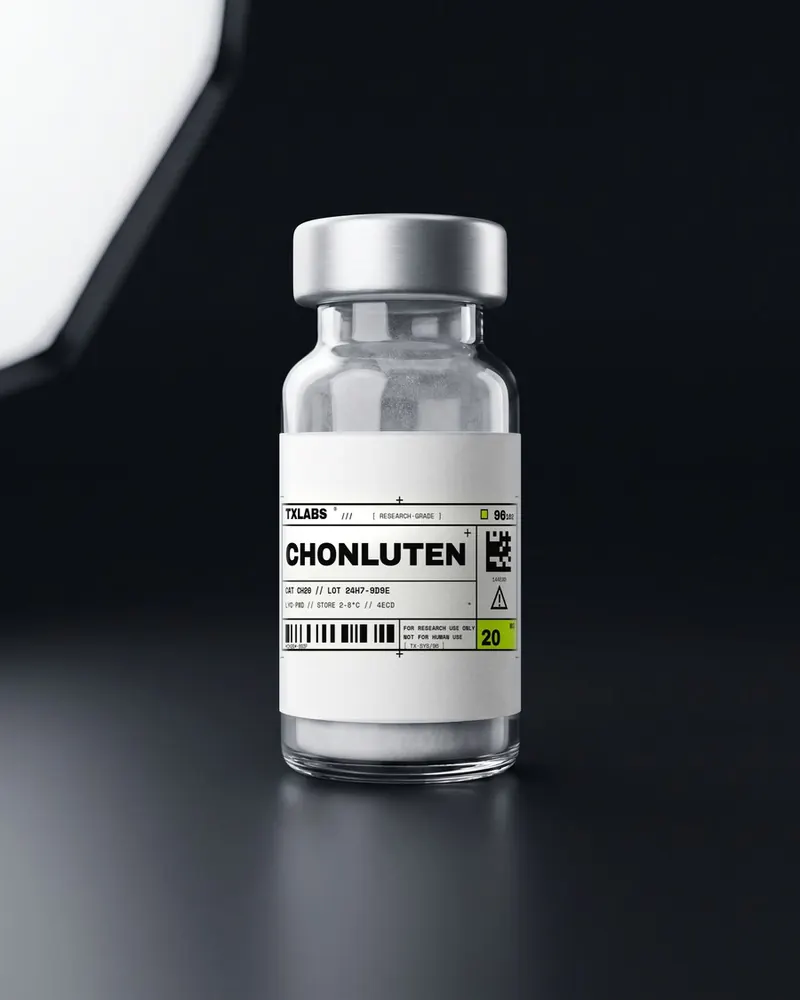
From $99 AUD · ≥98% HPLC purity · third-party COA · ships Australia-wide
What is Chonluten?
Chonluten (Glu-Asp-Gly, EDG) is a synthetic tripeptide bioregulator associated with lung and bronchial tissue. Originally derived from bronchial epithelial peptides, this Khavinson short peptide is investigated in preclinical research on respiratory cell function and gene expression. Chonluten serves as a research reference for pulmonary tissue studies.
Specifications
- From: $99 AUD
- Category: Longevity & Bioregulators
- Form: Lyophilised powder
- Purity: ≥98% HPLC
- Testing: Third-party Certificate of Analysis
- Classification: Research reference material · For Research Use Only
What the research covers
Chonluten is a synthetic tripeptide, Glu-Asp-Gly, developed within the ultrashort peptide bioregulator programme led by Professor Vladimir Khavinson at the St Petersburg Institute of Bioregulation and Gerontology. It carries the lung and bronchial name in that programme's tissue-based naming scheme, and the respiratory characterisation attached to it was carried out by the originating groups.
Its composition sets it apart chemically from most of the family. Glutamate and aspartate are both acidic; glycine is the smallest and least reactive residue there is. Chonluten therefore has no basic residue at all, which means it carries net negative charge at neutral pH, has a low isoelectric point, and behaves quite differently from the lysine-containing members such as vilon, vesugen and the KED tetrapeptides. That distinction is not cosmetic. It determines how the compound retains on a chromatography column, which ion-pairing reagents are appropriate, how it ionises in a mass spectrometer, and how it behaves in a buffer.
As with every compound in this family, the mechanism advanced in the originating literature is direct peptide interaction with DNA or chromatin-associated proteins producing tissue-selective changes in gene expression, rather than receptor binding. That is a proposal from one research tradition supported mainly by modelling and by that tradition's own studies. It has not been established by independent structural or pharmacological work and this page does not present it as though it had.
The usual caution about the evidence base applies without qualification. The literature is concentrated in a handful of originating laboratories, is largely Russian-language, has accumulated over several decades, and has attracted very limited independent replication.
TXLABS supplies chonluten as a laboratory reference material only. It is not an approved therapeutic good in Australia and is not supplied for human or veterinary administration.
Reading the certificate
Chonluten is the member of this family where the choice of chromatographic method matters most, and a certificate should be read with that in mind. Standard reversed-phase peptide methods use trifluoroacetic acid as an ion-pairing reagent, an approach optimised for cationic peptides; an all-acidic tripeptide gains almost nothing from it and elutes essentially unretained. Anion exchange or hydrophilic interaction chromatography give real separation here, and a certificate showing a single early peak on a generic C18 gradient has not tested the material seriously. Confirm identity by observed mass and check for the deletion species Glu-Asp and Asp-Gly, which are more polar again. TXLABS publishes third-party certificates for tested lots in the CoA library; no certificate is currently published for chonluten, and the certificate for the specific lot supplied is available on request to support@txlabs.bio.
Storage and handling
Two carboxylate side chains and no basic residue make chonluten one of the most hygroscopic materials in the catalogue. The failure mode is not a cake that will not dissolve but one that has already partly dissolved in the air of the room: an acidic short peptide left open on a humid bench will visibly deliquesce, and once that has happened the weighed mass is no longer the peptide mass. Work quickly, equilibrate a cold vial to room temperature sealed before opening it, and reseal with desiccant. Store the dry material at -20 °C, desiccated and dark, and reconstituted solution at 2-8 °C in single-use aliquots. Solubility in water is excellent and needs no assistance. On the Australian transit question, the humid coastal and tropical parts of the country are the genuine hazard for this compound rather than the heat itself, since the vial is sealed in transit but the ambient humidity at the point of opening is what determines whether the powder survives handling.
Working out concentration
Chonluten is stocked in a 20 mg vial. With 2 mL of bacteriostatic water that gives 10 mg/mL; with 4 mL, 5 mg/mL; with 5 mL, 4 mg/mL; with 10 mL, 2 mg/mL. If the material is instead being taken up in a buffer for analytical work, remember that a peptide with two free carboxylates and no basic residue will shift the pH of a weakly buffered solution as it dissolves, so the final pH is worth measuring rather than assuming, particularly at the higher concentrations above. The calculator handles the mass and volume arithmetic. These figures are concentration examples for laboratory record-keeping, not a protocol of any kind.
How it relates to adjacent compounds
Within the family, chonluten's closest sequence neighbour is ovagen, Glu-Asp-Leu, which shares the first two residues and swaps glycine for leucine. That single change makes ovagen markedly more hydrophobic and much harder to dissolve, which is a compact illustration of how much a terminal residue governs the practical chemistry of a tripeptide. Chonluten also shares its tissue name with bronchogen, Ala-Glu-Asp-Leu, a different molecule assigned to the same tissue within the same programme, which is a reminder that these names index a research target rather than a chemical class. Cartalax is the same length with an alanine in place of the terminal glycine's position. Sequence relationships only, with no implication about relative activity.