Crystagen Australia — Glu-Asp-Pro Bioregulator, 20 mg
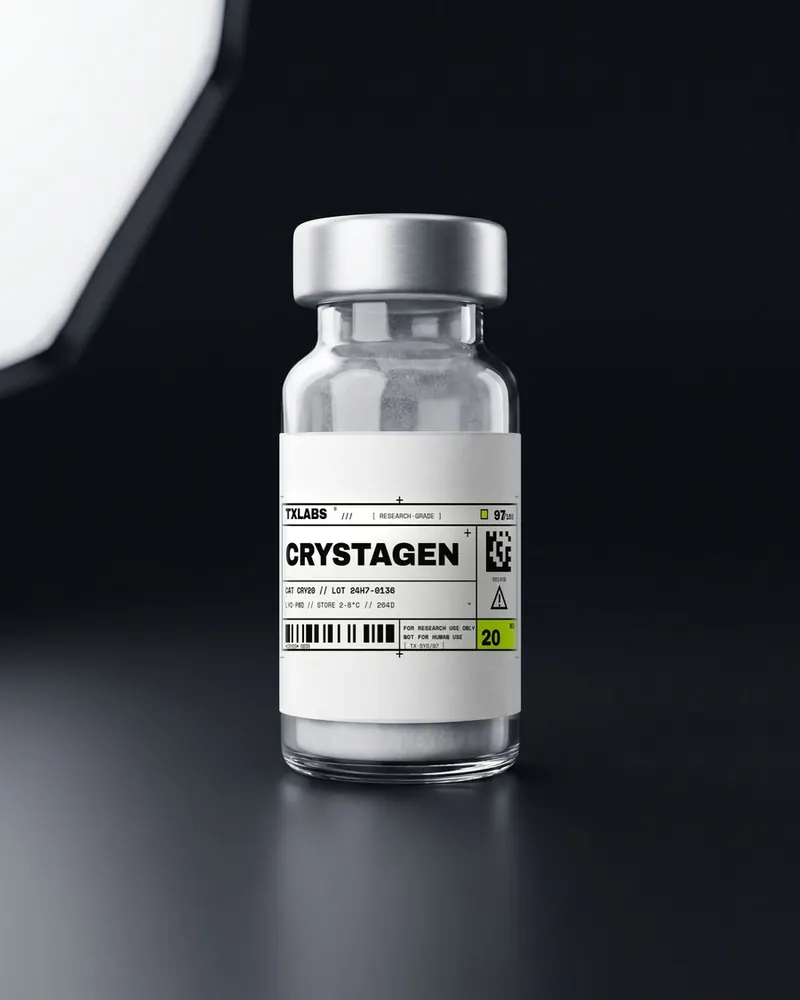
From $99 AUD · ≥98% HPLC purity · third-party COA · ships Australia-wide
What is Crystagen?
Crystagen (Glu-Asp-Pro, EDP) is a synthetic tripeptide bioregulator associated with the immune system and thymus. Part of the Khavinson short-peptide class, it is studied in preclinical research on immune cell function and tissue-specific gene expression. Crystagen is supplied as a reference material for immunological peptide research.
Specifications
- From: $99 AUD
- Category: Longevity & Bioregulators
- Form: Lyophilised powder
- Purity: ≥98% HPLC
- Testing: Third-party Certificate of Analysis
- Classification: Research reference material · For Research Use Only
What the research covers
Crystagen comes from the ultrashort peptide bioregulator programme of Professor Vladimir Khavinson and colleagues at the St Petersburg Institute of Bioregulation and Gerontology, where it carries the immune and thymic name. It is one of the more difficult compounds in this catalogue to write about honestly, because the sources do not agree on what it is.
The Khavinson group's own published tabulation of ultrashort peptides lists Crystagen as the tripeptide Glu-Asp-Pro. A number of commercial listings spell the name Cristagen, and some describe the material as a tetrapeptide. Those descriptions cannot all be correct, and there is no regulated identifier to settle the matter: this family uses trade names coined inside one research programme, with no international nonproprietary name and no consistent CAS practice across vendors. A buyer cannot resolve the question from a product name, a catalogue entry or a supplier's description. It is resolvable only from an analyte identity and an observed mass on a certificate for the actual lot, and this page states the disagreement rather than choosing a side and presenting it as settled.
If the sequence is Glu-Asp-Pro, then crystagen is cortagen, Ala-Glu-Asp-Pro, with its N-terminal alanine removed. That makes each a plausible synthesis-related species of the other, which sharpens rather than softens the identity question.
On mechanism the originating literature proposes direct interaction with DNA or chromatin-associated proteins and tissue-selective modulation of gene expression, a hypothesis internal to that tradition rather than an independently established mechanism. The literature itself is concentrated in a few connected laboratories, largely Russian-language, accumulated over decades, and has attracted little independent replication.
TXLABS supplies crystagen as a laboratory reference material only. It is not an approved therapeutic good in Australia and is not supplied for human or veterinary administration.
Reading the certificate
This is the compound in the catalogue where the certificate does the most work, because it is the only place the identity question gets answered. What is needed is an observed mass, reported specifically enough to distinguish a tripeptide from a tetrapeptide, tied to a named analyte and a named lot, rather than a purity percentage against an unspecified reference. A purity figure alone is close to useless here: it tells you that one species dominates the chromatogram without telling you which species. Ask also whether the method retained the analyte at all, since a very polar short peptide elutes near the void on a generic reversed-phase gradient. TXLABS publishes third-party certificates for tested lots in the CoA library; no certificate is currently published for crystagen, and the certificate for the specific lot supplied is provided on request to support@txlabs.bio.
Storage and handling
Handle crystagen on the terms of the more demanding of the candidate structures, which is the sensible default whenever a material's exact composition is contested. Both candidate sequences are short, acidic, highly water-soluble and hygroscopic, so store the lyophilised cake at -20 °C, desiccated and protected from light, and equilibrate a cold vial to room temperature sealed before opening so that condensation does not settle on the powder. Reconstituted solution goes to 2-8 °C in the dark, divided into single-use aliquots rather than repeatedly frozen. The proline in the proposed sequence brings the slow cis-trans amide isomerism common to proline-containing peptides, so allow solutions to equilibrate thermally before comparative analytical work. In Australian conditions the practical hazard is the usual one and applies to any short acidic peptide: a summer parcel sitting in a delivery vehicle or an unshaded letterbox at well over 40 °C, followed by an opening in humid air. Collect it promptly and refrigerate.
Working out concentration
Crystagen is stocked in a 20 mg vial. Reconstituted with 2 mL of bacteriostatic water it gives 10 mg/mL; with 4 mL, 5 mg/mL; with 5 mL, 4 mg/mL; with 10 mL, 2 mg/mL. Those figures are mass per unit volume and are unaffected by the disagreement over the sequence. Molar concentration is a different matter: it requires dividing by a molecular weight, and until the identity on the lot certificate is confirmed there is no defensible number to divide by. Record mass concentration and note the lot, rather than converting to molarity from a figure taken off a supplier listing. The calculator handles the mass arithmetic. Concentration examples only, not a protocol.
How it relates to adjacent compounds
The most instructive comparison is cortagen, Ala-Glu-Asp-Pro, which the proposed crystagen sequence is a truncation of, and which raises the same proline chromatography questions in a compound whose identity is not disputed. Vesugen illustrates the mirror-image problem: there the risk is contamination by a family of one-residue-longer relatives rather than uncertainty about the label. Thymalin is the thymic member of the same research tradition and is an undefined tissue fraction rather than a synthetic peptide, which shows what happens when the identity question is not merely unresolved but unresolvable in principle. Structural and categorical relationships only, implying nothing about relative activity.