SS-31 Australia — Cardiolipin-Binding Tetrapeptide
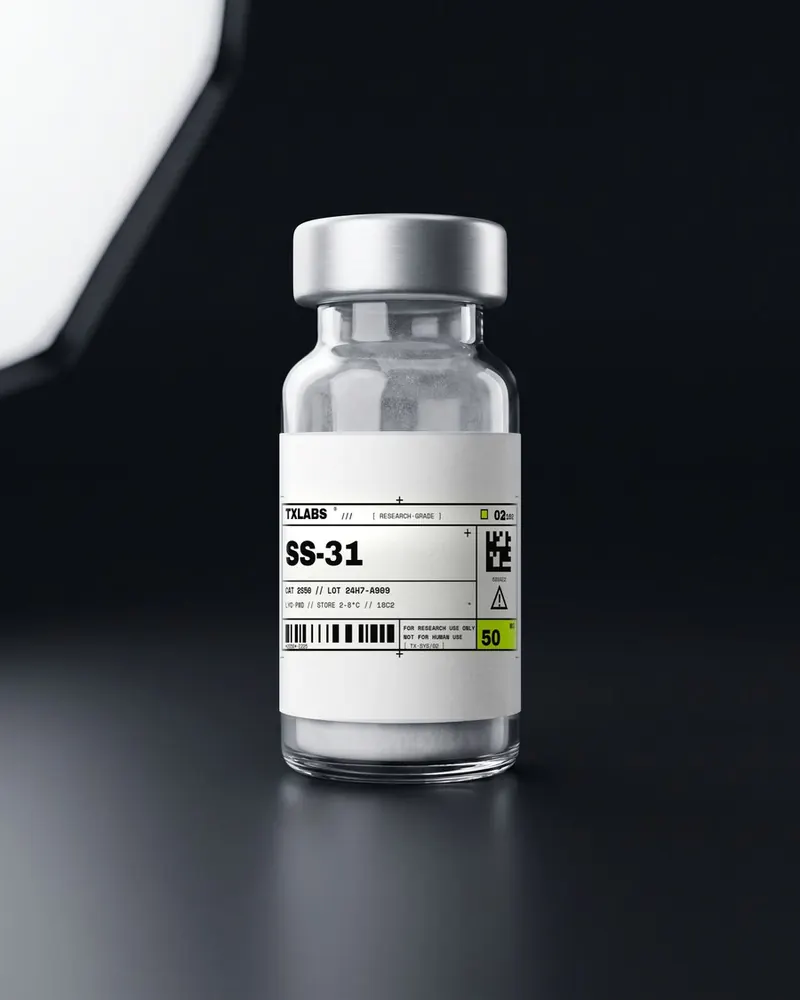
From $229 AUD · ≥98% HPLC purity · third-party COA · ships Australia-wide
What is SS-31?
SS-31 (elamipretide, MTP-131, Bendavia) is a mitochondria-targeting tetrapeptide that binds cardiolipin on the inner mitochondrial membrane. It is investigated in research on mitochondrial bioenergetics, oxidative stress and cellular energy production.
Specifications
- From: $229 AUD
- Category: Longevity & Bioregulators
- Form: Lyophilised powder
- Purity: ≥98% HPLC
- Testing: Third-party Certificate of Analysis
- Classification: Research reference material · For Research Use Only
What the research covers
SS-31, known in the literature also as elamipretide, MTP-131 and Bendavia, is a synthetic aromatic-cationic tetrapeptide. PubChem lists the formula C32H49N9O5 and a molecular weight of 639.8 Da. Its sequence is D-Arg-Dmt-Lys-Phe-NH2, where Dmt is 2,6-dimethyltyrosine, a non-proteinogenic residue, and the C-terminus is amidated. The alternating cationic and aromatic character of that four-residue arrangement is the design principle rather than an accident of sequence: it produces a molecule that partitions into and associates with membranes without requiring a transporter, and the D-arginine and the non-natural tyrosine analogue give a tetrapeptide unusual resistance to peptidase degradation.
What makes SS-31 unusual among the compounds in this catalogue is that it has no established receptor. The characterised interaction described in the published literature is with cardiolipin, a signature phospholipid of the inner mitochondrial membrane, where SS-31 is reported to associate with the lipid and to influence the organisation of cristae and the function of the electron transport chain components that cardiolipin scaffolds. That is a lipid-binding mechanism rather than a receptor-ligand one, and it is why SS-31 is described as mitochondria-targeting rather than as an agonist or antagonist of anything.
Published research has examined mitochondrial bioenergetics, reactive oxygen species handling and cristae morphology in cell and animal models, and SS-31 has been the subject of a substantial clinical development programme in primary mitochondrial disease and in cardiac and ophthalmic contexts. That programme means the compound has a far deeper published record than most peptides in this category, though the interpretation of its mechanism remains an area of active work.
TXLABS supplies SS-31 as an analytical reference material for laboratory research only. It is not an approved therapeutic good in Australia and is not supplied for human or veterinary administration.
Reading the certificate
The checks that matter for SS-31 are stereochemical and structural rather than a bare purity number. It contains a D-arginine, so epimerisation to the L-isomer produces a diastereomer with an identical molecular mass that mass spectrometry cannot detect and only reversed-phase HPLC will resolve. It contains 2,6-dimethyltyrosine, a non-proteinogenic residue, so the observed mass should be confirmed against 639.8 Da rather than calculated from ordinary residue masses. The C-terminal amide should be reflected in that mass. Salt form and residual water contribute to gross powder weight, making net peptide assay in milligrams the meaningful figure. TXLABS publishes third-party certificates for tested lots in the CoA library; no certificate is currently published for SS-31. The lot certificate is available on request to support@txlabs.bio.
Storage and handling
SS-31 is small, amidated and built partly from non-natural residues, which makes it chemically robust by the standards of this catalogue. It has no cysteine and no methionine, so the common oxidation routes do not apply, and at four residues it offers few sites for deamidation or aggregation. Its liabilities are physical rather than chemical: it is strongly cationic and highly surface-active, so it adsorbs readily to glass and plastic at low concentrations and can be lost from dilute working solutions. The dimethyltyrosine is also aromatic and benefits from light protection. Store the lyophilised cake at -20 °C, desiccated and protected from light, equilibrate to room temperature before opening, and hold reconstituted solution at 2-8 °C in the dark with single-use aliquots in place of repeated freeze-thaw. In Australian transit the compact structure gives SS-31 more thermal tolerance than a long peptide, but letterbox and vehicle temperatures above 40 °C are still worth avoiding by collecting promptly and refrigerating.
Working out concentration
SS-31 is stocked in 10 mg and 50 mg vials, a fivefold spread that produces very different concentrations from the same diluent volume. A 10 mg vial reconstituted with 2 mL of bacteriostatic water gives 5 mg/mL; with 1 mL, 10 mg/mL. A 50 mg vial with 5 mL gives 10 mg/mL, and with 2 mL, 25 mg/mL. At only 639.8 Da the molar concentrations are high: 5 mg/mL is approximately 7.8 mM, which matters because published mitochondrial work is usually specified in the nanomolar to low micromolar range and requires a long serial dilution. The reconstitution calculator resolves vial mass against volume. Concentration examples only, not a protocol.
How it relates to adjacent compounds
SS-31 sits in the mitochondrial research group in this catalogue alongside MOTS-c, and the two are worth contrasting rather than grouping: MOTS-c is a peptide encoded within the mitochondrial genome that signals through cellular energy-sensing pathways, whereas SS-31 is a wholly synthetic tetrapeptide that associates with a mitochondrial membrane lipid. One is a signalling molecule of mitochondrial origin, the other a synthetic molecule of mitochondrial destination. NAD+ appears in the same research literature as a redox coenzyme, again by subject matter rather than structure, and humanin shares MOTS-c's mitochondrial-derived peptide class. Nothing else in this catalogue is designed to reach a membrane lipid rather than a protein receptor, which is what places SS-31 slightly outside every category it is filed under. Mechanistic adjacency only.