Vesugen Australia — Lys-Glu-Asp Tripeptide
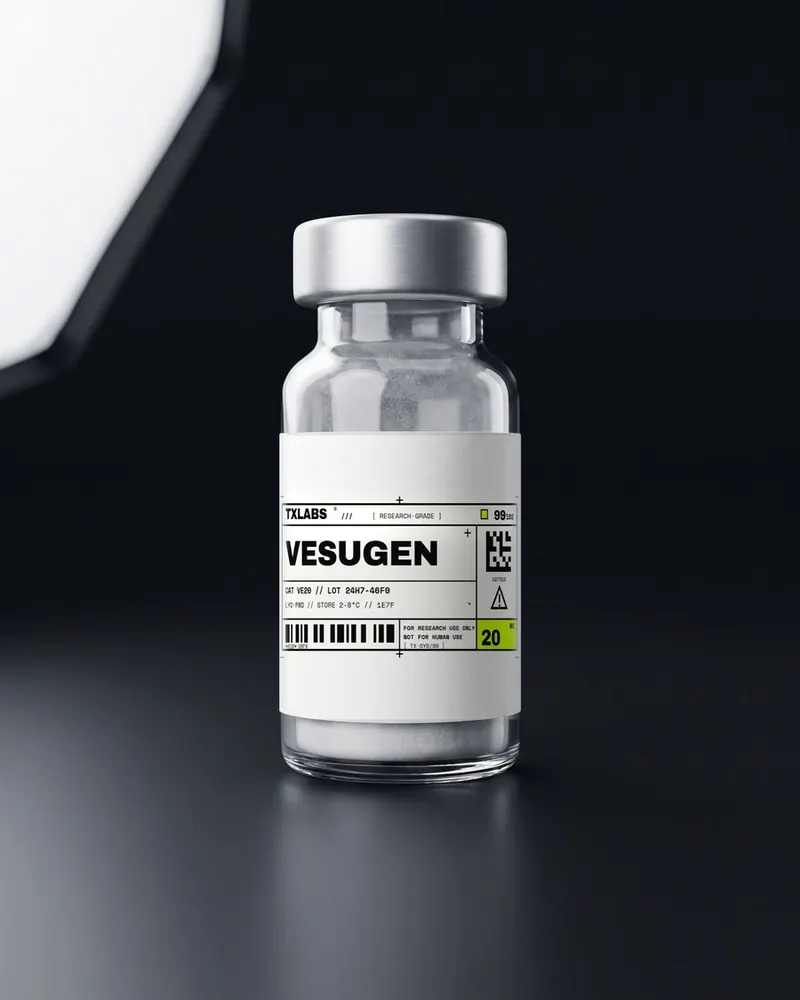
From $99 AUD · ≥98% HPLC purity · third-party COA · ships Australia-wide
What is Vesugen?
Vesugen (Lys-Glu-Asp, KED) is a synthetic tripeptide bioregulator associated with vascular tissue and blood vessels. One of the Khavinson short peptides, it is studied in preclinical research on endothelial cell function and vascular gene expression. Vesugen serves as a research reference for studies of vascular peptide regulation.
Specifications
- From: $99 AUD
- Category: Longevity & Bioregulators
- Form: Lyophilised powder
- Purity: ≥98% HPLC
- Testing: Third-party Certificate of Analysis
- Classification: Research reference material · For Research Use Only
What the research covers
Vesugen is a synthetic tripeptide, Lys-Glu-Asp, usually written KED. It comes from the ultrashort peptide programme run by Professor Vladimir Khavinson and colleagues at the St Petersburg Institute of Bioregulation and Gerontology, in which each sequence was characterised against a nominated tissue and named for it. Vesugen carries the vascular name, and the endothelial and vascular characterisation attached to it was produced within that programme.
What distinguishes vesugen structurally is that it is not merely one member of the family but the shared core of a whole sub-family. Livagen is KED plus alanine, testagen is KED plus glycine, prostamax is KED plus proline, and pancragen is KED plus an amidated tryptophan. Four of the tetrapeptides in this catalogue are, chemically speaking, vesugen with one residue added. That has consequences for identity that the marketing names entirely obscure, and it is the single most useful thing to understand about this compound.
The mechanism proposed in the originating literature is direct interaction with DNA or chromatin-associated proteins leading to tissue-selective modulation of gene expression, rather than binding at a cell-surface receptor. It is a hypothesis argued from modelling and from the programme's own experimental work, not a mechanism established by independent structural or pharmacological study, and this page treats it as such. A 2022 paper from the same group proposing uptake through the POT-family oligopeptide transporters and the LAT-family amino acid transporters states in its own text that transport of these peptides into cells has not been properly studied, and its conclusions rest on computational docking.
The evidence base is narrow in the way this whole family's is narrow: a small number of originating laboratories, largely Russian-language publication, decades of accumulation, reporting conventions unlike the international literature, and limited independent replication.
TXLABS supplies vesugen as a laboratory reference material only. It is not an approved therapeutic good in Australia and is not supplied for human or veterinary administration.
Reading the certificate
The certificate question for vesugen is contamination by its own relatives. Four catalogue tetrapeptides are KED with one residue appended, and in a synthesis or a shared production line the truncated KED species is the obvious failure product of each of them, just as the extended species are plausible carryover in a KED batch. They differ by small mass increments and, being similarly polar, they are poorly separated by a generic reversed-phase gradient. So the useful checks are a named analyte rather than a generic tetrapeptide or tripeptide designation, an observed mass reported to a resolution that actually distinguishes the neighbours, and a chromatographic method with genuine retention rather than a void-volume peak. TXLABS publishes third-party certificates for tested lots in the CoA library. No certificate is currently published for vesugen; the certificate held for the specific lot supplied is provided on request to support@txlabs.bio.
Storage and handling
Vesugen is a small, highly polar, strongly charged tripeptide with two acidic side chains and one basic one. It dissolves in water without persuasion and it takes up water from the air with equal enthusiasm, which is the practical risk. Bring a frozen vial fully to ambient temperature before breaking the seal, so that moisture condenses on the outside of the glass rather than onto the cake, and close it again promptly. Store the lyophilised material at -20 °C, desiccated and protected from light; 2-8 °C is fine for a vial in active use. Reconstituted solution goes to 2-8 °C in the dark and is aliquoted rather than repeatedly frozen and thawed, since short peptides in solution tolerate ice-interface stress poorly despite their simplicity. For Australian delivery the point of failure is a parcel sitting through an afternoon in a vehicle or an unshaded letterbox, where a sealed vial reaches ambient temperatures well above 40 °C in most of the country during summer. Collect promptly and refrigerate on arrival.
Working out concentration
The arithmetic is a single division. A 10 mg vesugen vial with 1 mL of bacteriostatic water gives 10 mg/mL; with 2 mL, 5 mg/mL; with 4 mL, 2.5 mg/mL. The 20 mg vial with 2 mL gives 10 mg/mL and with 5 mL gives 4 mg/mL. Because vesugen and its one-residue-longer relatives are stocked at overlapping vial sizes, it is worth recording the sequence alongside the concentration in any laboratory notebook rather than the trade name alone, since KED at 5 mg/mL and KEDA at 5 mg/mL are different molar concentrations. The reconstitution calculator resolves any vial and volume combination. Concentration examples only, not a protocol.
How it relates to adjacent compounds
Vesugen is the structural hub of this part of the catalogue. Vilon is KED minus its aspartate, a dipeptide, and shows what disappears when a residue is removed. In the other direction testagen is KED plus glycine, and livagen, prostamax and pancragen are the same core plus alanine, proline and amidated tryptophan respectively. Epithalon sits one substitution away from testagen and carries by far the largest literature of any peptide in this tradition, which makes it the natural entry point for anyone reading into the family. These are sequence relationships within a single research programme; they describe chemistry and nothing about relative activity.