MOTS-c Australia — Batch-Verified Research Peptide
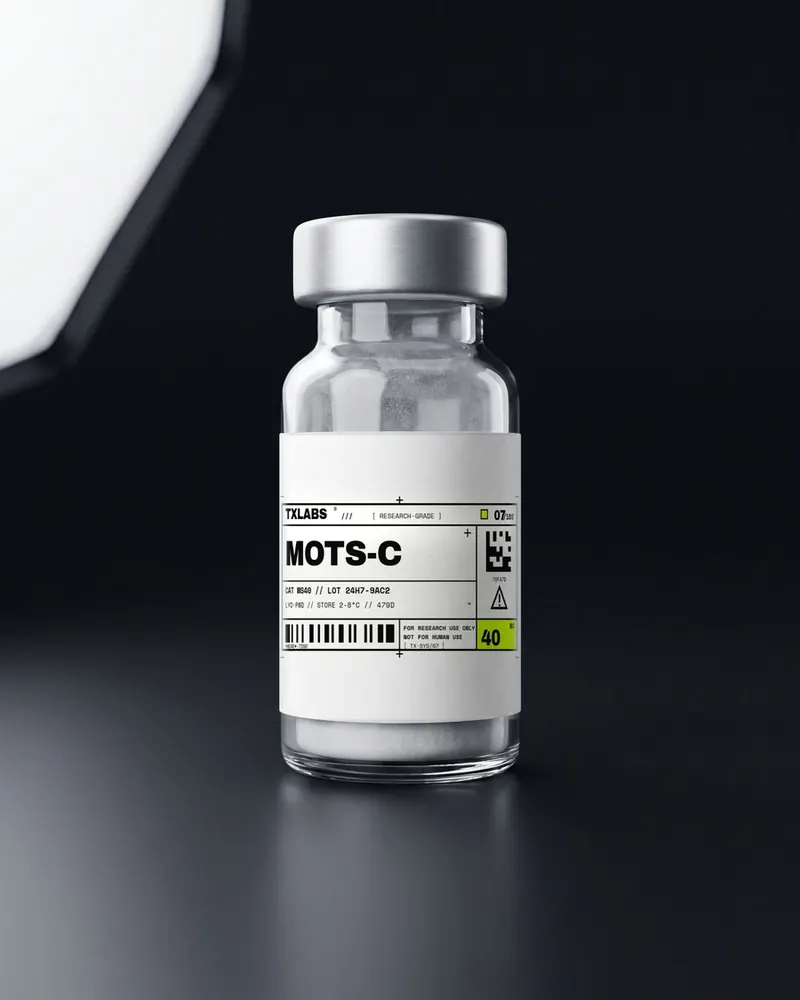
From $189 AUD · ≥98% HPLC purity · third-party COA · ships Australia-wide
What is MOTS-c?
MOTS-c is a mitochondrial-derived peptide encoded within the 12S rRNA region of mitochondrial DNA that helps regulate metabolic homeostasis. It is investigated in research on AMPK signalling, insulin sensitivity and exercise physiology.
Specifications
- From: $189 AUD
- Category: Longevity & Bioregulators
- Form: Lyophilised powder
- Purity: ≥98% HPLC
- Testing: Third-party Certificate of Analysis
- Classification: Research reference material · For Research Use Only
 View full report ↗
What the research covers
MOTS-c is a 16-residue peptide with the sequence MRWQEMGYIFYPRKLR, molecular formula C101H152N28O22S2 and molecular weight 2174.6 Da. What distinguishes it from every other peptide in this catalogue is its genomic origin: MOTS-c is encoded not in nuclear DNA but within the 12S ribosomal RNA region of the mitochondrial genome, read in an alternative open reading frame. It belongs to the class of mitochondrial-derived peptides, a group first opened up by the identification of humanin, and its discovery was reported in 2015 in work that established both its origin and an initial metabolic phenotype in mice.
The mechanistic literature centres on cellular energy sensing. Published work has described MOTS-c as acting on the folate cycle and de novo purine biosynthesis, with consequent accumulation of the intermediate AICAR and activation of AMP-activated protein kinase, the principal cellular energy-status sensor. A separate and much-discussed strand of research has reported that MOTS-c translocates to the nucleus under metabolic stress and associates with antioxidant response element regions, implying a mitochondrial-to-nuclear signalling role rather than a purely cytoplasmic one. Studies in rodents and in cell culture have examined glucose handling, insulin sensitivity indices, skeletal muscle metabolism and exercise capacity, and observational human work has examined circulating MOTS-c concentrations in relation to age and metabolic parameters. A polymorphism in the MOTS-c coding region has been studied in the context of longevity in specific populations.
The field is comparatively young and several proposed mechanisms remain under active investigation rather than settled.
TXLABS supplies MOTS-c as an analytical reference material for laboratory research only. It is not an approved therapeutic good in Australia and is not supplied for human or veterinary administration.
Reading the certificate
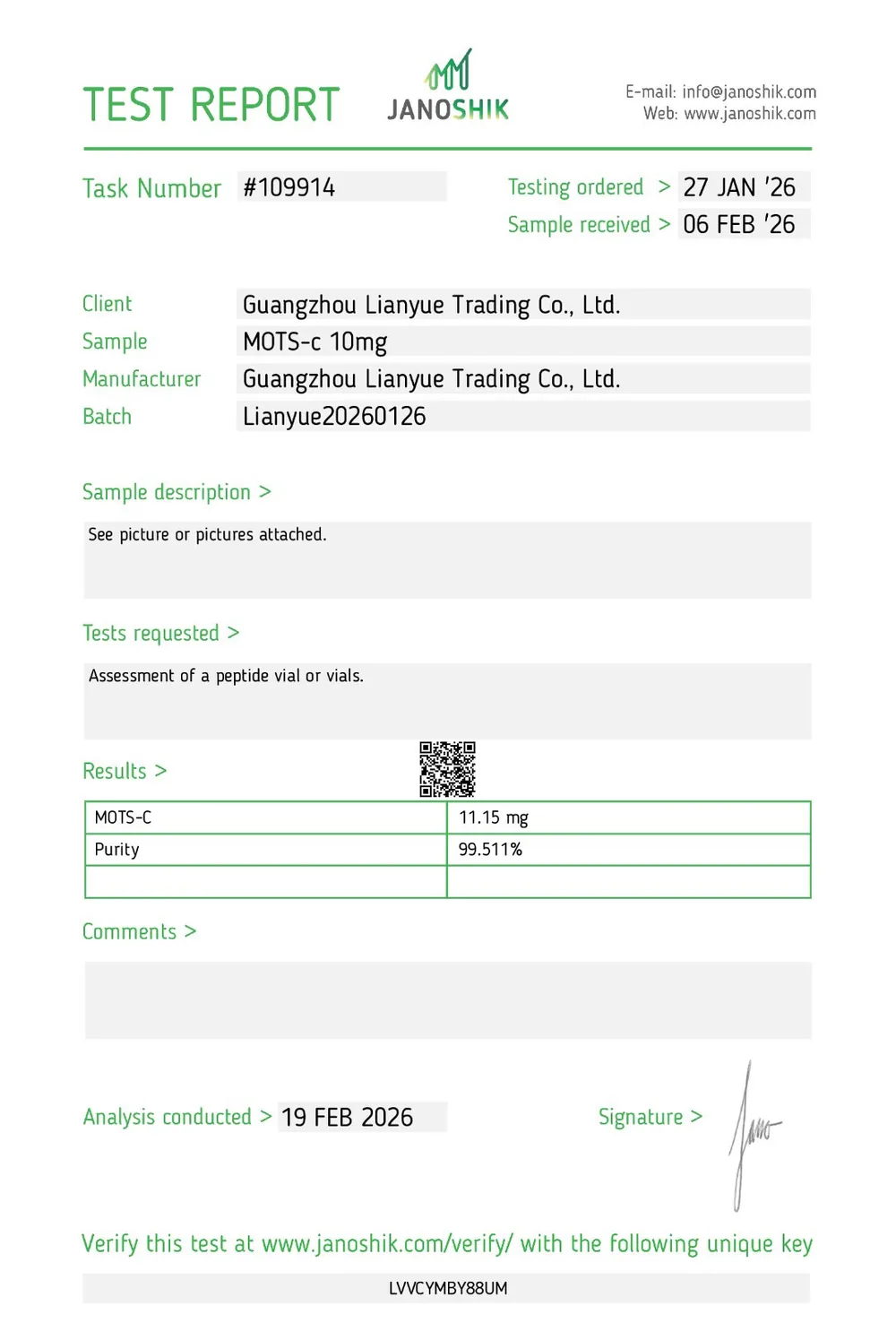
The impurity to look for on a MOTS-c certificate is oxidation, not truncation. With two methionines and a tryptophan in sixteen residues, the characteristic degradation species are methionine sulfoxide variants, which appear as earlier-eluting peaks on reversed-phase HPLC and as mass increments of sixteen daltons on mass spectrometry. A certificate that reports high purity on freshly synthesised material says nothing about oxidation acquired later in storage or transit, which is why the test date matters as much as the number. Confirm identity against 2174.6 Da and read assay in milligrams against label weight. TXLABS publishes the Janoshik Analytical report for MOTS-c in the CoA library: a 10 mg sample assaying 11.15 mg at 99.511% purity, and it is one of the reports published with the task number and verification key intact.
Storage and handling
MOTS-c has a specific chemical vulnerability that most short peptides do not: its sequence contains two methionine residues, at positions 1 and 6, plus a tryptophan at position 3. All three are oxidation-prone, and methionine sulfoxide formation is the degradation product to expect if solution is exposed to air, warmth or light. Handling should therefore minimise oxidative stress: keep headspace exposure short, work quickly when the vial is open, store solutions cold and dark, and avoid oxidising diluents. The lyophilised cake is held at -20 °C, desiccated and light-protected, and equilibrated to room temperature before opening so condensation does not wet the powder. Reconstituted material is kept at 2-8 °C, shielded from light, and aliquoted before freezing rather than freeze-thaw cycled. For Australian conditions the oxidation risk compounds the thermal one, since both methionine oxidation and tryptophan photodegradation accelerate with temperature and light exposure. A parcel sitting in a sun-facing letterbox in a 40 °C summer is a worse proposition for MOTS-c than for a peptide without these residues, so prompt collection and refrigeration matter here.
Working out concentration
MOTS-c is stocked in 10 mg and 40 mg vials. A 10 mg vial reconstituted with 2 mL of bacteriostatic water gives 5 mg/mL; with 1 mL, 10 mg/mL. A 40 mg vial with 4 mL gives 10 mg/mL, and with 8 mL, 5 mg/mL, so the same nominal volume across the two vial sizes produces a fourfold difference. At 2174.6 Da a 5 mg/mL solution corresponds to roughly 2.3 mM, which is the conversion needed when published cell-culture work specifies micromolar concentrations. The reconstitution calculator handles vial mass against diluent volume. These are worked concentration examples only and do not constitute a protocol.
How it relates to adjacent compounds
MOTS-c sits in the longevity and bioregulator category and is the only mitochondrially encoded peptide in the catalogue, which makes its structural relationships with other products essentially nil. Its closest functional neighbour is NAD+, not by structure but by subject matter: both appear in cellular energy metabolism research, MOTS-c through AMPK and folate-cycle signalling, NAD+ as a redox coenzyme and substrate for sirtuins and PARPs. Epithalon shares the same catalogue category and the general ageing-research context but is a synthetic tetrapeptide from an entirely different research tradition, with no mitochondrial connection. These are subject-matter and mechanistic adjacencies only, not comparisons of effect.