Cartalax Australia — Ala-Glu-Asp Tripeptide, 20 mg
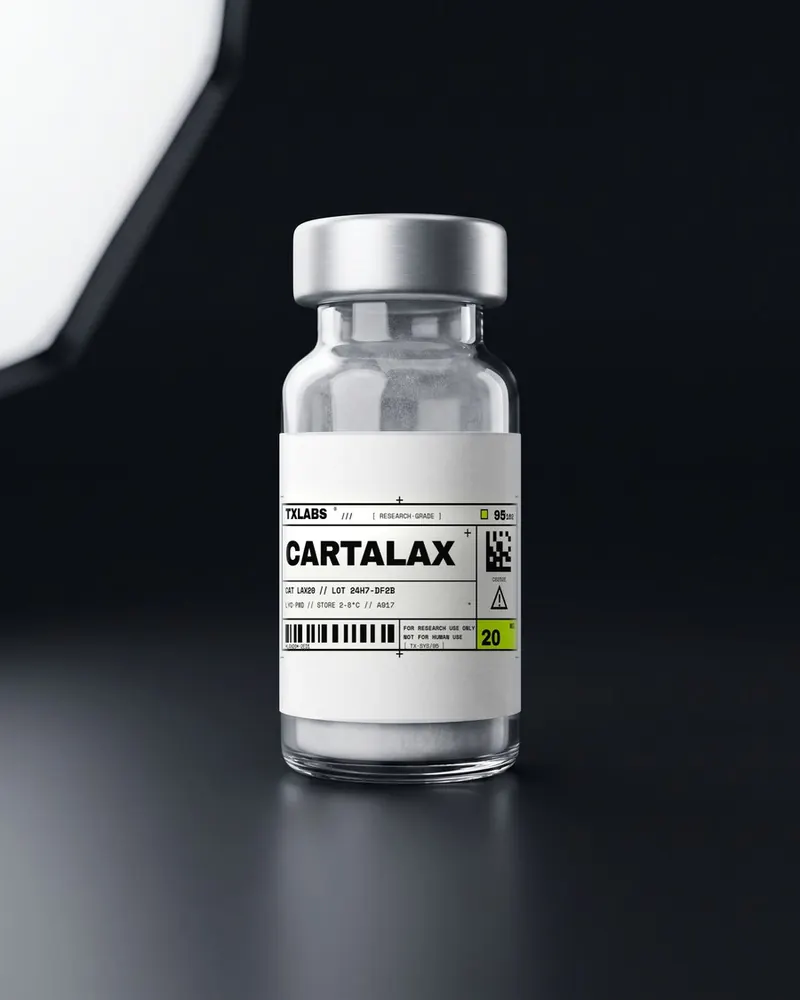
From $109 AUD · ≥98% HPLC purity · third-party COA · ships Australia-wide
What is Cartalax?
Cartalax (Ala-Glu-Asp, AED) is a synthetic tripeptide bioregulator associated with cartilage and bone tissue. A Khavinson short peptide with a sequence found in type XI collagen, it is studied in laboratory research on musculoskeletal cells and matrix gene expression. Cartalax is used as a reference material in connective-tissue research.
Specifications
- From: $109 AUD
- Category: Longevity & Bioregulators
- Form: Lyophilised powder
- Purity: ≥98% HPLC
- Testing: Third-party Certificate of Analysis
- Classification: Research reference material · For Research Use Only
What the research covers
Cartalax is a synthetic tripeptide, Ala-Glu-Asp, from the ultrashort peptide bioregulator programme conducted by Professor Vladimir Khavinson and colleagues at the St Petersburg Institute of Bioregulation and Gerontology. Within that programme it carries the cartilage and connective tissue name, and the characterisation associated with it was performed by the originating groups.
One claim about cartalax circulates more widely than any other and deserves examination rather than repetition. It is commonly stated that the sequence corresponds to a motif found within the alpha-1 chain of type XI collagen. The motif does occur there. What that establishes is much less than the phrasing suggests. There are twenty proteinogenic amino acids, so there are eight thousand possible tripeptides, and a protein of a thousand residues contains nearly a thousand overlapping tripeptide windows. Any given tripeptide will therefore occur by chance in a large fraction of the proteome, and finding Ala-Glu-Asp inside a collagen chain is close to what you would expect from chance alone. The same reasoning applies to most claims that an ultrashort peptide is a fragment of a named protein: at three residues, the observation is weak evidence of derivation and almost no evidence of function.
The mechanism proposed in the originating literature is direct peptide interaction with DNA or chromatin-associated proteins, altering gene expression in a tissue-selective manner. It is a hypothesis developed within a specific research tradition, supported largely by modelling and by that tradition's own experimental work, and this page does not present it as established.
The evidence limitation applies with full force. The publications cluster in a small number of laboratories, are mostly Russian-language, span decades, and have attracted limited independent replication, so external corroboration for most specific findings does not exist.
TXLABS supplies cartalax as an analytical reference material for laboratory research only. It is not an approved therapeutic good in Australia and is not supplied for human or veterinary administration.
Reading the certificate
For a tripeptide with no chromophore, the certificate should be read for what it does not contain. Purity determined at 214 nm on a short reversed-phase gradient is weak evidence when the analyte is barely retained, so look for evidence of a method with real retention and for an observed mass consistent with Ala-Glu-Asp rather than a purity figure alone. The specific related substances worth asking about are the deletion sequences: Glu-Asp and Ala-Glu are the obvious synthesis failures, and both are more polar again and easily lost in the void. Net peptide content against gross vial weight is the other figure that matters, since counterion and water are a large share of the mass at this size. TXLABS publishes third-party certificates for tested lots in the CoA library; there is none currently published for cartalax, and the lot certificate is supplied on request to support@txlabs.bio.
Storage and handling
Ala-Glu-Asp is a small, acidic and very water-soluble tripeptide with no aromatic residue, no thiol and no methionine, which removes most of the oxidative degradation routes that complicate peptide storage. The dominant practical problem is moisture uptake. Two acidic side chains make the lyophilised cake markedly hygroscopic, and a vial opened straight from a freezer will condense water onto the powder before anything else has happened. Let it reach room temperature sealed, then open it. Keep the dry material at -20 °C, desiccated and dark, and reconstituted solution at 2-8 °C, divided into single-use aliquots rather than refrozen repeatedly. For Australian delivery, the specific risk for a hygroscopic acidic peptide is not so much the heat of a summer parcel as the wet-season humidity in the northern half of the country combined with a vial whose seal has been compromised in transit. Inspect the closure on arrival, then refrigerate.
Working out concentration
The cartalax vial is 20 mg. Reconstituted with 2 mL of bacteriostatic water it gives 10 mg/mL; with 4 mL, 5 mg/mL; with 5 mL, 4 mg/mL; with 10 mL, 2 mg/mL. Note that most of the other bioregulators in this catalogue are stocked at both 10 and 20 mg while cartalax is offered at 20 mg only, so a diluent volume carried over from a 10 mg sibling will produce double the intended concentration. That is a common and entirely avoidable record-keeping error. The reconstitution calculator will convert any vial mass against any volume. These are concentration examples for laboratory records, not a protocol.
How it relates to adjacent compounds
Cartalax sits one residue away from two of its neighbours in opposite directions. Chonluten is Glu-Asp-Gly, the same length with a different first and last residue, and epithalon is Ala-Glu-Asp-Gly, which is cartalax with a glycine appended and by a wide margin the most studied compound in this tradition. Reading epithalon's page alongside this one shows how much difference the size of a literature makes to what can honestly be written. Cortagen is Ala-Glu-Asp-Pro, the same core extended by proline instead. These are sequence relationships inside one research programme and carry no implication whatever about comparative activity or relative usefulness.