ARA-290 Australia — Cibinetide EPO Helix-B Peptide
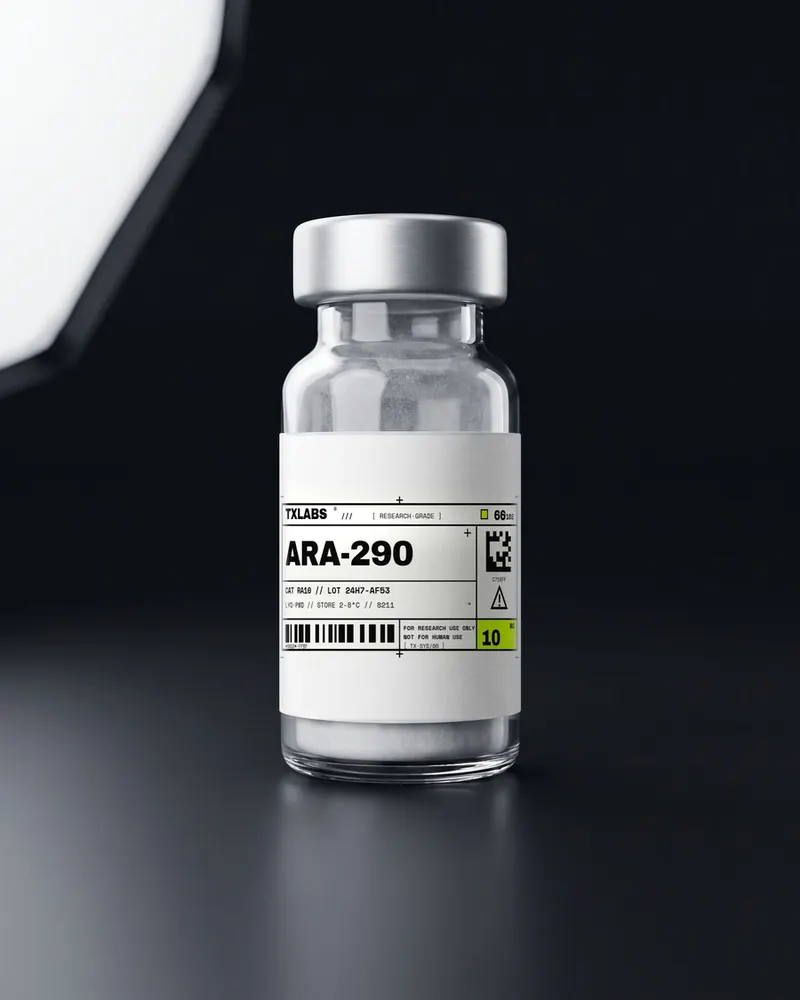
From $69 AUD · ≥98% HPLC purity · third-party COA · ships Australia-wide
What is Ara-290?
Ara-290 (cibinetide) is an 11-amino-acid erythropoietin-derived peptide that selectively activates the innate repair receptor. Unlike EPO it does not stimulate red blood cell production, and is studied in research on inflammation, tissue protection and small-fibre neuropathy.
Specifications
- From: $69 AUD
- Category: Recovery & Repair
- Form: Lyophilised powder
- Purity: ≥98% HPLC
- Testing: Third-party Certificate of Analysis
- Classification: Research reference material · For Research Use Only
What the research covers
ARA-290, also known as cibinetide, is a synthetic linear peptide of eleven residues derived from the helix-B domain of erythropoietin. It is reported in the literature with the sequence pGlu-Glu-Gln-Leu-Glu-Arg-Ala-Leu-Asn-Ser-Ser, carrying a pyroglutamate at the N-terminus, and with a molecular weight commonly given as near 1257 daltons; both figures are reported values rather than something this page asserts independently, and the lot certificate is the reference to work from.
The design rationale is a separation of functions. Erythropoietin acts through the classical homodimeric erythropoietin receptor to drive red blood cell production, but a body of work associated with Brines and colleagues proposed a second receptor, a heterodimer of the erythropoietin receptor with the beta-common receptor CD131, described as an innate repair receptor and associated with tissue-protective and anti-inflammatory signalling rather than erythropoiesis. ARA-290 was engineered from the helix-B region to engage that second receptor without the erythropoietic activity, and that separation is the reason the compound exists at all.
Its development history should be stated. Araim Pharmaceuticals held orphan drug designation for sarcoidosis-associated small-fibre neuropathy. No marketing application was submitted, the company has since closed, and there is no approved cibinetide product in any jurisdiction. It is not registered on the ARTG. The published work is therefore preclinical together with early clinical studies that were never carried through to a completed regulatory programme.
The pyroglutamate N-terminus is worth flagging early because it has practical consequences: it is a cyclised, blocked terminus rather than a free amine.
TXLABS supplies ARA-290 as an analytical reference material for laboratory research only. It is not an approved therapeutic good in Australia and is not supplied for human or veterinary administration.
Reading the certificate
The pyroglutamate is the distinguishing analytical feature and it cuts both ways. Because it is a cyclised, blocked N-terminus, Edman degradation sequencing fails on this peptide, which removes one common orthogonal identity method. It also means the uncyclised glutamine form is a real and predictable related substance, differing from the target by roughly seventeen to eighteen daltons and easily resolved if anyone looked. Ask specifically whether the N-terminal cyclisation was confirmed rather than assumed from the synthesis route. Beyond that, deamidation of the asparagine and glutamine residues gives species one dalton heavier, which requires reasonable mass accuracy to distinguish, and the usual deletion sequences apply. TXLABS publishes third-party certificates for tested lots in the CoA library; no certificate is currently published for ARA-290, and the certificate for the specific lot supplied is available on request to support@txlabs.bio.
Storage and handling
At eleven residues ARA-290 is short enough to be reasonably robust but long enough to carry real chemical liabilities, and both of those are specific. Asparagine and glutamine residues are the deamidation-prone ones, converting to aspartate and glutamate with a gain of about one dalton, and that reaction is accelerated by elevated pH and elevated temperature. The two C-terminal serines add a further site of concern in the sense that the C-terminal region is where succinimide-mediated chemistry tends to occur. Keep the lyophilised material at -20 °C, dry and shielded from light, and let a cold vial reach ambient temperature with the seal intact before it is opened. Reconstituted solution goes to 2-8 °C, aliquoted into single-use volumes rather than repeatedly frozen, and should not be held in an alkaline buffer for longer than necessary. In Australian conditions the transit leg is where deamidation quietly accumulates, since a parcel sitting above 40 °C for an afternoon does exactly what a stability study would do deliberately. Collect promptly and refrigerate on arrival.
Working out concentration
ARA-290 is stocked in a 10 mg vial. Reconstituted with 1 mL of bacteriostatic water it gives 10 mg/mL; with 2 mL, 5 mg/mL; with 5 mL, 2 mg/mL; with 10 mL, 1 mg/mL. Converting to molarity requires a molecular weight, and the figure commonly quoted for this peptide is around 1257 daltons; because that value circulates in secondary sources more than in primary literature, the mass on the certificate for the lot supplied is the better basis for any molar calculation. Working from a quoted mass that does not match the material in hand is a common and avoidable source of error. The reconstitution calculator handles the mass arithmetic. Concentration examples only, not a protocol.
How it relates to adjacent compounds
The closest catalogue relationship is conceptual rather than structural. SS-31 and humanin occupy the same broad research territory of cytoprotective and mitochondrially-oriented peptides while sharing no sequence and no receptor with ARA-290. Thymosin alpha-1 is a comparable case of a defined synthetic peptide derived from a larger endogenous protein and studied for immunological signalling. Nothing else in this catalogue is derived from erythropoietin or engages the receptor system ARA-290 was designed around, which makes its pharmacology unrelated to anything shelved beside it and means no neighbouring page can be used to infer its regulatory or analytical position. These are subject-matter adjacencies only, noted because they help locate the compound, and they imply nothing about comparative activity.