LL-37 Australia — Human Cathelicidin, 37 Residues
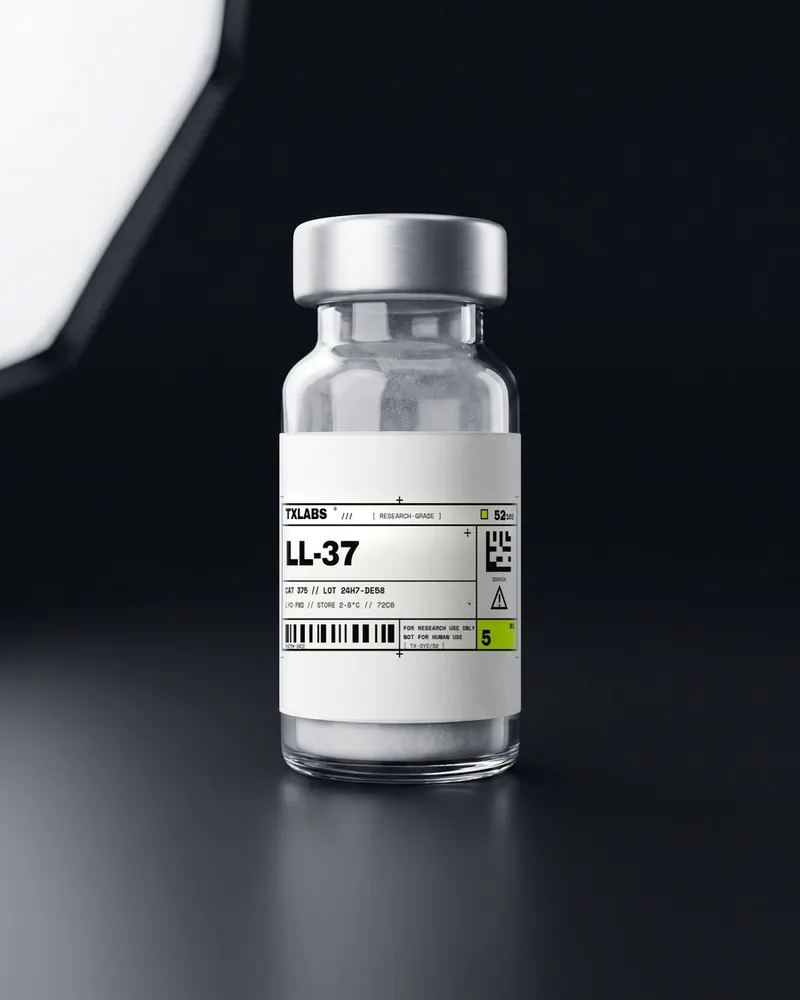
From $79 AUD · ≥98% HPLC purity · third-party COA · ships Australia-wide
What is LL37?
LL-37 is a human cathelicidin-derived antimicrobial peptide (host-defence peptide) with broad membrane-disrupting activity. It is studied in laboratory research on innate immunity, bacterial membrane interactions, and inflammatory signalling.
Specifications
- From: $79 AUD
- Category: Recovery & Repair
- Form: Lyophilised powder
- Purity: ≥98% HPLC
- Testing: Third-party Certificate of Analysis
- Classification: Research reference material · For Research Use Only
What the research covers
LL-37 is the mature 37-residue human cathelicidin peptide, sequence LLGDFFRKSKEKIGKEFKRIVQRIKDFLRNLVPRTES, named for the leucine-leucine pair at its N-terminus. It is encoded by the CAMP gene and catalogued in UniProt as P49913. In vivo it is not translated directly but released by proteolytic processing from the precursor protein hCAP-18, which is itself derived from a longer preproprotein; that processing step is what activates the peptide.
Structurally LL-37 is strongly cationic and amphipathic, adopting an alpha-helical conformation in membrane-mimetic environments in which the basic residues cluster on one face of the helix and the hydrophobic residues on the other. That arrangement is the standard architecture of a membrane-active antimicrobial peptide and it accounts for most of what has been studied about the molecule: published work has examined its membrane-disrupting antimicrobial activity against bacteria, its binding to bacterial lipopolysaccharide, and a broader set of immunomodulatory and chemotactic functions in innate immunity.
At 37 residues LL-37 is one of the longer synthetic peptides in this catalogue, which changes the analytical picture. Solid-phase synthesis at that length reliably generates deletion sequences, peptides missing one residue somewhere in the chain, and those species are close enough in mass and in chromatographic retention to the target to be missed by a coarse method. Its conformational behaviour is also buffer-dependent in a way a short peptide's is not, so the same material can behave differently in different solutions.
The cationic, amphipathic character has a mundane but consequential practical effect: the peptide adsorbs strongly to surfaces.
TXLABS supplies LL-37 as an analytical reference material for laboratory research only. It is not an approved therapeutic good in Australia and is not supplied for human or veterinary administration.
Reading the certificate
For a 37-residue synthetic peptide the informative check is the related-substance profile rather than a single purity number. Deletion sequences, molecules missing one residue from somewhere in the chain, are the characteristic impurity class at this length; they differ from the target by one residue mass and can elute very close to it, so a shallow-gradient chromatogram and a mass spectrum tell you far more than a bare percentage. Net peptide content matters too, since a strongly cationic peptide carries a substantial counterion load and gross powder weight overstates peptide mass. Conformational state is a third dimension that chromatography does not report: circular dichroism is the usual check on helical content. TXLABS publishes third-party certificates for tested lots in the CoA library; none is published for LL-37, and the certificate for the lot supplied is available on request to support@txlabs.bio.
Storage and handling
Surface adsorption is the practical issue that catches people out with this peptide. A strongly cationic amphipathic sequence binds to glass, to ordinary polypropylene and to pipette tips, and a dilute working solution can lose a substantial fraction of its content to container walls without any degradation having occurred at all. Low-binding plasticware, siliconised tubes and the addition of a carrier protein where the experiment permits it are the standard mitigations. Aggregation is the second issue: amphipathic helices self-associate, and mechanical stress accelerates it, so add diluent gently down the vial wall and swirl rather than vortex. Store the lyophilised material at -20 °C, desiccated and dark, equilibrate the vial sealed to room temperature before opening, and hold reconstituted solution at 2-8 °C in single-use aliquots. Australian summer transit above 40 °C promotes aggregation in an amphipathic peptide more readily than in a short polar one, and aggregation is not reversible by refrigerating afterwards. Collect promptly.
Working out concentration
LL-37 is stocked at 5 mg and 10 mg. The 5 mg vial reconstituted with 1 mL of diluent gives 5 mg/mL; with 2 mL, 2.5 mg/mL. The 10 mg vial with 1 mL gives 10 mg/mL, with 2 mL gives 5 mg/mL and with 5 mL gives 2 mg/mL. A caution particular to this peptide: the concentration you calculate is the concentration you prepared, not necessarily the concentration in the tube an hour later, because adsorption to container surfaces removes material from dilute solutions. Preparing at higher concentration and diluting immediately before use limits the loss. The reconstitution calculator handles the arithmetic. Concentration examples only, not a protocol.
How it relates to adjacent compounds
KPV and thymosin alpha-1 are the catalogue's other peptides studied in immunological contexts, though both are far shorter and neither is membrane-active in the way a cationic amphipathic helix is. Full-length thymosin beta-4 is the closest comparison by length, at 43 residues, and shares LL-37's exposure to deletion-sequence impurities and to aggregation, which makes the two similar in what their certificates need to demonstrate even though their chemistry and their biology are entirely unrelated. Nothing else in the catalogue is a membrane-active host-defence peptide, so LL-37's handling requirements have no close parallel here. These are structural, analytical and subject-matter adjacencies only and carry no implication about comparative activity.