AHK-Cu Australia — Ala-His-Lys Copper Complex
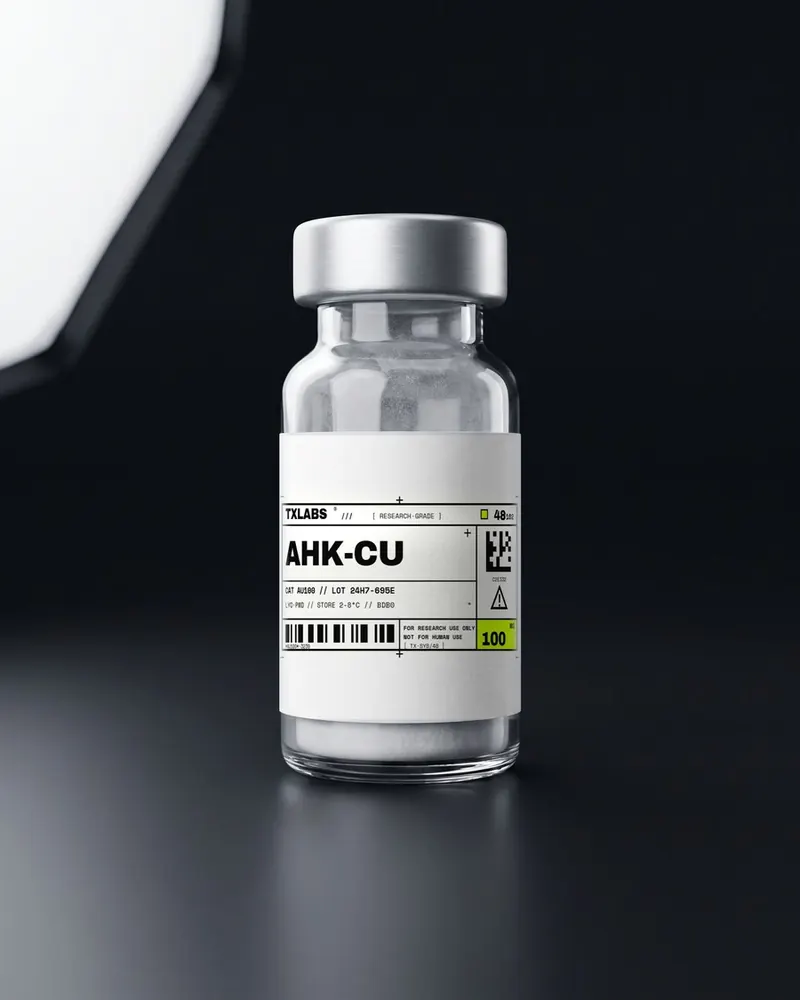
From $89 AUD · ≥98% HPLC purity · third-party COA · ships Australia-wide
What is AHK-CU?
AHK-Cu is a copper-binding tripeptide (alanyl-histidyl-lysine complexed with copper) used as a research reference material. It is studied in laboratory research on hair follicle biology, angiogenesis, and copper-dependent signalling in dermal tissue.
Specifications
- From: $89 AUD
- Category: Recovery & Repair
- Form: Lyophilised powder
- Purity: ≥98% HPLC
- Testing: Third-party Certificate of Analysis
- Classification: Research reference material · For Research Use Only
What the research covers
AHK-Cu is the tripeptide Ala-His-Lys presented as a copper(II) complex. It is a synthetic analogue of the naturally occurring GHK, differing from it at a single position: alanine in place of glycine at the first residue. The complex is widely reported with the formula C15H24CuN6O4 and a molecular weight near 416.9, though as with most metal-peptide complexes sold in this market those figures are best treated as reported values to be confirmed against the lot certificate rather than as fixed properties of the product.
The chemistry that makes both AHK and GHK interesting is copper coordination. A histidine at the second position, combined with the N-terminal amine and a backbone nitrogen, produces a three-point binding site with high affinity for copper(II). That arrangement is a genuine and well-characterised coordination chemistry motif, not a marketing construct, and it is the reason these peptides exist as defined complexes rather than as peptides that happen to be near copper.
The published work on AHK-Cu is considerably narrower than the work on GHK-Cu. GHK has accumulated a broad literature spanning dermal fibroblast biology, extracellular matrix components and gene expression profiling. AHK-Cu has been examined in a much smaller body of work concentrated on hair follicle and dermal cell systems. Anyone reading around this compound should be careful not to import GHK findings wholesale: the two are one methyl group apart in structure and many orders of magnitude apart in how much has actually been published about each.
TXLABS supplies AHK-Cu as an analytical reference material for laboratory research only. It is not an approved therapeutic good in Australia and is not supplied for human or veterinary administration.
Reading the certificate
Peptide purity by HPLC answers only half the question for a metal complex. The other half is the copper: how much is present, and in what stoichiometric relationship to the peptide. That is measured by an elemental technique, inductively coupled plasma mass spectrometry or atomic absorption spectroscopy, not by chromatography, and a certificate reporting only peptide purity has not established that the material is a complex at all rather than a peptide with some copper alongside it. Ultraviolet and visible absorbance carries information here too, since the d-d transition band of a copper-peptide complex sits in the visible region and its position reflects the coordination environment. Ask for copper content and stoichiometry alongside peptide purity and identity. TXLABS publishes third-party certificates for tested lots in the CoA library; no certificate is currently published for AHK-Cu, and the certificate for the specific lot supplied is available on request to support@txlabs.bio.
Storage and handling
A copper complex behaves differently from a bare peptide in ways that affect routine handling. Colour is the most immediately useful signal: copper(II) peptide complexes are blue to violet, and the intensity and hue relate to the coordination environment, so a marked change in colour genuinely indicates that something about the complex has altered. Store the lyophilised material at -20 °C, desiccated and protected from light, and equilibrate a cold vial sealed to room temperature before opening. Reconstituted solution goes to 2-8 °C in the dark. Two chemistry-specific cautions apply. Avoid chelating agents and strongly chelating buffers, since EDTA and similar species will strip copper from the peptide. And avoid strongly alkaline conditions, which alter copper coordination and can precipitate hydroxide species. Copper also catalyses oxidative chemistry, so any reducing agent in the same solution deserves thought. Australian summer transit above 40 °C is less damaging to a small complex than to a large peptide, but prompt collection and refrigeration remains sensible.
Working out concentration
Concentration is mass over volume as always. A 50 mg AHK-Cu vial reconstituted with 5 mL of diluent gives 10 mg/mL; with 10 mL, 5 mg/mL; with 2.5 mL, 20 mg/mL. The 100 mg vial with 10 mL gives 10 mg/mL and with 5 mL gives 20 mg/mL. One point specific to a metal complex: the mass includes the copper and any counterion, so a molar figure calculated from the complex mass is not the same as one calculated from the free peptide mass, and the two are commonly confused. State which basis is being used in the record. The reconstitution calculator handles vial mass against volume. Concentration examples only, not a protocol.
How it relates to adjacent compounds
GHK-Cu is the compound AHK-Cu is an analogue of, differing only by a methyl group at the first residue, and it carries a far larger published literature; its page is the better starting point for the underlying copper-peptide chemistry. GHK basic is the same tripeptide without the copper and demonstrates directly what the metal contributes, including the way an apo peptide scavenges copper from its surroundings. The three together form a small set in which one variable changes at a time, which is unusual in this catalogue and analytically instructive when reading across between them. These are structural relationships and carry no implication about comparative activity or relative usefulness.