Dermorphin Australia — Mu-Opioid Heptapeptide Standard
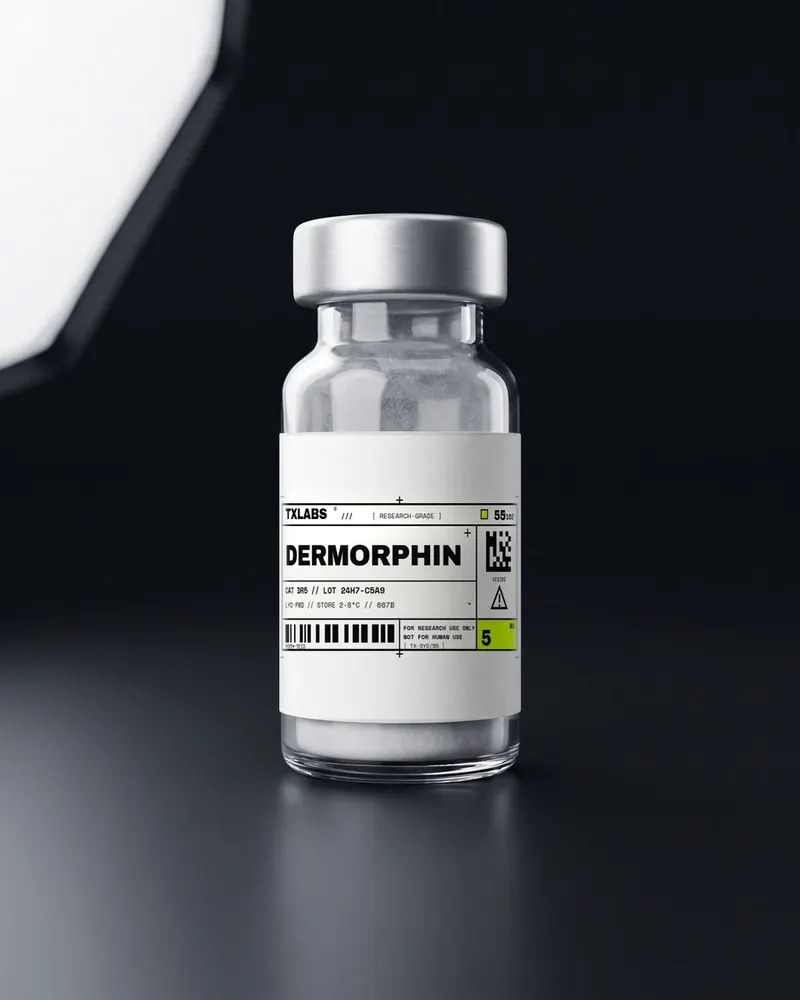
From $49 AUD · ≥98% HPLC purity · third-party COA · ships Australia-wide
What is Dermorphin?
Dermorphin — a research-grade peptide reference supplied lyophilized for laboratory use only.
Specifications
- From: $49 AUD
- Category: Recovery & Repair
- Form: Lyophilised powder
- Purity: ≥98% HPLC
- Testing: Third-party Certificate of Analysis
- Classification: Research reference material · For Research Use Only
What the research covers
Dermorphin is a heptapeptide with the sequence H-Tyr-D-Ala-Phe-Gly-Tyr-Pro-Ser-NH2, isolated from the skin of the South American tree frog Phyllomedusa sauvagei, with the sequence published in 1981 by Erspamer and colleagues. It occupies a genuinely important place in peptide biochemistry: it was the first vertebrate peptide shown to contain a D-amino acid. The D-alanine at position 2 is not incorporated during translation, which uses only L-amino acids, but arises afterwards through post-translational epimerisation of an L-alanine in the precursor by an enzyme in the frog's skin. That finding changed what was assumed to be possible in vertebrate peptide biosynthesis.
Pharmacologically dermorphin is a highly selective, high-affinity agonist at the mu-opioid receptor, encoded by OPRM1, and is reported in the published literature as far more potent than morphine on a molar basis in animal receptor and behavioural assays. It is used in receptor pharmacology as a selective mu-receptor tool compound.
Its other notoriety is in animal doping. Dermorphin was used illicitly in racehorses and is banned by horse-racing regulators internationally, which is why detection methods for it exist in equine testing laboratories.
A clear statement is necessary here. Opioid receptor agonists are among the most tightly controlled classes of substance in Australia. The Poisons Standard contains controlled-drug and prohibited-substance schedules covering opioid substances, and separate state and territory controlled-substances legislation applies in addition to Commonwealth scheduling. Dermorphin is not registered on the ARTG. Anyone contemplating handling this compound must establish its status under the current Poisons Standard and under the law of their own jurisdiction, and must hold the necessary institutional approvals, before doing anything at all.
TXLABS supplies dermorphin as an analytical reference material for laboratory research only. It is not an approved therapeutic good in Australia and is not supplied for human or veterinary administration.
Reading the certificate
The identity question here is the one that arises for any peptide containing a D-residue, and it is not answered by mass. A D-alanine and an L-alanine have identical molecular formulas and identical masses, so an all-L heptapeptide of the same sequence is isobaric with dermorphin and indistinguishable on a mass spectrum. Only chiral analysis, typically amino acid analysis after hydrolysis with chiral separation, establishes that the D-form is present, with reversed-phase retention giving supporting evidence since the two diastereomeric peptides usually resolve. The C-terminal amide is a second point: it differs from the free acid by about one dalton and requires real mass accuracy to confirm. The two tyrosines do at least provide a selective 280 nm detection wavelength. TXLABS publishes third-party certificates for tested lots in the CoA library; none is published for dermorphin, and the lot certificate is available on request to support@txlabs.bio.
Storage and handling
The D-alanine at position 2 gives dermorphin a degree of resistance to aminopeptidase attack that an all-L heptapeptide would not have, since proteases are stereospecific, and the C-terminal amide closes the carboxypeptidase route. That is a stability advantage in a biological matrix but it does nothing about chemical degradation. Two tyrosine residues make the molecule susceptible to oxidation and to photochemical damage, so light protection and minimal headspace are real controls rather than formalities. Hold the lyophilised material at -20 °C, desiccated and protected from light, and equilibrate a cold vial sealed to room temperature before opening. Reconstituted solution goes to 2-8 °C in the dark, in single-use aliquots. Beyond the chemistry, this is a compound where physical security and documented custody are part of handling: secure storage and a complete record of receipt and use are ordinary requirements for controlled material and should be in place before the vial arrives. Australian summer transit above 40 °C accelerates tyrosine oxidation; collect promptly and refrigerate.
Working out concentration
Concentration is mass divided by volume. A 5 mg dermorphin vial reconstituted with 1 mL of diluent gives 5 mg/mL; with 2 mL, 2.5 mg/mL; with 5 mL, 1 mg/mL. The 10 mg vial with 1 mL gives 10 mg/mL, with 2 mL gives 5 mg/mL and with 10 mL gives 1 mg/mL. Because the two tyrosine residues give a genuine absorbance near 280 nm, a spectrophotometric estimate against a known extinction coefficient provides an independent check on the calculated figure, which is a useful cross-check for a compound where accurate records matter particularly. The calculator handles the division. Concentration examples only, not a protocol of any kind.
How it relates to adjacent compounds
FOXO4-DRI and adipotide are the other catalogue compounds built with D-amino acids, and all three share the problem that mass spectrometry cannot establish their stereochemistry; the FOXO4 page treats that limitation at length. KPV is another short peptide corresponding to a fragment of a larger endogenous signalling molecule, though from a completely unrelated system. Nothing else in the catalogue is an opioid receptor ligand, which means dermorphin's regulatory position has no parallel here and cannot be inferred from any neighbouring product or from the catalogue's general posture on unapproved peptides. These are chemical and analytical adjacencies only, noted because they bear on how identity is established, and they imply nothing about comparative activity.