HCG Australia — Glycoprotein Hormone Reference Material
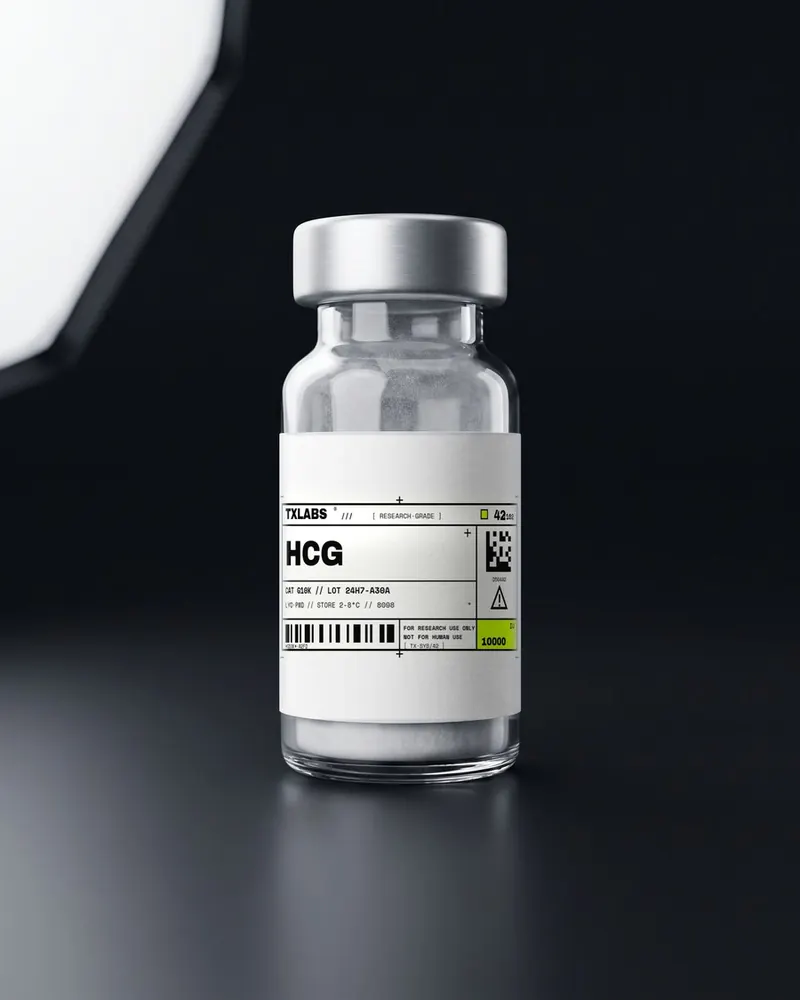
From $169 AUD · ≥98% HPLC purity · third-party COA · ships Australia-wide
What is HCG?
HCG (Human Chorionic Gonadotropin) is a glycoprotein hormone that acts on the LH/hCG receptor to stimulate gonadal steroidogenesis. It is studied in laboratory research on reproductive endocrinology, Leydig and granulosa cell signalling and the hypothalamic-pituitary-gonadal axis.
Specifications
- From: $169 AUD
- Category: Hormones & Sexual Health
- Form: Lyophilised powder
- Purity: ≥98% HPLC
- Testing: Third-party Certificate of Analysis
- Classification: Research reference material · For Research Use Only
What the research covers
Human chorionic gonadotropin is fundamentally unlike everything else in this catalogue, and treating it as a peptide leads to errors at every stage from storage to certification. It is a heterodimeric glycoprotein hormone: two separate polypeptide chains held together non-covalently, each heavily glycosylated. The alpha chain, catalogued in UniProt as P01215, is a 92-residue mature protein shared identically with luteinising hormone, follicle-stimulating hormone and thyroid-stimulating hormone, and carries two N-linked glycosylation sites. The hormone-specific beta chain, UniProt P0DN86, is a 145-residue mature protein carrying two N-linked and four O-linked glycosylation sites. Neither chain is active alone; the dimer is the hormone.
The beta chain's C-terminal peptide extension, which carries the O-linked sugars, is the structural feature that distinguishes hCG from luteinising hormone and is generally credited in the literature with hCG's substantially longer reported circulating half-life. Total molecular mass is usually given in the region of 36 to 40 kilodaltons, and it is not a single number: carbohydrate accounts for a large fraction of the mass and glycosylation is heterogeneous, so any preparation is a distribution of glycoforms rather than one molecular species.
Both hCG and luteinising hormone act at the same receptor, the LH/hCG receptor, a Gs-coupled G-protein-coupled receptor on gonadal cells. Published research spans reproductive endocrinology, receptor structural biology, the glycobiology of gonadotropins, and hCG's very long-established role as the analyte in pregnancy testing. Material may be urinary-derived, purified from human urine, or recombinant, expressed in cell culture, and the two routes give different impurity and glycoform profiles.
TXLABS supplies this material as an analytical reference material for laboratory research only. It is not supplied for human or veterinary administration.
Reading the certificate
A peptide-style certificate is the wrong document for a glycoprotein and should be recognised as such. A reversed-phase HPLC purity percentage does not describe a heterogeneously glycosylated dimer, and a single molecular mass cannot be reported for a molecule whose glycoform distribution spans several kilodaltons. The meaningful questions are potency in international units established by bioassay against a recognised reference preparation, dimer integrity as opposed to free subunit content, aggregate content by size-exclusion chromatography, glycoform profile, and whether the source is urinary-derived or recombinant, since the residual impurity profiles differ. TXLABS publishes third-party certificates for tested lots in the CoA library; no certificate is currently published for HCG. The lot certificate is available on request to support@txlabs.bio.
Storage and handling
A folded, non-covalently associated glycoprotein dimer is the least thermally robust item in this catalogue, and its handling should reflect that rather than following peptide conventions. The two chains are held together by non-covalent interactions, so heat, extremes of pH, shear and chaotropic conditions can dissociate the dimer into inactive free subunits without any change in total mass and without any visible sign in the vial. Denaturation of a folded protein is irreversible in a way that peptide degradation often is not. Store the lyophilised material at -20 °C, desiccated and protected from light, equilibrate to room temperature before opening, reconstitute gently without vortexing, and hold the solution at 2-8 °C. Freeze-thaw is particularly damaging to protein dimers, so single-use aliquots are essential rather than advisable. Australian summer transit above 40 °C is a genuine risk to this product specifically, more so than to any synthetic peptide here. Collect promptly, unpack indoors and refrigerate without delay.
Working out concentration
HCG is supplied by activity rather than by mass, in 2000, 5000 and 10000 IU vials, so the concentration arithmetic is worked in international units per millilitre. A 5000 IU vial reconstituted with 1 mL of bacteriostatic water gives 5000 IU/mL; with 5 mL, 1000 IU/mL; with 10 mL, 500 IU/mL. A 10000 IU vial with 10 mL likewise gives 1000 IU/mL, and a 2000 IU vial with 2 mL gives 1000 IU/mL. Converting IU to milligrams is not a simple arithmetic step, because the international unit is defined by bioassay against a reference preparation and specific activity varies between preparations. The reconstitution calculator handles the volume arithmetic. Concentration examples only, not a protocol.
How it relates to adjacent compounds
HMG is the closest catalogue relative, being another gonadotropin preparation and likewise a glycoprotein rather than a synthetic peptide, with the same class of characterisation requirements. Moving upstream in the same axis, gonadorelin is the hypothalamic decapeptide acting at the pituitary, and kisspeptin-10 acts a step above that. HCG is at the gonadal receptor end of the same pathway and shares no structural relationship with either, being a 36 to 40 kilodalton glycosylated dimer rather than a ten-residue peptide. It is also the only product in this catalogue quantified in international units rather than milligrams, a difference that follows directly from its glycoprotein nature rather than from any convention. Pathway relationships only, not comparisons of activity.