EPO Australia — Recombinant Erythropoietin Standard
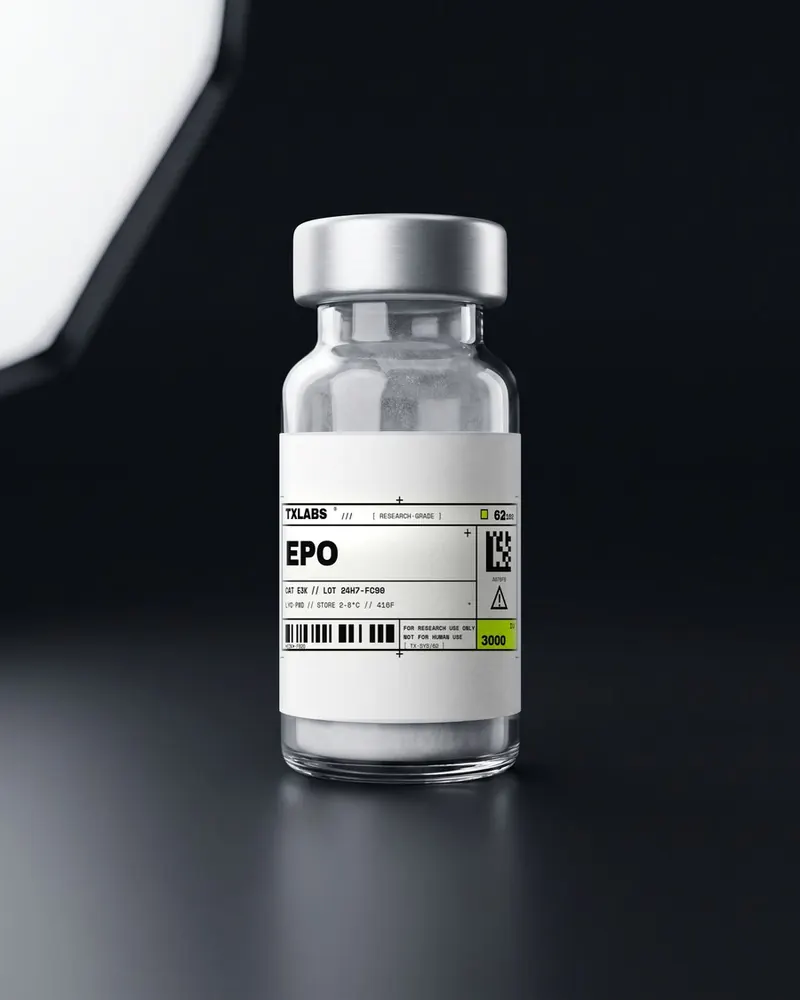
From $289 AUD · ≥98% HPLC purity · third-party COA · ships Australia-wide
What is EPO?
EPO (erythropoietin) is a glycoprotein hormone that stimulates erythropoiesis, the production of red blood cells in bone marrow. Produced mainly by the kidneys in response to hypoxia, it is used as a reference standard and investigated in research on oxygen transport, hypoxia signalling and haematopoiesis.
Specifications
- From: $289 AUD
- Category: Hormones & Sexual Health
- Form: Lyophilised powder
- Purity: ≥98% HPLC
- Testing: Third-party Certificate of Analysis
- Classification: Research reference material · For Research Use Only
What the research covers
EPO in this catalogue denotes recombinant human erythropoietin. It is a prescription-only medicine in Australia and registered prescription products containing recombinant erythropoietins exist on the Australian Register of Therapeutic Goods. TXLABS supplies it strictly as an analytical reference material for laboratory work. It is not supplied for human or veterinary administration, and this page does not describe clinical indications or effects in humans.
Erythropoietin is a glycoprotein hormone. The mature human protein, catalogued in UniProt as P01588, comprises 165 amino acid residues after signal peptide and C-terminal processing, and carries two intramolecular disulfide bonds. What makes it analytically distinctive is its carbohydrate: the protein bears three N-linked glycans and one O-linked glycan, and that glycosylation accounts for a large fraction of the total molecular mass, taking the intact glycoprotein to roughly 30 kDa against a polypeptide backbone nearer 18 kDa. The glycans are not incidental decoration. Their structure, branching and terminal sialylation determine the molecule's circulating behaviour and its isoelectric profile, and they vary with the expression system and the manufacturing process. Two preparations with identical amino acid sequences can therefore differ measurably.
That heterogeneity is the reason a reference material exists and is also the main subject of the relevant analytical literature. Recombinant erythropoietin is a WADA-prohibited substance, and a substantial body of published method development addresses distinguishing recombinant from endogenous erythropoietin and distinguishing one recombinant product from another. The established approaches are isoelectric focusing, sarcosyl polyacrylamide gel electrophoresis and related electrophoretic methods that separate glycoforms by charge or size, read with immunoblotting. Comparability assessment between originator products and biosimilars uses the same glycan-focused toolkit. Reference material of known provenance is a prerequisite for that work rather than an optional extra.
TXLABS supplies recombinant erythropoietin as an analytical reference material for laboratory research only. It is a prescription medicine in Australia, it is not supplied for human or veterinary administration, and it is not offered for any therapeutic purpose.
Reading the certificate
A certificate for a glycoprotein answers questions a peptide certificate never has to. Purity as a single reversed-phase percentage is close to meaningless here. What matters is the glycoform distribution, usually presented as an isoelectric focusing or capillary electrophoresis profile, since that is what distinguishes preparations and what changes on mishandling. Ask also for aggregate content by size exclusion chromatography, since aggregation is the principal physical degradation route; for the expression system, because glycan structures differ between mammalian cell lines; for host cell protein and host cell DNA levels, which are process-related impurities specific to recombinant production; and for the potency basis, since the international unit is defined by bioassay against an international standard and cannot be inferred from mass. TXLABS publishes third-party certificates for tested lots in the CoA library; no certificate is currently published for EPO. The lot certificate is available on request to support@txlabs.bio.
Storage and handling
Erythropoietin is handled as a glycoprotein biologic, not as a peptide. The dominant failure modes are physical rather than chemical: adsorption to container surfaces at low concentration, aggregation driven by interfacial stress at air-liquid boundaries, and denaturation from shear. Shaking a vial of this material is a real error rather than a stylistic one, because the resulting aggregates are effectively irreversible and are invisible without light scattering or size exclusion analysis. The two intramolecular disulfides can be reduced or scrambled by reducing agents and by pH extremes. The sialic acids on the glycans are labile to acid and to sialidase activity from any microbial contamination, and desialylation changes the isoelectric profile without changing the polypeptide, which is precisely the property the analytical methods are looking at.
Store lyophilised material frozen, desiccated and protected from light, and equilibrate the sealed vial to room temperature before opening. Reconstitute by adding diluent slowly down the vial wall and swirling gently. Hold solutions at 2-8 C, aliquot rather than freeze and thaw, and avoid vortexing at any stage. Australian summer transit above 40 C is a realistic risk for a protein of this class, and prompt refrigeration on arrival is the appropriate response.
Working out concentration
Erythropoietin is presented by activity, not by mass. The TXLABS vial is nominally 3000 IU. Taken into 1 mL that gives 3000 IU/mL; into 3 mL, 1000 IU/mL; into 6 mL, 500 IU/mL. There is no general conversion from international units to milligrams: the relationship depends on the specific activity of the particular preparation, which is a manufacturer-determined figure of the order of a hundred thousand units per milligram of protein, meaning a 3000 IU vial contains a very small mass of protein, in the tens of micrograms. At that mass, adsorptive loss to container surfaces is a substantial fraction of the total. The calculator handles ordinary mass and volume conversions. Unit arithmetic only, not a protocol.
How it relates to adjacent compounds
Within this catalogue the closest analytical relatives of erythropoietin are the other materials whose content is defined by biological activity rather than by mass. hCG and HMG are both gonadotropin preparations standardised in international units, and both share the glycoprotein problem that sequence identity does not establish identity of product. HGH 191AA somatropin is the catalogue's other recombinant human protein presented in international units, though it is unglycosylated, which makes an instructive contrast: its unit-to-mass relationship is fixed and simple, while erythropoietin's is not. All four sit apart from the synthetic peptides that make up most of the catalogue. These are metrological and structural adjacencies only, and imply nothing about comparable activity or interchangeable use.