Teriparatide Australia — rhPTH(1-34) Reference Material
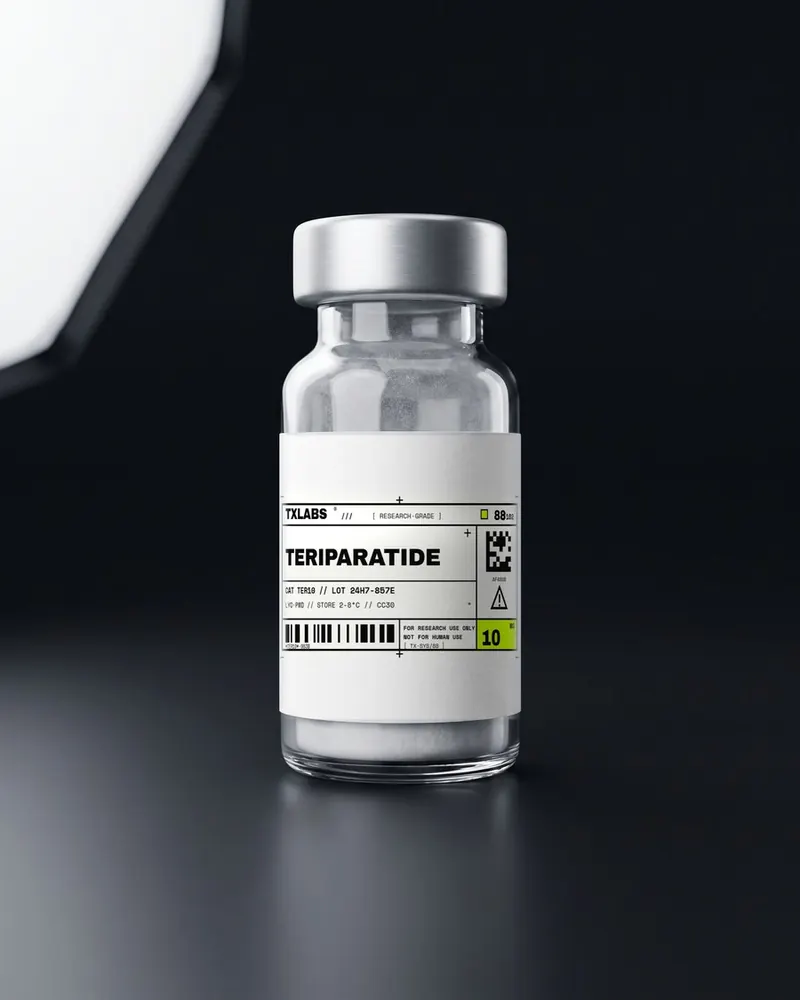
From $419 AUD · ≥98% HPLC purity · third-party COA · ships Australia-wide
What is Teriparatide?
Teriparatide (recombinant human PTH 1-34) is the N-terminal fragment of parathyroid hormone studied in bone-formation research. Corresponding to the first 34 amino acids of parathyroid hormone, it is used as a reference in preclinical studies of osteoblast activity and bone anabolism under intermittent exposure.
Specifications
- From: $419 AUD
- Category: Hormones & Sexual Health
- Form: Lyophilised powder
- Purity: ≥98% HPLC
- Testing: Third-party Certificate of Analysis
- Classification: Research reference material · For Research Use Only
What the research covers
Teriparatide is a prescription-only medicine in Australia and registered prescription products containing it exist on the Australian Register of Therapeutic Goods. TXLABS supplies it strictly as an analytical reference material for laboratory research. It is not supplied for human or veterinary administration, and no clinical use is described on this page.
The molecule is the N-terminal 1-34 fragment of human parathyroid hormone, conventionally written rhPTH(1-34), with a molecular weight of approximately 4118 Da. Full-length parathyroid hormone is an 84-residue polypeptide secreted by the parathyroid glands and encoded by the PTH gene. The structural point that defines teriparatide is that receptor activation resides almost entirely in the first 34 residues: the N-terminal region contacts the receptor's transmembrane core and drives signalling, while the C-terminal two thirds of the hormone contribute to binding affinity and to clearance but are not required for activation. Truncation at residue 34 therefore produces a molecule that retains the receptor-activating portion of the parent hormone in a much smaller and more tractable form.
The published literature relevant to the fragment is substantial and long-standing. Much of it is receptor pharmacology at PTH1R, a class B G protein-coupled receptor: ligand binding studies, cyclic AMP accumulation and beta-arrestin recruitment assays, structural work on the receptor-ligand complex, and comparisons between PTH(1-34) and the related parathyroid hormone-related protein fragments. A separate strand of work uses the fragment as a stimulus in cultured osteoblast and osteocyte systems and in rodent bone models, examining transcriptional responses and signalling pathway activation. In that context the fragment functions as a defined pharmacological tool, and reference-grade material is what makes those experiments comparable between laboratories.
It is worth noting that a 10 mg research presentation is orders of magnitude larger than any pharmaceutical presentation of this molecule. That difference is itself a reason to treat the material as a reference standard rather than as a medicine.
TXLABS supplies teriparatide as an analytical reference material for laboratory research only. It is a prescription medicine in Australia, it is not supplied for human or veterinary administration, and it is not offered for any therapeutic purpose.
Reading the certificate
For a 34-residue synthetic or recombinant peptide the certificate should answer three separate questions. First, identity: an observed mass consistent with approximately 4118 Da, ideally supported by sequence confirmation, since a deletion of a single residue in a peptide this long produces only a small proportional mass change. Second, purity by reversed-phase HPLC with attention to the oxidised methionine species, which elute close to the parent and carry a plus-sixteen mass shift, and to deamidated forms, which are nearly isobaric with the parent and are resolved chromatographically or not at all. Third, content: peptide content against gross vial weight, together with the salt form and residual water, since counterion and moisture add mass without adding peptide. TXLABS publishes third-party certificates for tested lots in the CoA library; no certificate is currently published for teriparatide. The certificate for the lot supplied is available on request to support@txlabs.bio.
Storage and handling
At 34 residues teriparatide has several specific liabilities. It contains methionine residues near the N-terminus, and methionine oxidation to the sulfoxide is the classic degradation route for this fragment; oxidised species are chromatographically resolvable and carry a mass shift of sixteen daltons, so they are detectable if the method looks for them. The sequence also contains asparagine and aspartate residues subject to deamidation and isomerisation in aqueous solution, both of which accelerate with warmth and with pH away from mildly acidic. The peptide is helical in part and, like other class B receptor ligands, is prone to surface adsorption at dilute concentration and to aggregation at high concentration.
Store the lyophilised powder at -20 C or colder, desiccated and protected from light, and equilibrate the sealed vial to room temperature before opening so moisture does not condense onto cold material. Add diluent gently down the vial wall and swirl rather than shake. Hold reconstituted solution at 2-8 C in the dark and aliquot into single-use volumes rather than freezing and thawing repeatedly. Australian summer freight can exceed 40 C, which accelerates both oxidation and deamidation, so prompt collection and cold storage on arrival are the sensible defaults.
Working out concentration
The TXLABS teriparatide vial is 10 mg. Reconstituted with 2 mL of bacteriostatic water it gives 5 mg/mL; with 1 mL, 10 mg/mL; with 5 mL, 2 mg/mL. Using a molecular weight of approximately 4118 Da, 5 mg/mL corresponds to roughly 1.21 millimolar and 2 mg/mL to roughly 0.49 millimolar. Because assay work with this fragment is commonly specified in nanomolar or picomolar terms, the stock will normally sit several orders of magnitude above the working range and a carefully recorded dilution series is the part where errors occur. The reconstitution calculator resolves any vial and volume pairing. Concentration arithmetic only, not a protocol.
How it relates to adjacent compounds
Teriparatide sits in the hormone group of this catalogue alongside other fragments and analogues of endogenous human hormones. Gonadorelin is the closest conceptual relative here: both are the natural sequence of a hypothalamic or endocrine hormone supplied as a defined reference peptide, and both are handled as prescription-medicine actives rather than as novel research compounds. Oxytocin acetate occupies the same position, being simultaneously a registered prescription medicine in Australia and a long-established laboratory standard. Further afield, hCG illustrates the contrast between a small defined synthetic peptide like this one and a heterogeneous glycoprotein whose certificate answers entirely different questions. These are structural and regulatory adjacencies only, and imply nothing about comparable activity or interchangeable use.